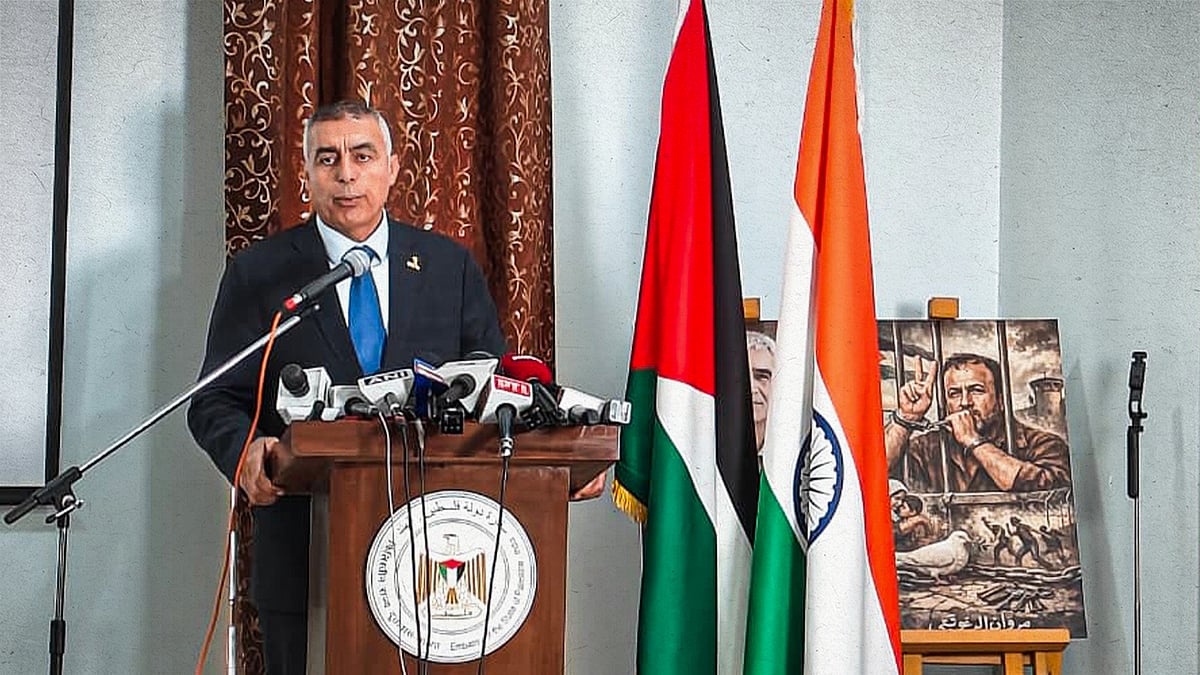
Videos of bombed hospitals in the Gaza Strip and testimonies of doctors desperate for medical aid played on the screen as Abdullah Abu Shawesh, the Palestinian Ambassador to India, sought to draw the attention of journalists gathered at the Embassy to the state of the healthcare system in the genocide-ravaged region.
This footage, played before a press conference, set the stage for a stark assessment by Ambassador Shawesh, who described the healthcare system in Gaza as having “reached breaking point”, while also seeking the urgent support of the Indian government “to ensure the immediate and sustained delivery of humanitarian and medical assistance.”
Today marks the 986th day of the ongoing genocide in Gaza committed by Israeli forces – with the threshold of 1,000 days nearly upon us. The press conference came at a crucial time, with global attention diverted to other major international events, such as the recent 14-point MoU signed by the US and Iran.
The Ambassador’s words on the healthcare crisis were stark. “The healthcare system in the Gaza Strip has reached an unprecedented level of devastation. Only 19 of the 36 hospitals remain partially operational, under extremely limited emergency conditions,” he said. His statements are further underlined by WHO reports that claim “51 percent of essential medicines are currently at zero stock in the Gaza Strip.”
Highlighting the most vulnerable groups, the Ambassador stressed how “Almost all children in Gaza now require mental health and psychological support”. According to the UN, as high as 96 percent of Gaza’s children are very sure that death is imminent. This, coupled with the trauma of a conflict that has spanned years, reflects the mental health crisis there.
The call for assistance from the Indian government was reiterated multiple times throughout the press conference, with particular emphasis on India as the “champion of the (Global) South”. After outlining the historical ties between India and Palestine, he remarked how “Palestine looks up to India as a big brother.”
He also appealed to the Indian mainstream media, saying, “Mainstream media in India must give us a chance to speak.”
The Ambassador also drew a sharp contrast between how the Indian mainstream media treats Israeli officials and how it has treated him. “The mainstream media here in India, who are used to seeing the Israeli occupation Ambassador, some of them did not even reach out to me on the phone. Some of them, unfortunately, did not even give me the courtesy and the chance to pay them a visit,” he said.
‘If not India, then who?’
India has long maintained its support for Palestinian statehood. It has backed a two-state solution to this conflict as recently as this month.
At a UN Security Council debate on the ‘Maintenance of International Peace and Security: Advancing Political Solutions in the Middle East: Mediation and Dialogue for Lasting Peace’, India’s Permanent Representative to the UN, Ambassador Harish Parvathaneni, reaffirmed support for “a sovereign, independent and viable State of Palestine, living side by side in peace and security with Israel within secure and recognised borders.”
He also announced $2.5 million in developmental aid to Palestine on the same occasion. While the Ambassador acknowledged and thanked Prime Minister Modi for the recent announcement of funds and for the 81.5 MT of medicines and medical supplies provided as aid to Gaza, he reiterated the need for more.
“If it is not India and the Indian people, then who? If not now, then when?” he said.
‘It's not a peace plan’
On the ongoing Phase 2 of the ‘Gaza Peace Plan’, the Ambassador did not mince words. “It is not a peace plan; you cannot talk about peace when Israel violates every single aspect of this ‘plan’. Israel does not abide by the ceasefire, and it (has) killed more than 1,000 Palestinians since they signed this plan.”
While Israel claims 4 of its soldiers have been killed since the truce was brokered back in October last year, the number remains staggeringly higher on the Palestinian side, exceeding 990 according to health officials in Gaza.
The Ambassador’s words come at a critical juncture as negotiations remain underway for the implementation of the second phase of the ceasefire agreement. While he did opine on the West’s waning support for Netanyahu’s “genocidal war”, he did not hold back in calling out their hypocrisy either. Talking about the “double standards of the West”, he remarked, “So many international sanctions against Russia, but zero on Israel.”
When asked about his hopes for lasting peace, the Ambassador offered a grim outlook. He said, “We cannot talk about peace when we in Palestine endure attacks every day. We cannot talk about peace while Israel is turning its back on international law, while Israel is thinking itself to be above international law.”
The author is an editorial intern with Newslaundry.
Small teams can do great things. All it takes is a subscription. Subscribe now and power Newslaundry’s work.
Newslaundry is a reader-supported, ad-free, independent news outlet based out of New Delhi. Support their journalism, here.