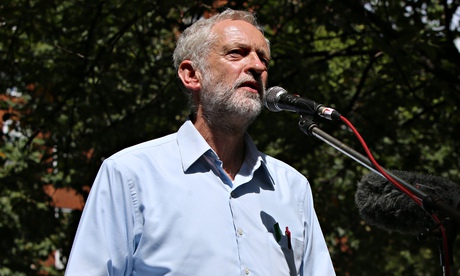
I do not regret nominating Jeremy Corbyn. I have been surprised, however, by the sheer extent of his success. I have no time for those who claim that it would have been better to have kept him off the ballot paper, particularly now, when that it looks as though he could win. Not to face what Jeremy’s success is telling us would condemn Labour to yet further and more devastating electoral defeats.
A big lesson for me from Jeremy’s support is not simply that I was unaware of just how significantly the beliefs and attitudes of the Labour party membership have changed since the last leadership contest only five years ago. Then, Diane Abbott, the hard-left candidate, gained only 7.4% of the vote. Even allowing for the change in Labour’s electoral college to a one-person one-vote basis, this change in support is extraordinary.
Something significant is taking place. We are witnessing the plight of the most vulnerable in our society now finding its natural expression as central to the Labour leadership contest.
Whatever the result of this contest, Labour has been changed. The emphasis on the dispossessed, and ceasing to assert that their needs are somehow automatically met by whatever welfare reform programme is visited upon them, has to be set in a wider debate of the kind of society the vast majority of voters will be inhabiting in 2020.
The anger for which Jeremy acts as a lightning conductor has to be made integral to this wider appeal and not an aspect simply bolted on to whatever we have got used to saying. But just as Labour sometimes forgets the needs of our traditional support base, so Jeremy ignores that to win we have to ride at least two political horses at once; the more affluent as well as that of the dispossessed. Sketching in the outline of this new programme is where one of the other three candidates could emerge as a leader who begins to look like an alternative prime minister in 2020.
What are today’s issues that we can fight on that give hope to groups beyond the most disadvantaged ? Here are four: jobs, immigration, welfare and housing.
Instead of simply moaning that the Tories have stolen our living wage policy, we need to steal it back. Osborne’s living wage holds the promise of laying the foundation of a new welfare consensus. But a living wage policy could be a disaster unless it becomes integral to a strategy of raising productivity.
How do we raise productivity in low-paying industries when we have open borders with the EU supplying well-educated workers so keen to work that improving general skill levels and capital investment is, in the short run, a non-starter? But raising productivity centring on low-paying industries first could kickstart a wider transformative industrial policy in which all voters have a vital interest.
How can we protect the weakest and begin this wider productivity strategy if we continue the Blair/Brown policy of open borders? Jeremy is never going to renounce this aspect of Blairism, dressed up as it is in the false cloak of internationalism. But which one of the leadership candidates will?
Likewise with welfare. Many of our supporters deeply resent our “open borders” type welfare state. We run a National Health Service and a national welfare policy. The operative word here is “national”. Health and welfare are not part of our internationalism, as some of the left believe. Who of the leadership candidates is going to begin arguing for a welfare state based on contributions and thereby begin to establish that welfare and health are issues that help define our borders?
Likewise with housing. Most of the younger population is now disenfranchised, never to own their own homes. A major driving force pushing up housing costs is the green belt. Which one of the leadership candidates is going to slay parts of the sacred green belt?
But what is the point of building many more houses if our borders are open and no one knows how many households will be seeking accommodation in 2020? Likewise, if we believe that the main basis of welfare is contribution, shouldn’t long-standing citizens be at the front of the queue for social housing, as in all other aspects with the welfare state? Jeremy isn’t going to agree with that, but which of the other three candidates will begin to give voice for the poor and the wider electorate?
The polls show that a new coalition of voters is only too willing to sign up to this kind of programme. And it is in this way we can help build a coalition of voters whose sharp elbows will advance not only their own interests, but those of the weakest too. Here are the beginnings of a route march to 2020. But who will lead us? Five weeks to go.
Frank Field is MP for Birkenhead and chair of the work and pensions select committee