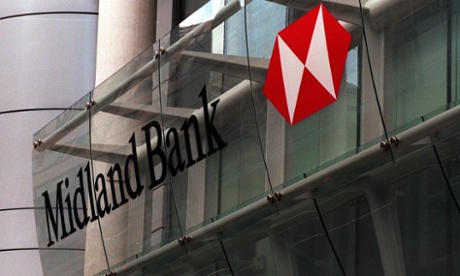
Thanks to the reconfiguration of the imperious but wayward HSBC bank, the name Midland may soon reappear above a thousand of its British branches. If it does – HSBC has yet to fix on the new name for certain – then an optimist might see the change as a portent; if not quite on the scale of Noah’s dove returning across the waters with an olive leaf, then certainly something to lift the heart of anyone who believes that institutions and businesses should have names that reflect their history and purpose – that their titles should be specific and transparent, even engaging, rather than mysterious abbreviations or Esperanto-like nouns put together at great expense by branding consultants who have persuaded their clients that they need to be called by a word that can be spoken as easily in Swahili as in Mandarin. In my book, Mrs Thatcher was never more likable than when she took out her handkerchief and knotted it around the tail of a model British Airways jet to hide a new design that disowned the union flag – BA then trying to be “the world’s favourite airline”, embracing a thousand cultures and belonging nowhere in particular.
Midland isn’t, I admit, the most inspiring of names. My clockwork toy engine had LMS painted on the side, and when I discovered this meant London, Midland and Scottish railway, the middle initial represented an area that was far less attractive to me than the other two; the most middling, you might say. Likewise with British Midland, the defunct airline, or the adjective “Midlands” when attached to professions such as writer, comedian and pop star. But this is no more than a thoughtless calumny; there is DH Lawrence, Philip Larkin and George Eliot to consider as well as Slade and Jasper Carrott.
The Midland Bank arrived long before any of them. It opened a Birmingham office in 1836, grew by absorbing its local rivals, and in the last years of the 19th century got a foothold in the capital when it merged with the Central Bank of London to become the London City and Midland Bank. By 1918, expansion through acquisition had made the Midland the biggest bank in the world, and its innovations and emphasis on customer service over the next 80 years (it was “the listening bank”) kept it among Britain’s so-called “big four” retail banks until, in 1992, it was taken over by a bank with very different origins – in imperial trade rather than domestic manufacturing. To secure the takeover, the Hongkong and Shanghai Banking Corporation, which had been founded by a Scottish shipping grandee in the 1860s, moved its headquarters to London and reinvented itself as HSBC Holdings. HSBC then began to buy banks everywhere until, like the Midland before it, it could claim to be the world’s largest, with 266,000 employees spread across 80 countries and, eventually, a reputation stained by the tax evasion and money laundering that it permitted some of its customers.
On a British high street, unlike, say, in a trader’s office on the Shanghai Bund, the letters HSBC meant little or nothing. But at least they were a straightforward abbreviation, like ICI or BR or BOAC: meaning could be got with just a little delving. The next generation of company titles were much more opaque. When the drink-and-food businesses Guinness and Grand Metropolitan merged in 1997, the Wolff Olins branding consultancy was commissioned to devise a new group title and came up with Diageo, which according to its Wikipedia entry splices the Latin word for “day” with the Greek word for “world” and somehow implies that its products give pleasure every day, everywhere. (It was also Wolff Olins who devised the logo for the London Olympics, which managed to be both ugly and anonymous.) Three years later, Norwich Union merged with another insurance company, CGU (a semi-abbreviation that came from an earlier merger of Commercial Union and General Accident), and after a poll of shareholders adopted the name Aviva on the grounds that it was memorable and universal – at least if you took the universe to mean people who’d done Latin at school or knew a Latinate language. To anyone who grew up with Norwich Union advertisements that ran the line “A fine city, Norwich” beneath a dignified picture of the castle or cathedral, this seemed a loss; it may even be that by abandoning this civic identity, Aviva contributed to – or did nothing to prevent – Norwich’s later reputation as a Hicksville that could tolerate Alan Partridge.
How much these changes cost, and to what profit, is anyone’s guess. Certainly, branding consultants don’t come cheap. One imagines the boardroom meetings, the assistants bringing coffee, Evian and fresh fruit, the PowerPoint presentations, the Venn diagrams, the long pursuit of the word that will serve the business best, until after all that labour a mouse is at last brought forth – Diageo, Aviva, Arriva – and with it the bill for a million or so, not including VAT.
These days it can be done for much less expense. I recommend a trip to the online agency BrandBucket, where you can buy a domain name and its logo for as little as $1,395. Bonbilla, for example, or Fantigo or Prudentum or Dignico or Nonova: there are 6,500 invented or “coined” names for sale, each ready to grow your business “with unique sounds that evoke a variety of different feelings”, each of them “hand-selected” having passed “a series of tests for pronunciation, spelling and unique character”. A business can narrow the choice by the line of trade it pursues. The filter marked “food”, for example, reveals a selection that includes Freshara, Mintero, Greeniva and Luvabite.
This Cubist arrangement of the familiar – the stuff of nightmares – might have Esperanto as its inspiration, or Edward Lear or the late Professor Stanley Unwin. As the last might have said, irritatingly, “Never a diageo by when I don’t aviva myself of a nice-o cuppo tea in the early mordy.” For all this nonsense, the route back to the Midland could with any luck mark the beginning of the end.
Paris, finished? Not while it’s got this bookshop
In Paris this week, I remembered how John Lewis’s managing director, Andy Street, had described France as “sclerotic” and “finished” in a speech a few months ago to a gathering of young British entrepreneurs. “Nothing works,” he said, “and nobody cares about it.” Perhaps the Seine glittering in the June sunshine provided a version of rose-tinted glasses, but it seemed to me that one or two things “work” better in Paris than in London. One is a housing market that hasn’t been skewed by international capital: a flat in central Paris, which is undoubtedly one of the world’s most attractive townscapes, costs about the same as a flat in Hackney, which isn’t. The other is the great number of independent bookshops: Paris has nearly a thousand of them, roughly 10 times as many as London.
Man cannot live by independent bookshops alone, and I realise they aren’t necessarily a mark of a healthier or more equal society. But that a shop as charming and well stocked as Shakespeare and Company can flourish bang in the city centre, just across the river from the Notre Dame, suggests that the city and its regulations have got something right. Three years ago its owner, Sylvia Whitman, employed seven staff; now she employs 30, and this summer will open a cafe in an adjacent building, where the items on the menu of this old American outpost will include Flapjack Kerouac and (my personal favourite) The Bun Also Rises. Other suggestions will no doubt be welcome – but to Whitman rather than me.
- This article was amended on 15 June 2015. It originally used the term acronym when referring to abbreviations such as HSBC and ICI. The term acronym only applies to abbreviations that can be pronounced as words. This has been corrected.