Hospitals treating the victims of an alleged chemical weapons attack in Syria have reportedly been bombed in the northern province of Idlib.
There were no immediate reports of casualties, but a journalist from the AFP news agency said a strike brought rubble down on medical staff treating patients at one hospital.
Footage that could not immediately be verified showed a reporter speaking to a camera as doctors worked, before an explosion threw him to the floor and the screen blacked out.
The Syrian Civil Defence rescue group said two of its centres were targeted by air strikes - one in Khan Sheikhoun and one in nearby Habit.
The group said none of its volunteers were injured but the damage but the facilities out of service.
At least 58 people including 11 children were reported dead after the initial attack on the rebel-held town of Khan Sheikhoun.
Boris Johnson, the Foreign Secretary, called the reported chemical weapons attack “horrific”.
“This bears all the hallmarks of an attack by the regime which has repeatedly used chemical weapons," he said, saying the UK would support an upcoming international investigation.
"If this is shown to be the work of the regime, it is further evidence of the atrocities perpetrated against the Syrian people over six years of appalling conflict."
Federica Mogherini, the EU's high representative for foreign affairs, told delegates at a conference on Syria in Brussels that Bashar al-Assad's regime bore responsibility for the atrocity.
France called for an emergency UN Security Council meeting over the massacre, while Recep Tayyip Erdogan told Vladimir Putin "such inhumane attacks are unacceptable" during a phone call.
Russian forces are backing the Syrian government with air strikes against Isis and rebel groups but the defence ministry denied any involvement in Tuesday's attacks.
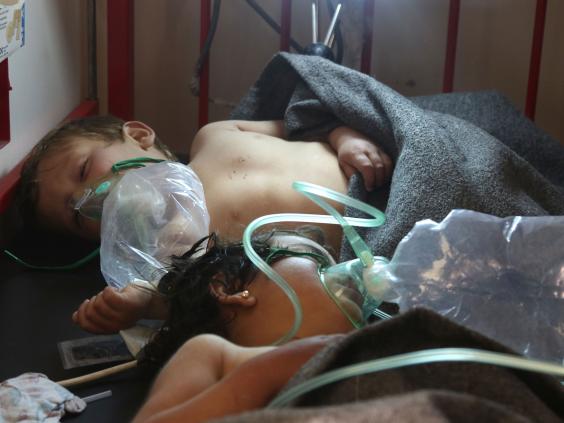
Doctors said victims started to choke, vomit and faint with foam coming out of their mouths, showing symptoms of possible sarin gas exposure.
Pin-point pupils and a lack of the odour associated with more commonly used chlorine gas was among the evidence cited for the nerve gas, which is banned as a weapon of mass destruction under international law.

The UK-based Syrian Observatory for Human Rights said women and children were among dozens killed, with reports of “suffocation” following barrel bombings.
It put the death toll at 58 but warned the number could rise as several victims remained in a serious condition.
Mohammed Hassoun, a media activist in nearby Sarmin, said the town's hospital had been receiving some of the casualties.
“Because of the number of wounded, they have been distributed around in rural Idlib,” he told the Associated Press by phone.
“There are 18 critical cases here. They were unconscious, they had seizures and when oxygen was administered, they bled from the nose and mouth.
"Chlorine gas doesn't cause such convulsions."
Hussein Kayal, a photographer for the pro-opposition Idlib Media Centre, said he was awoken by the sound of a bomb blast around 6.30am local time (4.30am BST).
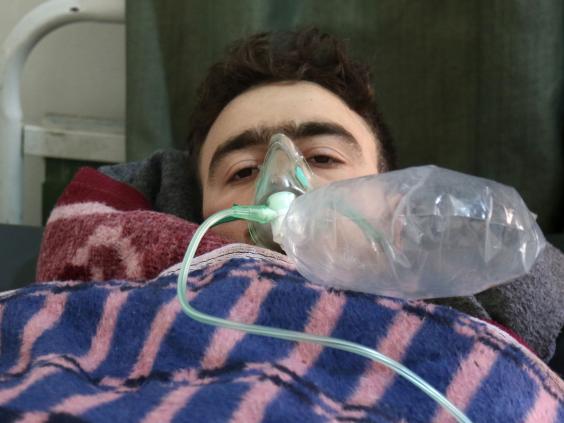
When he arrived at the scene there was no smell, he said, finding entire families inside their homes, lying on the floor with their eyes wide open but unable to move.
Mr Kayal said he wore a mask to take the victims to hospital, removing their clothes and washing them in water, but was treated for a burning sensation in his fingers.
Turkey opened its border crossing at Reyhanli to allow victims through for treatment, with graphic footage showing convulsing and choking patients being doused with water and loaded into ambulances.
Rescue workers from the White Helmets group were seen wearing gas masks to protect themselves while treating people lying amid rubble on the ground.
Activists posted video online claiming to show the moment the bombs struck, alleging they were dropped by Syrian air force helicopters as clouds of smoke rose into the air.
It came little over a week after another alleged chemical attack hit a hospital in the town of Latamneh, just 14 miles away.
Médecins Sans Frontières (MSF), which supports the facility, said a bomb dropped by a helicopter struck the entrance on 25 March.
“Immediately after the impact, patients and staff reported suffering severe respiratory symptoms and burning of mucous membranes – symptoms consistent with an attack using chemicals,” a spokesperson said.
The hospital’s orthopaedic surgeon was among two people killed in the attack, leaving just two orthopaedic surgeons for a population of around 120,000 people, and the clinic was put out of service for three days.
“Bombing hospitals, although banned by international humanitarian law, remains common practice in Syria, and health services are severely affected by these repeated attacks,” said Massimiliano Rebaudengo, MSF’s head of mission in northern Syria.
Over the past year, the charity has received reports of at least 71 attacks on 32 different health facilities it runs or supports in Syria.
Assad's forces have been accused of repeatedly using the nerve agent during the six-year civil war, including in a massacre in Ghouta that almost sparked military intervention by the UK in 2013.
A report by the Organisation for the Prohibition of Chemical Weapons (OPCW) released last year concluded that Syrian government forces were responsible for three examined chemical attacks but China and Russia have vetoed sanctions.
Damascus has denied the allegations, while Isis has also used chemical weapons including mustard gas.
The OPCW said it was “seriously concerned” about reports emerging from would investigate the Khan Sheikhoun attack and was gathering and analysing evidence, following "persistent allegations" of illegal chemical weapons use in Syria.
Pro-government media outlet Al-Masdar News said the Syrian Army denied using sarin gas in Khan Sheikhoun, claiming that a "jihadist gas factory" had been hit.
Idlib province, in north-western Syria, is a key battleground between regime forces and rebels including an alliance of Islamist factions linked to al-Qaeda.
It was the destination for rebel fighters evacuated from eastern Aleppo earlier this year, and is widely expected to be Assad's next major target.
Khan Sheikhoun sits near the frontline between regime and opposition held territory, on a key motorway linking the city of Hama with rebel strongholds to the north.
The alleged chemical attack came as world leaders gathered in Brussels for a conference organised by the EU and UN on “supporting the future of Syria”.
Successive rounds of peace talks in Geneva have so far failed to produce a lasting ceasefire in the Syrian conflict, which shows no sign of ending in its seventh year of bloodshed.