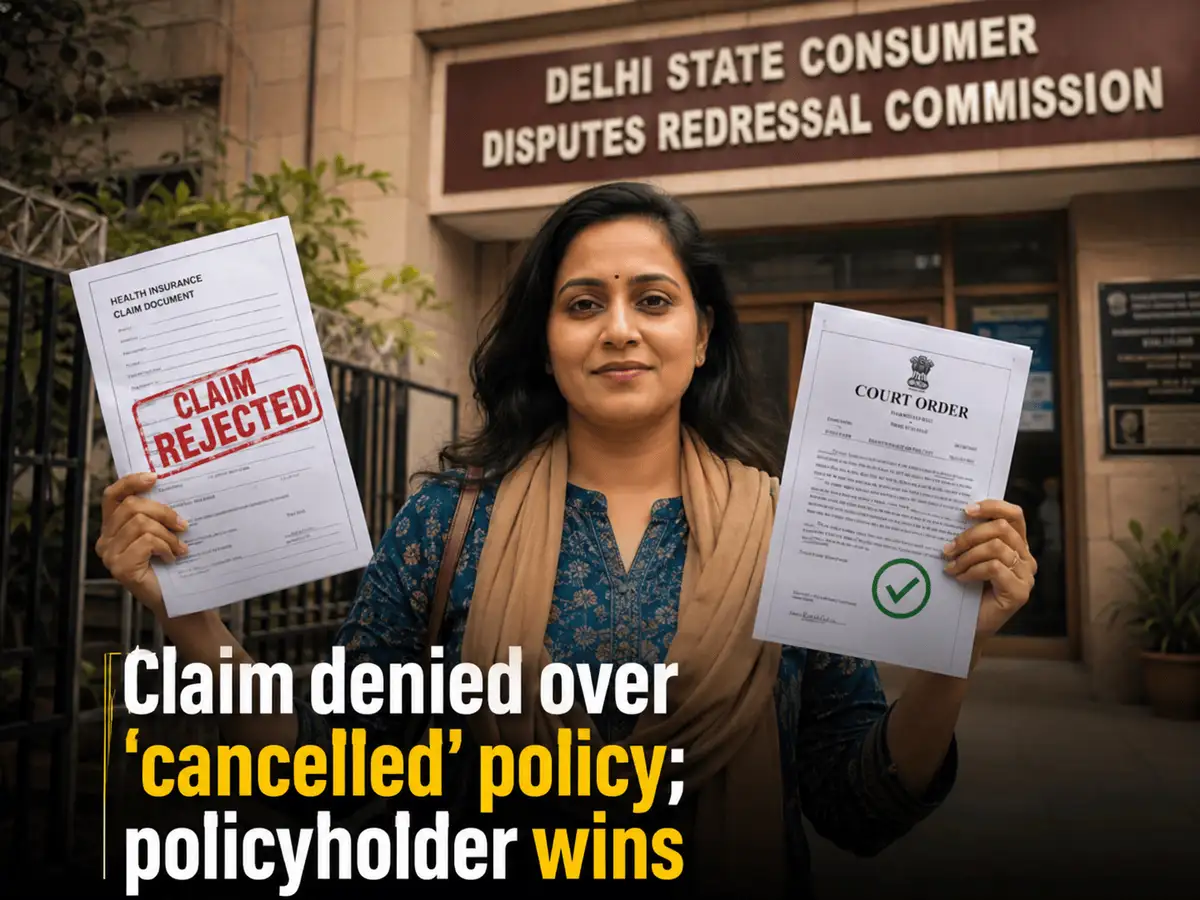
A Rs 37,950 health insurance claim became a lesson in consumer law. The Delhi State Consumer Commission dismissed ICICI Lombard General Insurance Company's appeal, not because it ruled on whether the claim itself was valid, but because the insurer failed to follow mandatory legal procedures during the case.
Here's what happened, and why every insurance policyholder should know about it.
Why was the health insurance claim rejected?
The policyholder had purchased an online health insurance policy with a sum insured of Rs 5 lakh, valid from December 21, 2018, to December 20, 2019.
During the policy period, she was hospitalised between September 13 and September 17, 2019, incurring medical expenses of Rs 37,950, which she initially paid herself.
When she later submitted a reimbursement claim, the insurer rejected it on October 29, 2019, stating that the policy had been cancelled. The policyholder then approached the consumer commission seeking reimbursement along with compensation.
Why did the Consumer Commission rule in favour of the policyholder?
The Commission's decision was based not on the validity of the insurance claim itself, but on the insurer's failure to comply with the mandatory procedure laid down under the Consumer Protection Act, 2019.
According to Amitraj Kaushal, Advocate at the Supreme Court of India, when the complaint was filed, the insurer failed to submit its written statement within the statutory 30-day period, plus the permissible 15-day extension, as required under Section 38(3)(a) of the Consumer Protection Act, 2019.
The insurer later argued it never got a chance to raise this properly because it hadn't received a complete set of the complaint.
ET Wealth Online had reached out to ICICI Lombard for its response regarding this case. The insurer's response is awaited.
Timeline of Events
|
Date
|
Event |
| Dec 21, 2018 | Health policy purchased |
| Sept 13-17, 2019 | Hospitalisation |
| Oct 29, 2019 | Claim rejected as policy cancelled |
| 2023 | Consumer complaint filed before proper Commission |
| Nov 22, 2023 | District Commission rules for consumer |
| Apr 28, 2026 | State Commission dismisses insurer's appeal |
Supreme Court precedent became crucial
While hearing the appeal, the State Commission relied on the Supreme Court's ruling in New India Assurance Co. Ltd. vs Hilli Multipurpose Cold Storage Pvt. Ltd. (2020).
The Supreme Court had held that if a party claims it did not receive complete documents, that objection must be raised on the very first date of appearance. Raising it later cannot be used to justify delays in filing the written statement.
“The insurer itself admitted before the State Commission that it had consciously chosen not to raise this objection on the first date and had instead sent a letter seeking the complete set of documents. The Commission held that this explanation was legally unsustainable because the Consumer Protection Act is intended to ensure expeditious disposal of consumer disputes, and parties cannot circumvent statutory timelines through delayed procedural objections,” explains Kumar.
Why wasn't the 13-day delay accepted?
The insurer also argued that its written statement was filed only 13 days late and requested the Commission to condone the delay.
The Commission refused.
It observed that condoning a delay is not an automatic right. Whether a delay should be excused depends on the facts of each case and is left to the court's discretion. Merely because the delay was only 13 days did not entitle the insurer to automatic relief.
What did the Commission order?
Since the insurer's defense was struck off, the policyholder's evidence, including the insurance policy, hospital records, medical bills and claim rejection letter, remained unchallenged.
Striking off the defence means that the opposite party loses the right to place its version of events before the consumer forum. The Commission then decides the case based on the evidence available on record, unless there are legal reasons to reject the complaint.
The District Commission held the insurer guilty of deficiency in service and directed it to:
- Pay Rs 37,950 towards the medical claim.
- Pay 9% annual interest from the date of filing the claim until payment, failing which 12% interest would apply.
- Pay Rs 25,000 as compensation for mental agony and harassment.
- Pay Rs 10,000 towards litigation costs.
The Delhi State Consumer Commission upheld this order and dismissed the insurer's appeal.
What should policyholders learn from this judgment?
According to Advocate Vivek Kumar, this judgment highlights that an insurer's rejection of a claim should not always be treated as the final word.
If an insurer repudiates a claim without proper legal justification or fails to comply with its statutory obligations during litigation, policyholders have an effective remedy under the Consumer Protection Act, 2019.
“Additionally, proper documentation is critical. Consumers should preserve the insurance policy, premium payment records, hospital bills, discharge summaries, claim forms, correspondence with the insurer, and the repudiation letter. These documents often become the foundation of a successful legal claim,” explains Kumar.
The ruling also underlines the importance of statutory timelines.
“Insurance companies are legally bound to respond within a fixed window, and if they miss it, their defence can be struck off entirely, regardless of how strong that defence might have been on the facts,” says Kaushal.
For a consumer, this means it's worth tracking these procedural deadlines rather than assuming the insurer's silence means nothing; silence at the right procedural moment can become decisive, he adds.
The judgment demonstrates that procedural compliance is not merely a technical requirement. Courts and Consumer Commissions expect both consumers and service providers to adhere to statutory timelines.
An insurer that fails to comply with mandatory procedural requirements risks losing the opportunity to present its defence altogether.
Lastly, this case is a reminder that a delay in filing on the insurer's side is not treated lightly by consumer forums. Condonation of delay is discretionary, not automatic, and Commissions are increasingly unwilling to grant it routinely, since that would defeat the very purpose of a law meant to ensure speedy redressal. For consumers facing a wrongfully repudiated claim, this case is a useful precedent to cite if the insurer's own response was delayed or procedurally deficient, explains Kaushal.