The federal government has announced a national taskforce to deal with ice, a form of methamphetamine. So what are the latest statistics on ice use and the related health impacts?
One of the most comprehensive surveys of drug use in Australia, the National Drug Strategy Household Survey (NDSHS), was last conducted in 2013.
For illicit drug use, the only statistically significant increase between 2010 and 2013 was in misuse of pharmaceuticals. There were declines in the use of heroin and ecstasy, with other drugs, including amphetamines and methamphetamines (the NDSHS groups both together as meth/amphetamines), remaining unchanged at around 2%:
Indeed, the use of meth/amphetamine is lower when compared to the high point of 2004. Despite this decrease, there are a number of other metrics that point to increases in one form of methamphetamine use amongst users, that is crystal meth or “ice”, and the harms associated with it.
The type of meth/amphetamine people are using has changed dramatically. Between 2010 and 2013 the main form used shifted from powder (speed) to crystal (ice):
Use of ice has also increased among people who inject drugs, according to another national survey conducted by the National Drug and Alcohol Research Centre (NDARC), and the shift to ice has also coincided with an increase in amphetamine-related harm, according to an analysis in the Medical Journal of Australia.
The analysis of ambulance data in Victoria showed a 318% increase in ice-related attendances (from 3.4 to 14.2 attendances per 100,000 people) between the 2010–11 and 2011–12 financial years. This underpinned a substantial rise in all amphetamine-related attendances over the same time period (from 11.1 to 21.1 attendances per 100,000 people).
According to another report produced by NDARC, amphetamine-related hospitalisations have also increased over time, peaking in 2011-12, the most recent year that data was available for:
The average purity of ice seized by police has also increased, from 21% in 2009 to 64% in 2013.
How does ice compare in terms of harm with other illicit drugs, and legal drugs such as alcohol and tobacco?
From a purely toxicological point of view, one study puts methamphetamine behind alcohol, heroin, cocaine and nicotine when considering the risk based on lethal doses. However, as the authors of the study point out, much of the harm from drug use is not inherently related to consumption, but depends on the environmental conditions of the drug use.
A 2010 study in the Lancet by the former UK chief drugs adviser David Nutt asked drug-harm researchers in Britain to score various drugs by a range of harmful effects such as drug-related mortality, crime, drug dependency, and economic costs. Methamphetamine ranked fourth, behind alcohol, heroin, and crack cocaine:
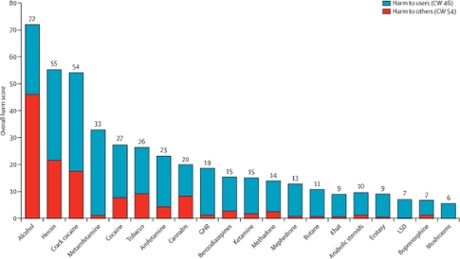
Methamphetamine also had one of the largest scores for “harm to users”.
This is not to say that just because ice ranks behind several other drugs, ice use isn’t a problem that needs addressing – it obviously is.
It’s also worth reading Nicole Lee’s piece in the Conversation, where she points out:
“While investment in policing and prevention is important, the bulk of the changes in use and the resulting harms are due to the small proportion who use more regularly and are at risk of dependence.
“We know that for every dollar spent on drug treatment we save $7 to the community, compared with $2 for stronger policing. We need to ensure that treatment is a significant part of the solution to the problems created by changes in methamphetamine use.”