In its fourth edition, the Ibiza Tech Forum has firmly established itself as the epicentre where the present and the future of technology meet. This year, the main stage has been set in the spectacular Caló de s'Oli Auditorium, where the forum has taken a qualitative and quantitative leap forward, showing that the island is about far more than its well-worn label as the world's party capital.
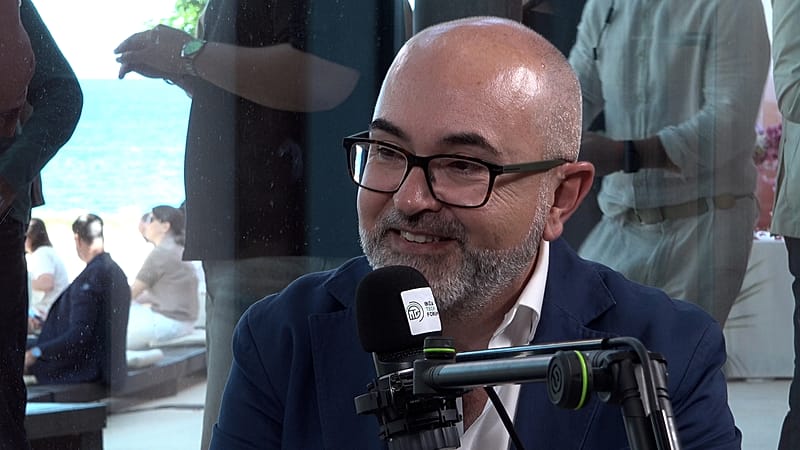
Euronews spoke to Vicent Roig, mayor of Sant Josep de sa Talaia, the municipality hosting the event, about the strategic role played by Ibiza on the global technology map, and how public administrations need to evolve by harnessing the power of data.
Governing with empirical data, not beliefs
After taking part in the forum's institutional panel, Roig drew a clear conclusion: public administrations still have unfinished business when it comes to sensorisation. "One thing is to make decisions with a political slant or based on beliefs, and quite another is to take decisions grounded in real empirical data," the mayor told this outlet in no uncertain terms.
For Roig, a municipality equipped with sensors translates directly into an improvement in citizens' quality of life, thanks to technology that makes it possible to move from a reactive administration to a preventive one: "Knowing in real time when a rubbish bin is full, detecting a water leak immediately so the supply does not have to be cut, or monitoring flows of people with drones and cameras to optimise public safety or cordon off a fire efficiently are just some examples of how artificial intelligence and technology are transforming local management."
A technological shield against 'piracy' in tourism
One of the big debates in island destinations is how to strike a balance between economic appeal and protecting the local way of life in the face of the overcrowding so often denounced by residents of the Pityusic island, and by Spaniards in many parts of the country who see their areas coming under strain from the influx of tourists. For the mayor of Sant Josep, the key once again lies in controlling data, since, as he puts it, in many cases 'the feeling of congestion is greater than the reality'.
Yet Roig identifies what he sees as the real problem: the illegal offer. Unlicensed operators muscling in on transport, tourist accommodation without the proper permits and clandestine parties generate an underground economy that is impossible to quantify using traditional methods.
'It is precisely that strand of tourism we do not control that turns saturation into reality,' he explains. The council plans to tackle this by introducing camera and drone systems to help safeguard the "Ibiza product", whose current erosion is felt above all in terms of its image.
Overcoming barriers to attract global investors
Ibiza has an unbeatable combination: innovation and quality of life. Thanks to its international connections, more and more families and professionals are choosing Sant Josep as a year-round base in search of safety, stability and well-being.
Even so, the path towards full digitalisation is not without obstacles. Roig does not hesitate to point to the barriers faced by local councils, which are not about money or political will but about bureaucracy and basic infrastructure. The mayor laments the fact that a technology event of this calibre has to rely on generators because there is not enough power capacity, or the regulatory complexities involved in rolling out fibre optic networks.
A showcase and testing ground for the world
Hosting technology leaders, investors and international institutions is putting Ibiza on the map as a global magnet. Far from wanting to turn its back on its party reputation, Roig argues that the island's leisure scene is also synonymous with cutting edge and innovation: "What is created in Ibiza is exported to the rest of the world, not only in music but also in the management of major leisure events."
To conclude, the mayor sends a clear message to companies and investors looking towards the archipelago: Ibiza and Sant Josep offer legal certainty, quality of life and, above all, a unique territory. As an island of 542 square kilometres, it becomes the perfect testing ground for trialling technologies that can later be exported nationally and internationally.
You can watch the full interview with Vicent Roig on our YouTube channel (source in Spanish).
This text was translated with the help of artificial intelligence. Report a problem : [feedback-articles-en@euronews.com].