TSUKUBA, Ibaraki -- On a fine day after a series of rainy days, I climbed to the top of Nyotai-san, which is 877 meters above sea level and the highest point on Mt. Tsukuba in Tsukuba, Ibaraki Prefecture. The summit is a narrow rocky area from which pastoral landscapes are seen stretching out below.
Looking out, snow-capped Mt. Fuji to the right was beautiful under the blue sky, and I could see the surface of Lake Kasumigaura on the horizon.
Looking in another direction, the ridgelines of mountains in the northern Kanto region could be seen all in a line.
Except for Nantai-san, which looks like two camel humps when paired with Nyotai-san, there were no mountains to block my view. And I was able to enjoy the panoramic view of the Kanto Plain, which meets the sky at the horizon.
"You cannot fail to enjoy the scenic view from the summit in the morning when the air is clear," said 69-year-old Kazuyuki Yoshihara, head of Tsukuba-shi Kanko Volunteer Guide 298, a city tourism volunteer guide association.
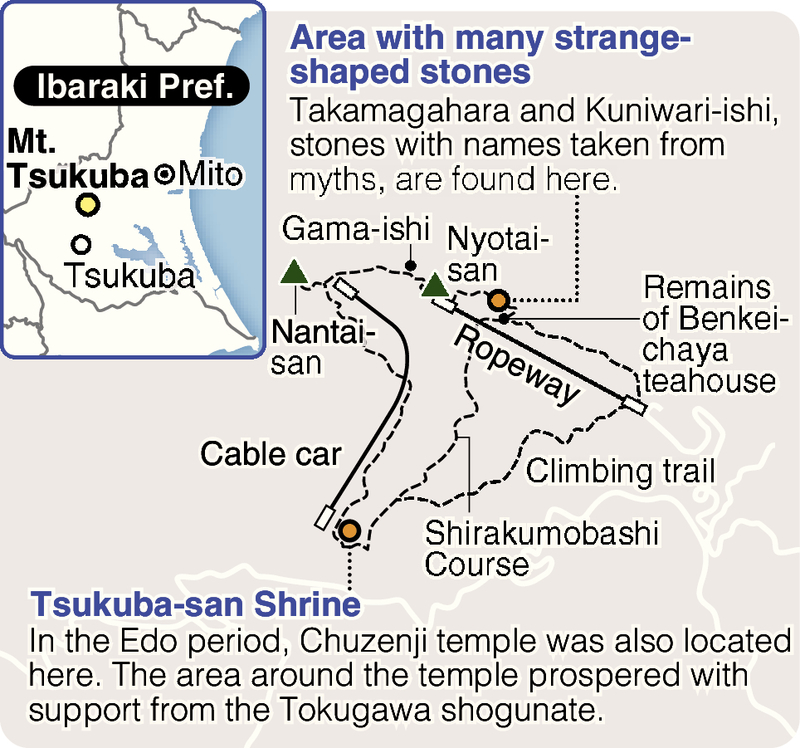
Encouraged by his words, I began climbing in the early morning from Tsukuba-san Shrine at the foot of the mountain to the summit of Nyotai-san.
Out of several climbing trails, I chose the Shirakumobashi Course, measuring at 2.7 kilometers long and 620 meters above the starting point -- nearly the height of Tokyo Skytree.
I started along the trail, passing between forests containing sudajii chinquapin and cedar, aiming for the remains of the Benkei-chaya teahouse, which is about two kilometers from the trailhead.
The trekking was harder than I had imagined. Initially, I felt like I was hiking, but soon it became difficult to take steps on the steep slope, which was covered with rocks. Even raising my feet became difficult.
I kept moving by taking a rest on a rock every five minutes. Just as I felt as if my legs were about to cramp up, I reached the teahouse remains.
From this point, the other purpose of my trip began: looking at strange-shaped stones. Climbers first come across a huge boulder named Benkei Nanamodori that is supported at an angle by two standing rocks. When people look up at it while walking between the two supporting rocks, they feel sure it will fall on them.
A legend from this area says that Benkei, a legendary monk of the late 12th century who was a famous, brave warrior, was afraid when he saw the boulder and balked at walking underneath it seven times. The boulder gets its name from this story.
Near the rock, an elderly climber half-jokingly told a group of three women holding their smartphone cameras, "Raise your arms and you can take photos that look as if you are holding up the rock."
Another huge boulder named "Haha no Tainai Kuguri" (Pass through mother's womb), which has an overhang like the eaves of a house, is also worth seeing. There is also Gama-ishi (Toad stone), which is shaped like a toad with its mouth open. It is located halfway along a ridge connecting Nantai-san and Nyotai-san. If a climber succeeds in throwing a stone into the toad's mouth, which is about three meters above the ground, it is said that good financial luck will come to them.
'Miracle cure' from toads
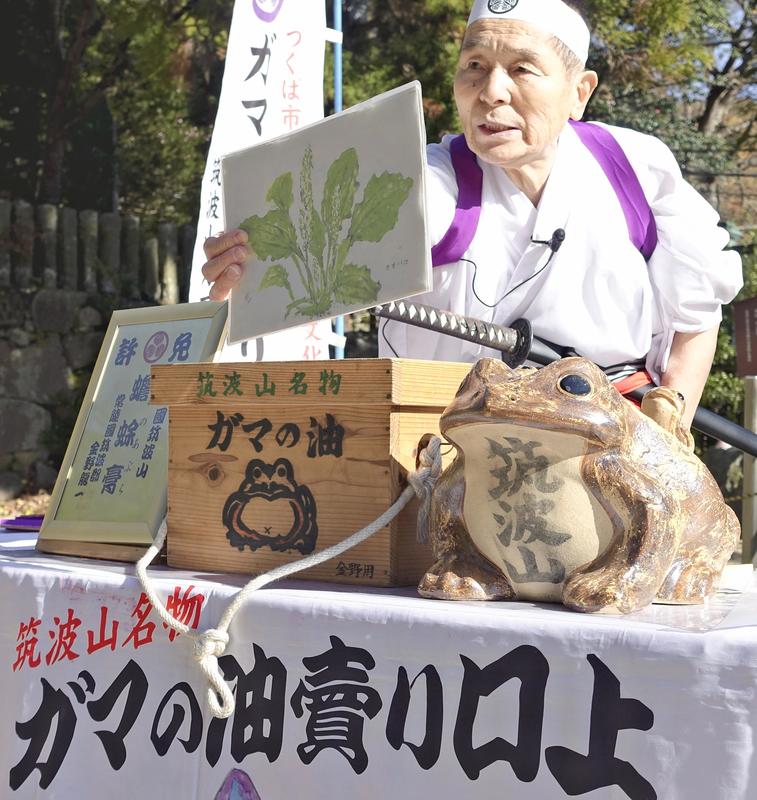
On the grounds of Tsukuba-san Shrine, which I arrived at by cable car on my descent from Nantai-san, a man clad in a white kimono-style shirt and hakama trousers with a Japanese sword at his waist was delivering a sales pitch in a traditional fashion.
He loudly called out: "Hey everybody, come and see! A miracle cure produced at Mt. Tsukuba, 'jinchuko gama no abura.' Toads here are totally different from toads in any other place." The name of the miracle cure means "oily secretion from toad skin used as a cream in samurai warriors' battlefield camps."
The sales pitch is designated by the Tsukuba city government as an intangible local folklore cultural asset. The man was Ryuichi Konno, 78, certified by an association for preserving the tradition as the 20th master of the sales pitch, and is given the name Nagai Hyosuke as a title.
The gama no abura (toad oil) cream became famous nationwide during the battles of Osaka no Jin in 1614 and 1615. Koyo Shonin, chief priest of a temple on Mt. Tsukuba, accompanied the Tokugawa clan's forces and treated injured warriors.
The historical episode says that the cream the priest brought to the battlefield was highly effective. Because the priest's face looked like that of a toad, people nicknamed him Gama Shonin. Initially, the reputation of the cream was that "the oil of Gama Shonin is effective." One theory says that over time, the phrase morphed into "the oil of gama [toads] is effective."
The association for preservation holds demonstrations of the sales pitch free of charge mainly on weekends. Konno began performing the sales pitch because he was deeply impressed by the performance of the 18th master.
"I want visitors to enjoy this traditional performance of which local people are proud," Konno said.
Wrapping up my trip, I took an open-air bath on the top floor of Aokiya, a hotel near the shrine. From the bath, I could see across the Kanto Plain.
The shape of the hot water spout in the bath was, of course, a toad.
Local udon great in winter
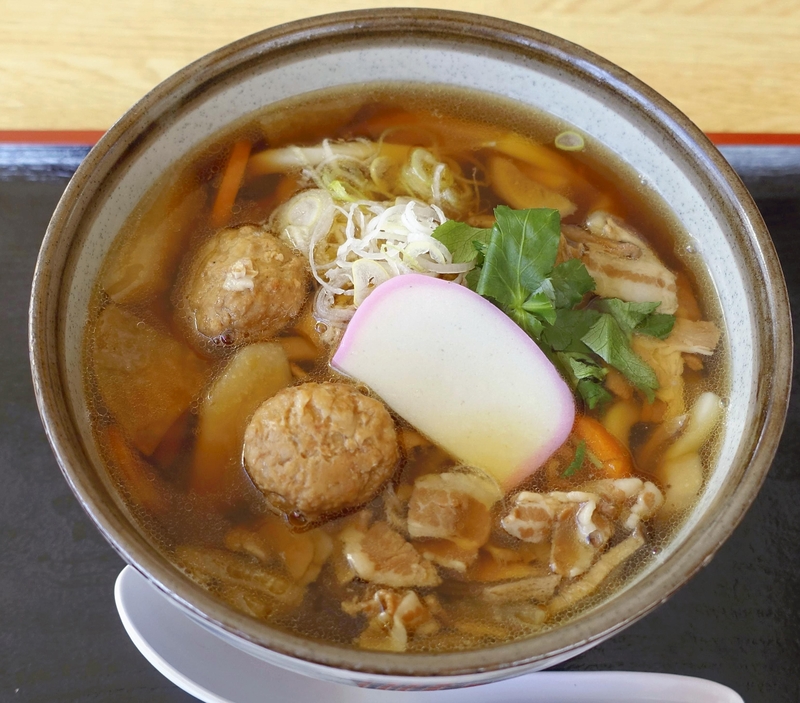
The most highly recommended local specialty of Mt. Tsukuba is Tsukuba udon. A bowl of the noodles contains locally produced tsukune chicken meatballs, gobo burdock root, daikon radish, carrot and thinly sliced pork.
The noodles are also made locally by kneading powdered lotus roots, harvested at Lake Kasumigaura, into the flour.
The soft and sticky noodles match the dashi broth, and the juice from the soft meatballs spreads through the mouth. This dish is good in winter, as a bowl of it warms the body and mind.
At Kandaya, a restaurant near Tsukuba-san Shrine, Tsukuba udon with a strong dashi flavor can be enjoyed. One bowl is priced at 1,000 yen.
Access
The fastest trip is 45 minutes on the Tsukuba Express Line from Akihabara Station to Tsukuba Station. To reach Tsukuba-san Shrine, take a Tsukuba-san Shuttle Bus for 40 minutes, which goes directly to the shrine.
For more information, call the Tsukuba Tourism and Convention Association at (029) 869-8333 or the Mt. Tsukuba Tourist Information Center at (029) 866-1616.
Read more from The Japan News at https://japannews.yomiuri.co.jp/