

That's all for now.
ianstewartjoat says:
Hi everyone - I’m signing off now, the keyboard is in danger of overheating... Lots of good questions, great fun. Hope you enjoyed it.
samjordison asks:
One last question, if there’s time: Where do you stand on the idea that there may be turtles all the way down...
samjordison asks:
Which was the first Terry Pratchett book you read? And did the ideas strike you as having interesting scientific implications early on?
 Guardian contributor
 I think it was Strata. Non-DW early Pratchett SF. After Jack introduced us in 1990 I started reading DW, Colour of Magic and so on. Instant fan! No, didn't see the science implications for ages... only after I started writing pop science semi-professionally and was seeking novel approaches.
WyomingPaul asks:
In your work describing the “science” of Discworld, it is clear that you see the physics of the place as consistent and predictable. Would you go one step further and extent that into the human realm and see the “common sense” logic that is based on such a flat physical world as consistent as well? And, of course, different in key ways from the common sense logic of our round world?
Guardian contributor I think that idea has a lot going for it. Time is short, but there are all sorts of interesting issues that can be followed up. I did a book once called Flatterland (sequel to Flatland) that explored a few. Who would physics work in a different geometry?
Jericho999 asks:
Do you think that writing the Science Of the Discworld books changed the way Terry Pratchett thought about the Discworld? Did you notice any of the ideas you talked about cropping up in any novels, for instance?
Guardian contributor Sometimes! It started before we got together on the SoD books, in fact. When Greebo is shut in a box and everyone discovers there are THREE states for a cat in box: alive, dead, and absolutely bloody furious --- Jack and I had been talking to Terry about Schrodinger's cat and quantum theory. He'd clearly run with the idea and found his own variation. Every so often we'd see something in one of the DW books and think "ah! I know where that came from!" Terry has often said (and recently written) that writers steal (oops, sorry, pay homage) ideas from everyone they know. We stole some of his and he paid homage to a few of ours.
C1aireA asks:
I gather you’re an expert in Catastrophe Theory. Could you explain what relevance, if any, it has to Terry’s work?
Guardian contributor Until you asked I'd never thought about it. Now I'm wondering if there's a book in it... 'Catastrophe theory' is a set of mathematical ideas about how things can undergo sudden changes. Not necessarily disasters, but those too. A rainbow is a catastrophe in the mathematical sense, but not a disaster (though it might be an omen..) The idea (it caught public attention, then got rubbished by mainly ignorant critics, and ended up winning but under a new name, singularity theory, so the critics still think it lost) was that there are natural 'shapes' for sudden changes. You can use these shapes to understand what's going on. I've used this kind of math to get some insights into how new species form in evolution, and how a horse changes gait from walk to trot and so on. The relevance to Terry is that every so often he phoned up his friends with strange but wonderful questions - on science, on folklore, whatever. He'd choose an 'expert' in the area and bug them. It helped a lot if you knew various esoteric things and could bring them to bear on the question. So I got all the math questions, and some physics/astronomy whatever. Jack got the biology ones (such as 'what do you know that's interesting about rats?' for The Amazing Maurice). Catastropeh theory is a part of nonlinear dynamics, and that sometimes helped me give vaguely sensible answers.
Underminer asks
Discworld was fiction: why did you decide to get involved in writing about its Science? As a SF/Fantasy series, it didn’t really have to follow any scientific rules other than those of Sir Terry’s and I wonder whether writing about its Science restricted the way Discworld developed thereafter.
Guardian contributor Very good question, and it was what Terry asked! Part of it was a growing vogue for 'science of X' books (X = Star Trek, X-files...) and we felt we could do at least as well. Part was the fact that although there's no science IN Discworld, there's a lot BEHIND it. Ponder Stibbons is a science nerd in wizard's garb, for example. HEX is a computer - of sorts. But on DW they think differently. It was only when we figured out that the wizards could invent Roundworld, and the science could all happen inside that, that we decided the idea would work.
MythicalMagpie asks:
Hi Ian,
I was originally going to ask you if you thought it might be possible to predict the future of the human race. However, since then I’ve started reading Figments of Reality and realised the answer might take a bit more space than is available here - about three hundred pages of space to be approximate. I’m very impressed you’ve managed to create a book that combines the subjects of mathematics and evolution in a way that I can, more or less, understand.
So, I’ve had to think of an alternative question. I was wondering if the limits of the human brain to comprehend the reductionist nightmare ever gets frustrating? Is living with phase space enough?
I was also wondering how your working relationship with Terry Pratchett got started. I noticed he was also one of the first readers of the Figments of Reality manuscript.
Guardian contributor It certainly gets frustrating for MY brain. The universe is constantly generating things that prove it's much cleverer than I am. Intelligent though we humans may be, compared to much else on this planet, it can take us an awful lot of thought to see the obvious. The good thing about reductionism is that you eventually get down to a problem small enough to solve. The bad thing is, it's not the problem you started with.
Jack Cohen introduced me to Terry in 1990 at the Novacon SF convention at a Birmingham airport hotel. Terry had come along unexpectedly, just as a fan. Jack knew him from before Terry was famous, so he introduced us and we all went off to lunch, and then the bar. Then Jack and I started writing books together - the first was The Collapse of Chaos, and Terry gave us some advice about that. When we followed it up with Figments, he gave us more advice, and contributed a cover quote. It was only some after that that we decided all three of us should do some sort of popular science book based on Discworld. Then it took about 6 months to find a format that would work - there being no science as such in Discworld.
judgeDAmNation asks:
I have a three-and-a-half year old son who is already reading, but in addition to his love of books he is also obsessed with numbers and counting, and can even do some basic sums. As a mathematician yourself, I was wondering if you could recommend any effective ways to help encourage and develop his grasp of numbers and what not, such as any good books or iPhone apps (would yours be suitable?).
Guardian contributor Definitely not my app! It's very accessible, but more at the bright 12-year old level onwards. Sometimes a lot onwards. Though I'm sure he'd have fun swiping the formulas and finger-drawing a waveform to Fourier analyse.
I'd be inclined to go the games-and-puzzles route. Ivan Moscovich has a lot of really neat stuff, some of it aimed at the very young.
samjordison asks:
What were the most interesting things you learned while writing the Science of The Discworld books?
And did the Discworld help you to think about our world in a new way?
Guardian contributor That dinosaurs don't fly - well, not horizontally...
No, actually, what all three of us learned was 'what science is'. When we did SoD2 we decided to have a pair of chapters in the middle where the wizards found out what science was. Believing this to be routine, we left those until the rest of the book had been written. Then Terry asked: "well, what is science then?" and we realised it wasn't going to be at all routine. Eventually Jack and I got round to the idea that science is about proving yourself wrong - or better yet, proving some other scientist wrong. I said I always told my PhD students that I knew they'd got their thesis on the right track when they discovered something I'd told them, or better still published, was wrong. Then I mentioned my current research on animal locomotion - trotting horse, off the ground sometimes? (Yes). And some old experiments with insects walking on a rotating cylinder covered in soot, to leave tracks.
Well, Terry decided this was the way to go. So we had an Ephebian philosopher who had argued on 'pure thought' grounds that a trotting horse never left the ground entirely, and a student who desperately wanted to prove the great man right. So he (deep breath) DID AN EXPERIMENT which was like the insect one but using a horse. Running on a beach. Suspended form a frame on rollers. The beach rolling past underneath on a conveyor belt... And, of dear, it turned out the Great Man was wrong. So the student walked into the sea and drowned himself.
At which point we could say: THAT'S NOT SCIENCE!!! A true scientist would give their right arm to prove their PhD supervisor wrong!
We also realised that if we'd thought of this scenario earlier, the whole book would have been different.
2. Yes, DW made us think in a new way. "What would the wizards think about this?" became a great way to spot places where we were just spouting the conventional wisdom. It made me somewhat sceptical about dark matter, for example. The wizards immediately spotted this was some sort of magical incantation, not science.
LoschmidtsParadox asks:
Did you feel as disappointed as many others with the Casting of David Jason as Rincewind in the TV adaptions?
Guardian contributor I admit he wasn't quite Rincewind as I'd imagined him. I like David Jason, on the whole, but he always looks and behaves like David Jason, so to speak. Every time I saw him as Rincewind I kept getting a funny feeling that Granville from Open All Hours really didn't belong on Discworld.
Ian is with us now
grameneill asks:
Hi Ian, I’ll go for the obvious:
1. What is your best Terry Pratchett anecdote?
2. What is your favourite Discworld novel and why?
Guardian contributor Sam told me to start at 1.00, so here we go...
1. I remember turning up at Terry's house in my new red Toyota Celica. My wife made lots of 'midlife crisis' jokes when I bought it for my 50th birthday... Then she bought a Caribbean blue MR2. Anyway, Terry saw the car, and said "Mathematicians should not own a car like that." Mind you, later on he expressed a wish to own a DeLorean. Maybe for time travel? Not sure. As far as I know he never bought one.
2. Small Gods. It hits all the buttons on organised religion, for me.
I’m happy to say that on 9 June at 1pm, we’re going to be joined for a live webchat by Ian Stewart, one of the three authors of The Science of Discworld.
I spoke to another member of that trio, Jack Cohen, last month about his experiences of working with Stewart and Terry Pratchett on these fascinating books. But, as that conversation shows, there are limitless possibilities for further questions. You’ll be able to ask Ian for his perspective on the writing triumvirate, about all the scientific ideas the books throw up, and maybe even about magic.
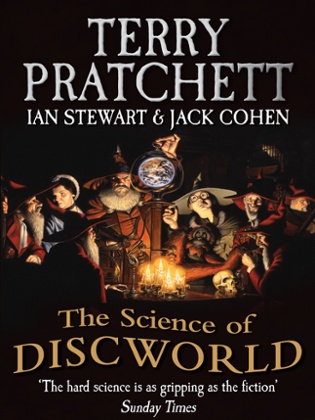
As well as a popular writer, Stewart is also a very distinguished mathematician, an emeritus professor at the University of Warwick, a former columnist for Scientific American and even the author of an iPhone app.
In short, we’re very lucky to have him. He’ll be live on 9 June – but please feel free to get your question in early.
Updated











I always felt that the 'explanation' of the origin of the universe that goes "it's always been here" is basically UNIVERSES ALL THE WAY BACK!