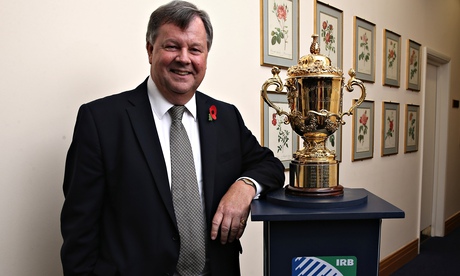
England’s autumn international series may have yielded two wins out of four with the defeats coming against the countries ranked one and two in the world, New Zealand and South Africa, but the chief executive of the Rugby Football Union, Ian Ritchie, maintains they are on course to succeed in the World Cup they are hosting next year.
The losses to the All Blacks and the Springboks prompted criticism of the RFU for awarding the England head coach, Stuart Lancaster, and his management team contract extensions to beyond the 2019 World Cup, but Ritchie justified saying job insecurity would blur their focus.
England finished the autumn series by defeating Australia, one of their World Cup group rivals, and their next fixture is against another, Wales, in Cardiff in February at the start of the Six Nations campaign. Ritchie will be meeting meet Lancaster for a debrief this week but will not be telling the him that he expects the title to be delivered after three years of finishing second.
“When you lose a game, whether it is to New Zealand or South Africa, you feel disappointed and frustrated and we are doing all we can to remedy that,” said Ritchie. “We should be expecting to win every match we play: the margins are pretty small at world-class level and we have to make sure they are on the right side every time.
“I believe we are in a good position looking ahead to next year and the World Cup. We have the talent, ability, resources and the commitment to back up the team in everything they are doing. Nothing during the autumn changed my opinion that we are in anything other than a really good position moving forward. There are things to work on but we are in a position to deliver next year. My confidence has not been dented and I believe we will be right up there as very strong contenders.”
When England lost to South Africa, it was their fifth defeat in succession after they finished the Six Nations with four straight victories. Ritchie pointed out that the first four had come against the All Blacks, three in New Zealand, and said the policy had been to gauge where England were a year out from the World Cup.
“What we have seen is that the gap is not a yawning chasm,” said Ritchie. “It is very marginal and we are in a place to be able to deal with it. That is the view of the coaching team as well. Things do not always work perfectly on the pitch, but that is sport. We were highly competitive against New Zealand, but we still fell short and it was not an accident we lost four out of four.
“We have to make sure that come the day, and the most important one is in September, that we are in the right place to do that. We need to learn and step up. This is not a learning phase and we are not a developing team. We need and have to be competitive and be in a position to beat every team. We will be stronger next year, not weaker; whether we are strong enough comes down to the fine margins of elite sport. I do not accept the view that we have stagnated. Wales in Cardiff is a big match for us, but it is not a must-win game: it will not make any difference to the World Cup match against them later in the year.”
Ritchie said the RFU had complete faith in Lancaster and his coaching team. “We gave them the security and comfort of new contracts to make sure they knew how we felt,” he went on. “We did not want them to be worrying about what their next job was while they were still in their current one.
“Our coaches are attractive to other people and you want them 100% focused on the World Cup, not thinking what they are going to be doing afterwards. We do not want to take the short-term view about these things. There is no lack of commitment because of the contracts, no one is sitting back and saying they are not going to bother. They are focused and committed. People work better when they are confident about their future. The confidence we have in them is very strong and we believe things will come right.”
Ritchie said that the RFU was focusing on its anti-doping programme, especially among 18-24-year-old below elite level, and was collaborating with other sports, most notably American football, to deal with the problem of concussion.