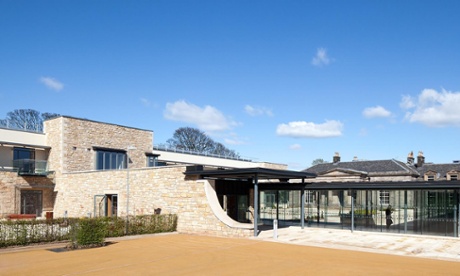
The architect Ian Clarke, who has died suddenly at the age of 52, believed passionately that hospitals for the dying should be welcoming, reassuring places – and, as a leading light in the architectural firm JDDK, he spent his career designing uplifting spaces for palliative care.
The modern hospice movement began in 1967 when Dame Cicely Saunders, dismayed at the treatment dying people received in hospitals, opened St Christopher’s hospice in Sydenham, south-east London. Since then, more than 250 hospices have been established in the UK, which is now regarded internationally as a pioneer in the provision of palliative care. St Christopher’s was the prototype for a new kind of building – a mixture of way station, retreat and therapeutic community, even if only for a few weeks or days.
Clarke, a Riba prizewinning graduate, was spotted in 1990 by the Newcastle upon Tyne architectural practice Jane Darbyshire & David Kendall (JDDK), early innovators in hospice design. Darbyshire – whose aesthetic was influenced by a 1960s scholarship to study Frank Lloyd Wright’s buildings and a subsequent study year in Japan – later recalled that, “although we didn’t have a job for him at the time, we just knew we had to have him”.
Clarke stayed with JDDK for the rest of his life, establishing a reputation for his finely wrought approach to designing healthcare buildings in which people might find care and human reassurance, with their personal identity nurtured and left intact. “The design of the environment,” Clarke wrote in the first of many letters to me when I was researching my book, Modern Hospice Design: The Architecture of Palliative Care (2009), “has many factors which can augment (or deplete) self-worth, particularly centred on issues such as choice and control, privacy and dignity, and continued connectivity to the outside world at large.”
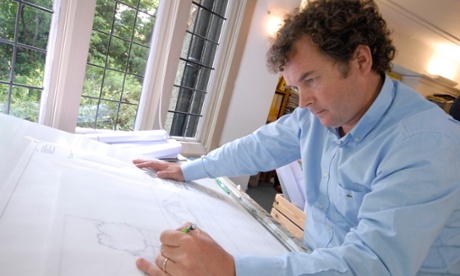
When Clarke subsequently showed me round JDDK’s St Oswald’s hospice in Newcastle, I was surprised to discover what a jolly place it was – an amiable labyrinth of colourful spaces and revealing configurations of light and shadow, interiors and sky, which emulated Aldo van Eyck’s radical reinterpretation of a children’s home in his 1960 Amsterdam orphanage. In his influential essay Building with Feeling (2006), Clarke wrote: “The design of the environment can make the journey through the building feel like one through a characterful village: incorporating distinct and legible ‘places’, with, importantly, the essential thresholds or buffers between them which assist in our knowing where we are and what sort of behaviour is appropriate in our progressive journey … Why can we not get away from the ubiquitous ‘no-place’ hospital corridors that we are so used to, which often feel like monotonous human vectors, or motorways, simply terminating at the patient bed almost as if it were an arbitrary destination?”
Like Saunders, Clarke despaired of conventional hospital design, particularly wards for the elderly where, as he so graphically put it, “distress is contagious”. Noting that more than 50% of all NHS complaints related to the care of the dying, Clarke adhered to Alvar Aalto’s belief that architecture should “defend man at his weakest”. Hospitals were, according to Clarke, exercises in sensory deprivation. The retention of a strong sense of self-identity was central to Clarke’s philosophy of space, at the centre of which was the patient’s bed. This, he said, was too often regarded as “a workbench for care delivery”, not the intimate place it had to be. Such sentiments echoed Norbert Elias, whose excoriating account of institutionalised death, The Loneliness of the Dying, concluded that in modern medicine, “care for the person is secondary to care for their organs”.
Clarke thought long and hard about creating spaces for patients that neither replicated the Florence Nightingale pavilion ward nor the Corbusier cell. Although current healthcare practice favours single-room accommodation, Clarke believed that there remained a need for multi-bedded rooms where a small community of patients could occupy separate niches, rather than being isolated separately behind closed doors. The dignity of the dying, he insisted, was not simply solved by greater privacy. He was also critical of the fussy domestic interiors of care homes, believing that modern hospice design could offer “an equally reassuring and hopefully uplifting atmosphere as the home”, but serenely free of clutter. Not a place of death, but a house of life.
Clarke grew up in Stockport, where he attended Stockport grammar school, and where his own father practised as an architect. He met his wife, Judith Bulmer, in 1994 and they married the following year. They shared a love of gardening, art, craft and of all things Japanese. In 2012, the couple finally visited Japan, where Ian bemused passers-by with his meticulous photographing of doors, windows, joinery details, floor surfaces, and all the minutiae of well-made things.
From 2000 onwards, and as a newly appointed director, Clarke led JDDK’s work at St Gemma’s hospice, Leeds; St Oswald’s hospice, Newcastle; St Patrick’s University hospital, Cork (in collaboration with Scott Tallon Walker); Wear Referrals Veterinary hospital, Sedgefield; St Columba’s hospice, Edinburgh; Highland hospice, Inverness; Marie Curie hospices in Glasgow and Solihull; and Thorpe Hall Hospice in Peterborough for Sue Ryder. He was adviser to the NHS Design Review Panel, to the Commission for Architecture and the Built Environment (CABE), and to the Irish Hospice Foundation. Darbyshire remembered Clarke as having “a little bit of the slightly eccentric, tousle-haired, bow-tied architect about him, which, with his lovely sense of humour, made him extremely likeable.”
He is survived by Judith, who is a consultant histopathologist.
• Ian David Clarke, architect, born 5 December 1962; died 25 August 2015