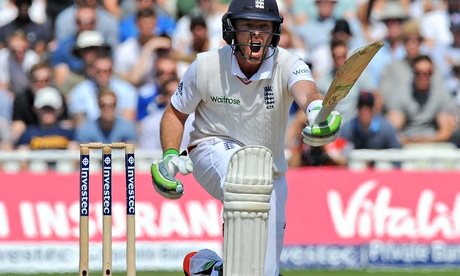
The first perfect morning of the match. Clear sky, bright sunlight, and a river of happy fans running from Birmingham city centre all the way along Sherlock Street and on down the Pershore Road to Edgbaston. Australia 23 ahead and seven wickets down. The crowd knew there was little chance they’d see a full day’s play for their money, but any frustration they felt was tempered by the knowledge that however long it did last, every minute of it would be spent cheering England on to an easy victory, one that had seemed wildly unlikely after their defeat at Lord’s. Knowledgeable lot as they are at Edgbaston, they should have known better. There’s no match situation so straightforward that England can’t find a way to complicate it somehow.
Soon after the start of play, the first clouds appeared and in the minds of many watching too. A flurry of runs, a few missed chances. An uneasy 45 minutes while the lead grew, up past 50, on towards 100. And even after Peter Nevill went, Mitchell Starc, Josh Hazlewood and Nathan Lyon stayed on long enough to take Australia to 265, a lead of 120. Just enough to make experienced England watchers worry. Then, after lunch, a startling delivery from Starc. Pitched on a length on middle-and-leg, it swung back past the outside edge of Alastair Cook’s bat and hit the outside of his off-stump. Bails flying. Hearts fluttering. Quiet falling. England 11 for one, 110 runs away, and Mitchell Johnson still to bowl.
Michael Clarke had held Johnson back from the attack during these opening overs, preferring Starc, Hazlewood and Lyon. It felt like a psychological ploy. You could almost see Johnson’s shadow looming over the innings from his station in the outfield, as everyone awaited the high noon of his arrival, mindful both of the two unplayable bouncers he had delivered in the first innings to dismiss Ben Stokes and Jonny Bairstow, and the many times before when he has torn his way through England’s fragile batting. Cook admitted later that he and his team were nervous. “You just wondered,” he said, “whether the cricketing gods had something in store for us.”
Next man in, Ian Bell. And with him, inevitably, a measure of trepidation. Bell made a skittish sort of fifty on Wednesday, at a run a ball. The innings was cut short by a poor shot when he stepped out of his crease to try and hit Lyon back down the ground for six.
After play that day, Bell and Trevor Bayliss had a long chat about how rash he had been. Before that, there was a 60 in the second innings at Cardiff. Those the two high peaks in an otherwise dismal run of form that’s brought Bell 183 runs in 13 Test innings since he made a century against West Indies in Antigua back in April. Bell is 33, and the promotion to No3 in the order felt like a watershed in his career. Succeed there, as he has done, and he’ll surely stay put until he quits. Fail, and he may have found he was running out of chances.
So, all that is in the back of everyone’s mind. And here comes Starc. The first ball was wicked. Fast, full, and swinging in from off to middle. Bell whipped it away through mid-wicket for four. It was the first shot of a few.
Next, another four, steered past third slip. Then, in Starc’s next over, a straight drive for four, played walking down the ground to meet the ball on the half-volley. Then another, hit over extra cover, played from low down in a crouch. A block. And then four more, from a glance to fine leg. Clarke’s field left a lot of gaps, and Bell’s range of strokes meant he was able to take advantage of them. At that point, he’d faced nine balls, hit five for four, each to a different part of the boundary. Breathtaking batting, it sped him to 20, and England to 36. Then he edged a catch to slip, where, lucky England, Clarke dropped him.
Clarke’s response was to unleash Johnson. It fell to Bell to face him. A different job, this, demanding different skills. He started to sway, duck, and shrug. By doing so he drew the sting from Johnson’s bowling. He faced each of Johnson’s first 20 deliveries. By the time he was done, Joe Root was in, Johnson was spent, and England, 64 for two, were halfway to the target, and further still on their way to winning the game.
When Bell cut Starc for another four, he raised his second fifty, and in doing became the first England No3 to make two in an Ashes Test since Robin Smith at Trent Bridge in 1993.
He looks a happy fit, glad to have the opportunity to dictate the pace of the innings, comfortable with the extra responsibility of the role. From there, he and Root eased England home, serenaded all the way by the fans, relaxed and happy again, at last.