No one expected the Australians to lie down and accept their fate. This was confirmed on poking a nose into the hotel corridor in pursuit of some breakfast. There the stentorian tones of an esteemed antipodean colleague rang out, not with a breezy “Good morning” but with a “Do you think Anderson will be fit to bat?”
There were 25,000 inside Edgbaston 10 minutes before play began. This has been a Test match where it has been advisable to turn up on time. On the first morning David Warner was sent on his way by the 14th ball of the game; on the second Mitchell Johnson terrorised England’s ginger middle order in his first over and on the third it was possible the game might be over within 10 minutes.
Of course that did not happen. It was never going to be that easy. The ovation that greeted the England players was spine-tingling. 23,000 of the 25,000 –that is assuming a combination of visiting Australians and decorous committee members accounted for the silent 2000 – opened their throats.
It is not lip service when the England players express their gratitude for the raucous support. Alastair Cook made a point of thanking hoarse supporters before saying anything else at the post-match ceremony.
Nor are the Australians impervious to the crowd. Even Warner, the pugnacious, barnstorming opener, is affected. “You hear the songs and chants. The crowds are singing and they’re obviously behind the English, especially when they’ve got their tails up.” Perhaps he is a sensitive soul, after all. “It’s a totally different atmosphere to Lord’s,” he said.
Yet there was restlessness in that morning session. The ball was old, the pitch looked innocent, dry and flat and Mitchell Starc is a bit of an impostor at No9. He stood tall and stroked the ball down the ground – perhaps that is how Frank Woolley used to do it – and the crowd, probably not contemplating the Woolley comparison, began to get a little twitchy. The home supporters could tolerate Australia having a reasonably good morning to elongate the entertainment but not a stellar session, please. The ball was swinging a little for Steven Finn but not for anyone else. Where was Jimmy Anderson (not contemplating his innings, it was hoped, but he is not a natural optimist)?
Then there was the review problem. England had been profligate on Thursday evening so they did not have any reviews left. Jos Buttler took off down the leg-side and took a champagne-winning, photogenic catch that might have dismissed Peter Nevill except that the umpire, Chris Gaffaney, was not convinced.
Later a leg-before appeal against Nathan Lyon would have all the credentials but still no review was possible. This nagged away at nervous old Englishmen, who had seen it all go wrong in the past. It was revealed that Lyon could – statistically – be regarded as the best No11 in the history of the game.
The target was 121, a stroll in a T20 match, a cakewalk in just about any contest – except perhaps an Ashes Test match. The spine-chilling games of the past came back. At Headingley in 1981 the target of 130 was too many for Australia; at Edgbaston in the next match 151 was beyond them; at Trent Bridge in 2005 England spluttered to 129 with only three wickets and no fingernails to spare.
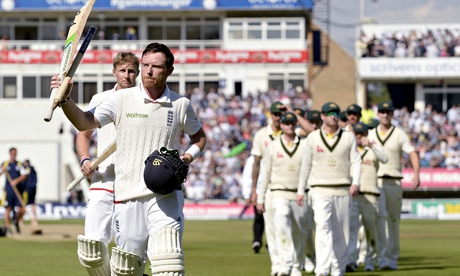
Then Cook was castled by a beauty from Starc. The stabiliser had gone. Nervous glances were exchanged as Ian Bell positively skipped out to the middle. Was this mere bluff and bravura? No, here was a wondrous, clear-headed determination to grab the game by the scruff of the neck. Five boundaries from nine balls from the meat of Bell’s bat and the cheers echoed round Edgbaston again and once Michael Clarke had spilled the catch at second slip even the pessimists began to recognise that this remained England’s day.
No, this is not like Lord’s. Neither in the Warner Stand, nor in the Compton nor Edrich, have the strains of “Stand up if you’re 2-1 up” echoed round the rafters. With 30 runs still required the occupants of the Hollies Stand merrily maintained this chant as the Australians were forced to the conclusion that this was a long way from Melbourne.
Colin Povey, the outgoing chief executive here, purred with delight.He would have liked four or five days’ play but the sun was shining, the stands were heaving and England were winning. “Perhaps England should always play Ashes Tests here,” he said, beaming. “They play well here and they like it.”
No one was prepared to argue with that.
Afterwards the crowd loitered for the post-match ceremonies, enjoying the sunshine and “I was there” moments. Out in the middle the groundsman, Gary Barwell, oversaw the watering of his square, patrolling his Test pitch for one last time. He had produced a superb surface, the best of the series, which should have seen the match last well into the fourth day. To his relief – for groundsmen seldom sleep in the build-up to a Test match – his 2015 Ashes job was done.
For the English players there remains much more work but at least they can go about their business in the lead-up to Trent Bridge with a Bell-like skip to their step.