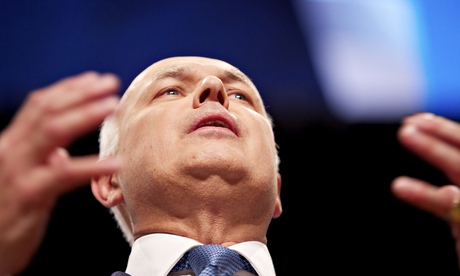
What a magician our work and pensions secretary has proved to be. Iain Duncan Smith has the power to keep parents together, and soon through sheer force of magical thinking – and nifty prestidigitation with statistics – he may make them marry too.
On Friday he put out a press release claiming a rise of three percentage points in the number of birth parents still living together. Few doubt that good counselling is valuable, whether it helps people stay together or part less acrimoniously – but Relate never boasted of instant effects. Burned by previous rebukes over misuse of statistics, the Department for Work and Pensions press release is craftily written, so a correlation between more families apparently staying together and more money spent on family relationship support is not quite described as a cause – but it takes linguistic detective work to spot the difference. Prominent is the claim that every £1 of taxpayers’ money invested saves “as much as” £11.50 in family breakdown costs. But that depends on the accuracy of these figures.
Hidden in the small print in the DWP’s own figures is a warning that this rise in parental bonding is “not statistically significant”. Worse, it appears that more new babies now don’t live with both parents – up from 15% to 21%. Any rise in family stability is for children over eight years old.
Professor Kathleen Kiernan, a family demographer, explains why. She is helping to set up the government’s new birth cohort study on which such figures are based, and she says families drop out of these surveys each year: the more chaotic drop out most, so as children grow older the families remaining in the study tend to be the most stable – hence the “rise” in stability. But never mind, IDS’s version of the story appeared in most of the Tory press – with some critical quotes from Christian groups complaining this was about cohabitation not marriage.
But they can take comfort that the Duncan Smith fairy dust is about to be sprinkled on cohabitees to make them marry: no doubt in due course he will find statistics to show it worked. It’s married couples’ bonus day on 6 April, designed to set off a stampede to the altar by those living in sin. The new married couples’ allowance gives £197 a year to the lawfully wedded: that means you can still make a profit, given the cost of some register office weddings – so long as you don’t have a party.
We may look back on this absurdity as a good epitaph for the last days of the Cameron government – a fine blend of dogma and disarray. From next month, a transferable £1,000 tax allowance – in effect an extra £197 a year – can be used by any married couple where one partner stays at home or earns very little. The idea is to “send an important signal” and “support the institution of marriage” because of its “proven advantages for children” – as if less than £4 a week will be a moral life-changer.
Duncan Smith’s Centre for Social Justice devised this, as family breakdown tops its five causes of poverty – all personal failings in the poor themselves. As those who marry are often from wealthier social classes, IDS claims marriage itself causes social success: the married tend to be richer, healthier, better educated and longer lived, with children more likely to be “cognitively and emotionally successful”. Duncan Smith likes to blur cause and effect, correlation and causation, his reports concluding that “marriage alters the behaviour of those who get married”.
If his party is still in power it will waste £820m by 2017 at a time when £12bn would be cut from benefits. It must rank as one of the most ill-conceived tax policies of all time. Where to begin? This goes to just 31% of the married – omitting couples where both partners work or one is in an upper tax bracket. Only a quarter of couples who get it have children: forget any idea this is for cementing parents to children, as only one in six families with children gain.
A third of recipients are pensioners, but maybe their morality needs encouraging too. Stay-at-home mothers, in whose name this is sometimes praised, will get not a penny: the money is paid to the husband’s pay packet, so 84% of gainers will be men. Those “hardworking” couples where both work get nothing. Worse still, if one partner is lifted by even £1 into the higher 40% tax band, the entire £197 is lost in a cliff-edge. This adds complexity to the tax system, as PAYE couples now need to fill out long tax forms – all for a piffling sum. The Treasury expects only a 70% take-up.
But David Cameron promised the allowance before the election, announcing it in a Daily Mail article. If it is designed to placate conservative Christians affronted by gay marriage, it fails on that score too: this tax break is for civil partners and married gay couples too. As the case for it got ever weaker, Cameron did not dare retreat: he fell back on a “it’s not about the money, but the message” claim. Another minister said it was about “nudging” behaviour – though the No 10 nudge unit has been quietly privatised.
Though the sum is puny, there will be indignation at the injustice to all those families denied it – widows, deserted wives, abused women escaping violent partners – while a philanderer on his third wife draws the tax break as a godly married man. It takes remarkable ingenuity to devise a tax policy that will affront so many people at once. Labour will abolish it – good – though it will use the money to fund a 10p tax rate that has blunders of its own. But nothing could match the egregious married couples’ allowance.
There is, however, a genuine financial disincentive to parents staying together that Duncan Smith could fix if he chose. The real “couple penalty” is in the benefits system where, unlike with taxes, couples are assessed jointly and are paid less together than if they live separately (or pretend to). Since the poorest parents are most likely to part, letting them claim separately while living together might keep parents together.
But Conservative piety about the value of marriage doesn’t extend to increasing the benefits of poor couples – who will instead see their married couples’ allowance clawed back from their universal credit. When the chips are down, meanness trumps morality.