Afternoon summary
- Greg Dyke, chairman of the Football Association, has told MPs that he will consider whether England could try to recover the money spent on bidding for the 2018 World Cup in the light of an interview given by Sepp Blatter saying there was an agreement before the vote to give it to Russia. Giving evidence to the Commons culture committee, Dyke said:
We will look in detail at what Mr Blatter says. I suspect the response [from him] will be ‘I was misquoted’, but if he says that then I think there is something to investigate. There’s nothing Mr Blatter says that surprises me much. If he is saying ‘we wanted Russia’ and it looks like he wanted that fixed before the vote, it’s suggesting that it was all fixed anyway.
Asked if the FA would look to reclaim the bid costs, Dyke replied: “We will obviously go back and look at it. I think it would be a good idea. But get the bid costs back from whom? From Fifa? I agree it would be very nice to get taxpayers’ money back.”
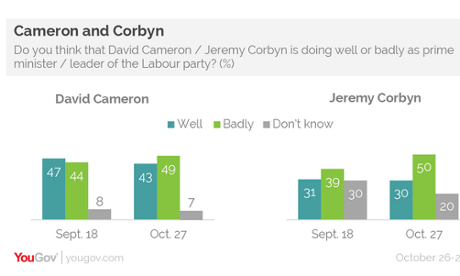
- A YouGov poll has shown that David Cameron and Jeremy Corbyn have both suffered a fall in their approval ratings over the last month. On the question of whether they are doing well or badly, Cameron’s score has fallen from +3 to -6. But Corbyn’s has dropped from -8 to -20, according to the YouGov survey.
The good news for Corbyn is that he no longer faces a Prime Minister with a positive score. His rating is now minus 6 (43% say he is doing well, while 49% say badly).
However, the news for Corbyn himself is much worse. His rating has slumped to minus 20. 30% say he is doing well, while 50% say badly. It’s not that the proportion saying ‘well’ is down; in fact it is virtually unchanged. Rather, his problem is that the previous ‘don’t knows’ are breaking solidly against him.
- Philip Hammond, the foreign secretary, has confirmed that Karl Andree, the 74-year-old Briton threatened with flogging in Saudia Arabia for beaking anti-alcohol laws, will be released within a week. Hammond, who is visiting the country, said it was because of the “strength, depth and breadth” of relations between the UK and Saudi Arabia that they were able to “achieve effective results”.

- Angela Eagle, the shadow business secretary, has has attacked the government for sacrificing the UK’s steel industry on the “altar of laissez-faire economics”. In a Commons debate on the subject she said:
Our contention on this side of the House is that steel making in the UK is an industry of national strategic importance and that it should be supported by the government for that reason. It is important for UK manufacturing, it helps our balance of payments and it is vital for our defence and security.
If we are really about to embark on the huge infrastructure investments which the chancellor is so fond of boasting about then surely we should ensure that UK steel has every chance to compete and win those contracts. But to do that we have to ensure that there is a UK steel industry still in existence when those contracts come up for competition.
- Ukip has accused Iain Duncan Smith of adopting one of its manifesto ideas. Following the work and pensions secretary’s announcement that he is planning to place benefits advisers in food banks, Ukip’s Suzanne Evans said the party’s election manifesto said Ukip would “train and fund the cost of 800 advisers to work in 800 foodbanks, so the poorest in our society have free and easy access to timely help in their hour of need”.
That’s all from me for today.
Thanks for the comments.
Updated
Jesse Norman goes next.
Q: You said you paid tax of £3,500 on the watch from the World Cup. How could you have paid tax when you thought it was not worth anything?
Dyke says he got the watch, and stuck it in a bag. It was only when the media made an issue of it that he was told he had to pay £3,500 in tax. He said he did not want the watch. But he had to pay the tax anyway.
And, that’s it, Dyke’s evidence is over.
Updated
Dyke says questions need to be asked about what KPMG, Fifa’s auditors, have been doing.
Quite significant sums of money do not appear to have been accounted for.
Q: So are you suggesting there are still slush funds that have not been identified?
In the past, yes, says Dyke. He does not know if that is the case now.
Dyke: "How do you account for suddenly giving the Irish 5m euros because Thierry Henry handballed the ball?"
— Rob Harris (@RobHarris) October 28, 2015
Dyke: "1st thing I would have done is sent in forensic accountants to go through the last 10 years. Where has the money come from & gone?"
— Rob Harris (@RobHarris) October 28, 2015
Updated
Dyke says cronyism is not inevitable at Fifa. It’s a question of having proper processes, he says.
Dyke says its "questionable" whether anyone English could ever be elected to #FIFA president @CommonsCMS
— James Dale (@JamesDale8) October 28, 2015
Dyke says the whole of football must be shocked by what has happened in recent months. But he questions whether that will be enough to produce change.
Q: Did you speak to the BBC about the amount of money they were spending on World Cup broadcasting rights?
Dyke says he used to work there. It was not for him to intervene.
Q: But you could have said the money was going to a corrupt organisation?
Dyke says it was not his priority. But when he was at the BBC, he did question how much was being spent on World Cup rights.
Former BBC DG Dyke says he did not speak to BBC about broadcast of WC: "Broadcasters are nervous of losing the rights." #FIFA @CommonsCMS
— James Dale (@JamesDale8) October 28, 2015
Updated
Dyke says the last time he want to a Fifa congress, it was like something out of North Korea.
Everyone took turns to take to the stage to say what a wonderful person Sepp Blatter was. If you did not want to praise Blatter, you did not get the chance to speak.
Q: Why are the prosecuting authorities in America so much more active than other ones?
Dyke says the attorney general in America, Loretta Lynch, is “a piece of work”.
Q: Could we make a joint effort with the Americans to get out money back for what was spent on the 2018 World Cup bid?
Dyke says Blatter may claim that he has been misquoted in the Tass interview.
But, if he accepts that he said what he is quoted as saying, then there might be a case for looking into this, he says.
Dyke says Blatter and his friends did not treat stories about corruption in Fifa as something that ought to be investigated. They just reacted as if they were under attack, he says.
The SNP MP John Nicolson goes next.
Q: Is there any hope of eradicating corruption from world football?
It will be difficult, says Dyke. But it could be eradicated from the executive level at Fifa. You could do some of it.
When you deal with a body with members from all over the world, you find they have very different cultures, he says.
Q: How effective has the media been at exposing corruption? It is surprising there have not been more investigations.
Dyke says British journalism has taken the lead. There have been some investigations in Germany and Switzerland, but generally it has been the British media. That is why Sepp Blatter dislikes the British media so much.
Dyke says Uefa is run much more like a normal organisation than Fifa.
Dyke says Fifa should stop having an all-powerful executive president.
The board should be much more powerful, he says. At the moment it just meets four times a year.
Dyke: "Over the years, the President has been all powerful, and that's not in the interests of football" #FIFA @CommonsCMS
— James Dale (@JamesDale8) October 28, 2015
Updated
Q: What action should sponsor have taken action more quickly?
Dyke says the sponsors could have acted more quickly. It is still not clear how Sepp Blatter was re-elected on a Friday, but then resigned on a Monday. Clearly pressure was put on him, he says. But he doesn’t know who was doing that.
Dyke says the FA wants to be one of the groups that leads the reform of Fifa.
Dyke on Fifa: “If you could form something totally new and start again, that would be a good idea.” But says unrealistic.
— Ben Rumsby (@ben_rumsby) October 28, 2015
Dyke says the £16,500 watch he was given at the World Cup by Fifa was “remarkably ugly”.
In sport you get given gifts all the time, he says.
Dyke says he has doubts about whether Fifa can produce the reforms needed.
Damian Collins, a Conservative MP, is asking the questions.
Q: Would the FA back Gianni Infantino for Fifa president instead?
Dyke says the FA will decide nearer the time.
Q: And what do you think about the allegations about another candidate, Sheikh Salman?
Dyke says the FA will clearly ask him about those claims.
Dyke: FA backed Platini for #Fifa president as not have Blatter's "intense dislike of the England FA and in particular the English media"
— David Brown (@DavidhBrown) October 28, 2015
Asked if there is any prospect of England getting the money it spend in its World Cup bid back, in the light of what Blatter says about a pre-vote agreement for the 2018 bid to go to Russia, Dyke says that would be nice, but suggests it is not going to happen.
Jesse Norman, the committee chairman, asks about Blatter’s interview today with Tass.
Dyke says he is not surprised by anything Blatter says.
Greg Dyke: "There's nothing Mr Blatter says that surprises me very much."
— Harry Cole (@MrHarryCole) October 28, 2015
Dyke: #blatter does lots of strange interviews and this one reads like a dig at #Platini
— Kay Burley (@KayBurley) October 28, 2015
Dyke: #fifa has been corrupt for almost 40 years
— Kay Burley (@KayBurley) October 28, 2015
Dyke says he thinks it is “unlikely” to be a candidate by the time the election actually takes place.
FA chairman Greg Dyke questioned by MPs about Fifa
The Commons culture committee is taking evidence from Greg Dyke, the Football Association chairman, about Fifa.
Dyke says the FA had been impressed by Michel Platini as the replacement for Sepp Blatter.
But it has now withdrawn its support from Platini, he says.
It will make a decision who to support closer to the vote.
Lunchtime summary
- David Cameron has refused six times under questioning from the Labour leader, Jeremy Corbyn, to say whether people will be left worse off by cuts to tax credits after the Treasury revises the proposals. Corbyn used all his questions at PMQs to press Cameron on this issue, and commentators said later it was his best PMQs performance, and one that left Cameron looking evasive and defensive. See 1.47pm.
- Cameron has told MPs that free school meals for pupils in reception, year one and year two are primary school will not be scrapped as part of the spending review. He said:
I am immensely proud that it was a government I led that introduced this policy - 13 years of the Labour government, did they ever do that? Do you remember the infant free school meals Bill from the Labour party? So I’m proud of what we’ve done and we’ll be keeping it.
- Cameron said the government would legislate to put its agreement with internet companies on family friendly filters into law to protect children from online pornography. As the Press Assocation reports, under new net neutrality rules, users across the EU will be free to access the content of their choice and will no longer be unfairly blocked or slowed down. Cameron told MPs that Britain “actually secured an opt-out yesterday, so we can keep our family friendly filters to protect children”. His comments came after the Tory MP Amanda Solloway asked:
Yesterday the EU said that we can no longer have filters on the internet to protect our children from indecent images. I want to know what the prime minister is going to do to make sure that our children remain protected.
Referring to this story, Cameron replied:
Like her, I think it is absolutely vitally important that we enable parents to have that protection for their children from this material on the internet, and probably like her, when I read my Daily Mail this morning I spluttered over my Cornflakes because we worked so hard to put in place these filters, but I can reassure her, because we actually secured an opt-out yesterday, so we can keep our family friendly filters to protect children. And I can tell the House that we will legislate to put our agreement with internet companies on this issue into the law of the land, so that our children will be protected.
- Lord Strathclyde, the Conservative peer appointed to head a review into limiting the power of the Lords over finance matters and secondary legislation, has said he could end up recommending amending the Parliament Act to beef up the power of the Commons. Speaking on the World at One he said:
At its most extreme that is one possible solution to try and amend the Parliament Acts. It’s one of the options that are open to the Government and no doubt it will be one of the issues that I’ll examine. There are many others.
He also said that he hoped his review would be finished by Christmas and that he did not favour packing the Lords with many more Conservative peers. In the Telegraph today William Hague, the former foreign secretary, said the government should amend the Parliament Act to address this issue. In the Commons Chris Grayling, the leader of the Commons, said the votes in the Lords on Monday “marked a significant change, potential change in the relationship between the two Houses” and that a “firm foundation” needed to be established for the future.
PMQs - Verdict from the Twitter commentariat
This is what political journalists are saying about PMQs on Twitter. It was a clear win for Jeremy Corbyn.
From the Sunday Times’s Tim Shipman
Any fair analysis would score that 5-1 for Corbyn. But Cameron wasn't actually uncomfortable. He stuck calmly enough to his line.
— Tim Shipman (@ShippersUnbound) October 28, 2015
From the Independent’s Nigel Morris
Comfortable win for @JeremyCorbyn4PM in #PMQs today IMO (a tweet I could never have imagined sending 3mths ago)
— Nigel Morris (@NigelpMorris) October 28, 2015
From PoliticsHome’s Kevin Schofield
Effective tactics from @jeremycorbyn as @David_Cameron refuses 6 times to say whether those on tax credits will still be worse off. #pmqs
— Kevin Schofield (@PolhomeEditor) October 28, 2015
From the Telegraph’s Asa Bennett
Snap verdict: Corbyn's best #PMQs yet, had Cameron on the back foot asking about tax credits six times. Simple and effective.
— Asa Bennett (@asabenn) October 28, 2015
From the Daily Mirror’s Kevin Maguire
Cameron shifty, slippery, evasive & arrogant but Corbyn needed to do better to nail Dave as a tax credit-cutting liar #pmqs
— Kevin Maguire (@Kevin_Maguire) October 28, 2015
From the Independent on Sunday’s Jane Merrick
This is Corbyn's best #PMQs so far. Asking PM same question six times - are people going to be worse off - has made PM look evasive
— Jane Merrick (@janemerrick23) October 28, 2015
From LBC’s Julia Hartley-Brewer
Overall, I'd call that as an easy win for Corbyn at #PMQs. Cameroon should stand by his own policies, not be ashamed of them.
— Julia Hartley-Brewer (@JuliaHB1) October 28, 2015
From the New Statesman’s George Eaton
Corbyn wisely used all six questions on one subject today - first time he's done so. #PMQs
— George Eaton (@georgeeaton) October 28, 2015
My #PMQs review: Corbyn scores a win over tax credit cuts https://t.co/wZQW5qUGBM
— George Eaton (@georgeeaton) October 28, 2015
From Total Politics’s David Singleton
Corbyn wins #PMQs after kicking all his balls into the open goal that is tax credits.
— David Singleton (@singersz) October 28, 2015
From the BBC’s Sam Macrory
The noise on the Tory benches showed that that was Corbyn's most effective #pmqs yet. Stuck to one topic and made life awkward for the PM.
— Sam Macrory (@sammacrory) October 28, 2015
From the Daily Mirror
Snap PMQs' verdict: Slippery Cameron stumbles on tax credits https://t.co/BJgngsiIDU pic.twitter.com/6HkuZI4rIb
— Mirror Politics (@MirrorPolitics) October 28, 2015
From the Sun’s Harry Cole
Jeremy Corbyn’s “new style of politics” lasted precisely four weeks... Old politics is back! And it worked: https://t.co/7COiijB4Gw
— Harry Cole (@MrHarryCole) October 28, 2015
#PMQS: @mrharrycole scores it 4-2 to Cameron after Corbyn runs out of ideas on #taxcredits https://t.co/kGRGxpYqLo pic.twitter.com/6mvWSDY4KN
— #SunNation (@SunNation) October 28, 2015
From the Sunday Post’s James Millar
Feels like the old politics this week. And all the more effective for it. #PMQs
— James Millar (@PoliticalYeti) October 28, 2015
From ITV’s Chris Ship
By far Corbyn's strongest #pmqs yet. But then it would be hard *not* to give PM a tough time after the govt's chaotic week on #taxcredits
— Chris Ship (@chrisshipitv) October 28, 2015
From Newsnight’s Ed BrownFrom
Corbyn scored some #PMQs hits there - but then given tory rebellions, lords etc on tax credits, feels like wld have been difficult to miss
— Ed Brown (@Edsbrown) October 28, 2015
From ConservativeHome’s Mark Wallace
Corbyn's found a rhythm that works for him at #PMQs. Crucially involves downgrading the questions emailed to him.
— Mark Wallace (@wallaceme) October 28, 2015
From the Sunday Telegraph’s Will Heaven
Westminster consensus emerges: Corbyn was absolutely terrific at PMQs today. Meanwhile, @YouGov says his approval rating hits minus 20.
— Will Heaven (@WillHeaven) October 28, 2015
Strathclyde suggests he may recommend amending Parliament Act to strengthen power of Commons
Martha Kearney asks Lord Strathclyde if he would propose amending the Parliament Act (as William Hague proposes in the Telegraph today - see 9.27am.)
Strathclyde says this would be one option.
Q: What about creating many more Conservative peers?
Strathclyde indicates that he is not in favour of that.
Lord Strathclyde tells @Marthakearney David Cameron should not flood the Lords with more Tory peers. "That would be the wrong thing to do."
— Jack Blanchard (@Jack_Blanchard_) October 28, 2015
He says he will speak to Labour and Lib Dem peers as part of his review.
Q: And when will the review report?
Strathclyde says he would like to get it done by Christmas.
- Strathclyde says he may recommend amending the Parliament Act to strengthen the power of the Commons over financial matters.
- He says he hopes to produce his recommendations before Christmas.
"I'd like to do it fairly speedily, if I can do it before Christmas" it "would be of benefit to everybody" Lord Strathclyde on review #wato
— Kate Collins (@KitCollins) October 28, 2015
It was striking that Radio 4 listeners learnt far more about the government’s review from Strathclyde and Kearney on the World at One than MPs learnt about it from listening to Chris Grayling in the Commons.

Updated
Strathclyde says the Lords had the power to do what they did on Monday to the tax credit regulations. But they did not have the authority to do that, he says.
Lord Strathclyde, the Conservative former leader of the Lords who is carrying out the review for Number 10 into the relations between the Lords and the Commons, is on the World at One now.
"The House of Lords behaved wrongly and deplorably and unnecessarily" - Lord Strathclyde on #taxcredits row #wato
— Kate Collins (@KitCollins) October 28, 2015
Lord Strathclyde says no post-WW2 Govt would "put up with" the House of Lords "stopping in its tracks" major legislation #wato
— Kate Collins (@KitCollins) October 28, 2015
The statement is over. But, as a point of order, Chris Bryant rises to say Grayling said nothing about who will sit on the Strathclyde review, or how it will operate. He has not issued a ministerial statement. Will Grayling tell MPs first?
Grayling chooses not to reply.
John Bercow, the Speaker, says he expects that Grayling will tell MPs first about his plans in a statement. Grayling nods, and Bercow says he is taking that as a yes.
Kirsty Blackman, the SNP MP, asks why the government has appointed a hereditary peer to carry out a review into the abuse of power by the unelected chamber. When will the government stop digging.
Grayling says Strathclyde is a respected peer and, like Blackman, a Scot.
Labour’s Wayne David asks if the Strathclyde panel will be politically balanced, and if it will take evidence.
Grayling says the details will be announced in due course.
Mark Pritchard, a Conservative, says the Lords is acting in an unconstitutional manner.
Grayling says over the years he has heard many peers stress the importance of convention. Now they are ignoring it.
Grayling says the Commons has voted five times for the tax credit changes. That is why the Lords votes were unacceptable.
Peter Bone, a Conservative, says Grayling’s last answer (see 12.59am) shows why the Lords was entitled to vote against this measure. If there must be a review, it should be carried out properly, he says.
Grayling says tax credits count as benefits, not tax measures. If they were put in the finance bill, the finance bill would not necessarily be categorised as a money bill (and hence exempt from amendment in the Lords.)
John Stevenson, a Conservative, says the Lords should be elected.
Grayling says this is being discussed much more. But the government has other important issues to address, he says.
Alex Salmond, the former Scottish first minister and SNP MP, says the government’s position is based on a sense of entitlement.
Grayling says the government just expects conventions to be respected.
Jacob Rees-Mogg, a Conservative, says the primacy of the Commons dates back well before the Parliament Act. If peers do not obey the conventions that have applied for centuries, they should be force to.
Grayling says history was downgraded in schools under Labour. It is no surprise that Labour peers do not respect history, he says.
Grayling says appointing Lord Strathclyde to head this review is sensible because he understands the issues very well.
Grayling says there seems to be an alliance between Labour peers and Lib Dem peers to “demolish” the government’s platform.
Grayling says it is difficult to see how nothing can change after this week.
Liam Fox, the Conservative former defence secretary, says only the UK and Iran have unelected clerics in parliament.
Labour’s David Hanson says the Lords voted to stop the government doing something the Tories said they would not do during the election. Will the members of the panel sitting on the Strathclyde review be paid?
Grayling says the details will be published later.
Bernard Jenkin, the Conservative chair of the public administration committee, says that his committee has already started looking into the matters raised by the Lords vote.
He says in 1911, when the Parliament Act was passed, there was very little secondary legislation. Does not that highlight the need for the situation to be clarified, he asks.
Grayling says that most people would agree that Monday’s votes amounted to a significant new development.
Pete Wishart, the SNP, says in the contest between the Tory government and the unelected Lords, he wishes it could result in a joint knock-out.
Kenneth Clarke, the Conservative former chancellor, says it will be impossible for the government to govern if Labour and Lib Dem peers keep voting against their policy.
Grayling says he agrees. When Labour was in office, the Conservatives respected the conventions, he says.
Chris Grayling, the leader of the Commons, says the government will publish full details for review of relations between the Commons and the Lords in due course.
He cannot pre-empt what the review will say, he says.
He says if the government had put tax credits in a separate bill, the Speaker would not have classified that as a money bill.
And he says that any Commons committee can choose to hold an inquiry into this if it wants.
Chris Grayling's urgent question on tax credits and the Lords
Chris Grayling, the leader of the Commons, is now replying to an urgent question on the Lords vote on tax credits from Chris Bryant, the shadow leader of the Commons.
Bryant says members of the public thought the Lords did the right thing.
Can Grayling see an irony in a hereditary peer being invited to review the relations between the Lords and the Commons with a view to boosting the power of the Commons.
And Lord Strathclyde, the peer who is reviewing this for Downing Street, himself said that the convention that peers do not vote against secondary legislation should no longer apply. On the same day Tory peers voted down two of the then Labour government’s items of secondary legislation.
Is Grayling a hypocrite?
John Bercow rules that out of order. Bryant withdraws that.
Bryant says, if there must be a review, a Commons committee should be doing this.
Bryant says the Lords spends time scrutinising secondary legislation because the Commons does not spend much time on it.
Simon Burns, a Conservative, asks if Cameron will extend bullying in the workplace rules to the Commons.
Cameron says that, given Burns has been called to ask a question at 12.38pm, he seems to be getting fair treatment.
Bercow continues his one man mission to extend #pmqs towards the 40 minute mark. Cameron must be so pleased
— Jack Blanchard (@Jack_Blanchard_) October 28, 2015
Updated
Michael Fabricant, a Conservative, asks if the West Midlands will get the best devolution deal possible.
Cameron says some in the West Midlands worry they could lose out from the Northern Powerhouse. But it could benefit from being between the Northern Powerhouse and a revived London. He urges the West Midlands to put forward the most ambitious plans possible for devolution.
Mary Creagh, the Labour MP, asks about a family in her constituency whose children died of carbon monoxide poisoning while on holiday in Corfu. Tomorrow there is a vote on improving carbon monoxide safety rules in the European parliament. Will Tory MEPs back this?
Cameron says he will look at this issue. He remembers meeting the family, and admires their campaigning work.
Asked if he is a feminist, Cameron says that if being in favour of equality for women, he is a feminist.
Christopher Pincher, a Conservative, asks Cameron to confirm that he would be willing to recommend an Out vote in the EU referendum.
Cameron says he can confirm that. He is ruling nothing in or out. But he wants to make the point that seeking to follow Norway (which is out of the EU, but bound by EU rules) would be a mistake. Norway pays the same per head as the UK to the EU, and takes as many immigrants.
Tim Farron, the Lib Dem leader, says he visited a refugee camp on Lesbos yesterday. He is ashamed the UK is not taking more refugees. He says Britain should take 3,000 child refugees.
Cameron welcomes Farron (it’s Farron’s first question as Lib Dem leader) and he jokes about it being good to see such a good Lib Dem turnout.
The UK is taking 20,000 Syrian refugees, he says. To date, it has not agreed specifically to take 3,000 children.
Mark Durkan, the SDLP MP, asks about a constituent who died from cervical cancer after being a refused a smear test because she was under the age of 25. Will Cameron consider why this happened?
Camerons says this is a tragic case. As he understands it, screening for under-25s is not carried out not for resource reasons, but because there are too many false positives; there are anatomical changes in young women. But he will see if allowances can be made for people with a family history of cervical cancer.
Graham Evans, a Conservative, says he has had lots of emails form constituents. One, from John, says Cameron should not listen to Jeremy Corbyn and adopt his high tax, high spending policies.
Cameron says John demonstrates more sense than Corbyn did in his six questions.
Michelle Donelan, a Conservative, asks what Cameron will do to help children in the care system.
Cameron says he wants to speed up adoption. But he also wants to improve life for those in care homes. Today he can announce he is appointing Martin Narey, the former Barnardo’s chief executive, to carry out a review of residential care homes for children.
Kirsty Blackman, the SNP MP, asks how MPs can say people on £25,000 a year are earning too much. Did Cameron refuse to put this in the manifesto because he knew he would not get elected?
Cameron says in 2010 nine out of 10 families qualified for tax credits, including some MPs. That was crazy. In the last parliament that came down to six out of 10, and the changes will take it to five out of 10.
PMQs - Snap verdict
PMQs - Snap verdict: A powerful performance from Corbyn, which saw him highlighting effectively the central fact about the tax credit cuts through the use of a pointed question repeated six times. For weeks Cameron and his colleagues used to brush aside questions about tax credits by claiming that eight out of 10 families would be better off. Cameron has now abandoned that line, and instead he resorted to a broad but blunt defence about economic competence. His “unelected and unelectable” line was smart, but it fell flat when it came up against Corbyn’s dour but high-minded seriousness.
Corbyn says the prime minister is still refusing to answer the question. This is not a constitutional crisis; it is a crisis for 3m people who will lose tax credits. Michael Gove said during the election the Tories would not cut tax credits. Why?
Cameron refers to what he, not Gove, said during the election. If you don’t cut welfare, you have to cut more from policing and health. When will Corbyn stop deficit denial and tell us what he will do?
Corbyn says he has five times asked Cameron if people will be worse off next April. He still can’t answer. He will put a question he was sent - Tories jeer, and Corbyn says they may find it amusing - he was sent a question by Karen, who wants to know why Cameron is punishing working families. Can Cameron give a cast-iron guarantee that people will not lose out. He is asking for the sixth time.
Cameron says if Karen will benefit from the tax threshold going up. And she will benefit from a growing economy. Labour lost the election because they were not trusted on debt and the deficit. Since then, the deficit deniers have taken over Labour. Working people like Karen would pay the price.
Corbyn says this is the time to ask questions of the prime minister. People are very worried about what will happen next April. So what does the prime minister mean? Is he going to cut tax credits or not? Will people be worse off or not?
Cameron says the election manifesto said the Tories would find £12bn from welfare. That is important, because every penny not saved from welfare has to come from other budgets. Because of the Lords vote, there needs to be a debate about welfare. But Corbyn has opposed every cut to welfare. If we want a strong economy, we must reform welfare.
Corbyn says he is talking about tax credits for those in work. Cameron has lost the support of some sympathetic to him, and some newspapers (the Sun). Can Cameron answer the question today?
Cameron says it is a strange set of events when the Commons votes for something five times, and there is no Tory rebellion, and Labour is relying on the Lords. It’s a new alliance - the unelected and the unelectable.
Updated
Jeremy Corbyn says he spoke to Meacher’s family last night. They gave him a statement to read out. Meacher felt that people who got into power compromised their principles. Meacher was a principled man. He was a brilliant environment minister, and a lifelong campaigner against poverty and injustice.
Corbyn says that, following the belated acceptance by Cameron of the Lords vote, can he guarantee that no one will be worse off next year as a result of the tax credit changes.
Cameron says he can guarantee the government will move from a high tax, high welfare society, to a low tax, low welfare one.
Corbyn asks, again, if Cameron can confirm that no one will be worse off.
Cameron says the new proposals will be set out in the autumn statement. Then Corbyn can study them.
Stephen Metcalfe, a Conservative, says one in 10 of the world’s tractors is built in Basildon. Will he ensure Britain remains a great place to do business.
Cameron says Basildon has a special place in his heart. He did not know about the tractors, but he knows the youth claimant count in Basildon is down 44%. Jeremy Corbyn will be pleased to start the day with tractor statistics, not least because his new adviser, Seumas Milne, is a great fan of the Soviet Union.
David Cameron starts by paying tribute to Michael Meacher. He died suddenly last week, he said. He dedicated his life to public service. He represented Oldham for 45 years. He passionated believed in the causes he supported. MPs will remember him with affection and miss him greatly.
.@johnmcdonnellMP is behind the box for the first time at #PMQs. He's squeezed in next to @tom_watson, who's next to @jeremycorbyn.
— Tim Sculthorpe (@timsculthorpe) October 28, 2015
Chancellor @George_Osborne sitting next to @David_Cameron for #PMQs. Expect #taxcredits - and row with the Lords - to come up in next 30mins
— Tom Barton (@tombarton) October 28, 2015
Corbyn is wearing a poppy.
— Guido Fawkes (@GuidoFawkes) October 28, 2015
After PMQs there will be an urgent question on tax credits and the House of Lords.
I will be covering that in detail.
UQ 12.30 to @RhonddaBryant to ask @CommonsLeader to make statement on Govt’s Review of Financial Privilege of Commons under Lord Strathclyde
— Labour Whips (@labourwhips) October 28, 2015
Cameron and Corbyn at PMQs
Jeremy Corbyn will be up at PMQs shortly.
The Sun is being nice about him today.
A man of taste... pic.twitter.com/6AtWpXSpdM
— Harry Cole (@MrHarryCole) October 28, 2015
Iain Duncan Smith at the work and pensions committee - Summary
Here are the key points from the hearing.
- Duncan Smith said he was planning to put benefit advisers in food banks. This was already happening at one food bank in Manchester, and it was a success, he said, because the advisers could help resolve problems with people’s benefit claims. He told the committee:
I am trialling at the moment a job adviser situating themselves in the food bank for the time that the food bank is open and we are already getting very strong feedback about that. If this works and if the other food banks are willing to encompass this and we think it works we think we would like to roll this out across the whole of the UK.
Frank Field, the committee chairman, said the sooner Duncan Smith could roll this out nationally, the better.
- Duncan Smith dismissed claims that benefit sanctions have pushed some claimants to suicide. In response to a question from Labour’s Emma Lewell-Buck, he replied:
I don’t accept your assertion somehow that these things are directly linked. These are tragedies in their own right and they are often very complex as individual cases. Sanctions have been part of the benefit system for some time. Under the last Labour government they were accepted as part of the benefit system. I always accepted them. I always recognised there were issues occasionally and problems but I didn’t go round accusing the then Labour government of running a system that somehow ended up in the way that you are making this allegation.
- He said the the new “life chances” approach to measuring poverty would change the way policy was made in government “dramatically”. As an example, he said it would force ministers to focus on whether a policy like the pupil premium was actually helping poor pupils. It was not clear from the way he raised this whether or not he was suggesting it was not a successful policy. (See 11.38am.)
- He said he did not agree with the claim from the Resolution Foundation that the tax credit cuts will undermine universal credit because they will reduce work incentives. Under universal credit, people would still be better off in work, he said.
Frank Field goes next.
Q: How will your “life chances” approach to poverty change the way the department operates?
Duncan Smith says he thinks focusing on “life chances” is a better way of looking at poverty. He thinks it will change policy “dramatically”, because it will drive policy. Ministers will look at whether policies improve life chances. For example, does the pupil premium increase life chances? He says he is chair of the cabinet’s social justice committee and can drive this forward.
Field says he may invite Duncan Smith back to ask him about this in more detail.
- Duncan Smith says the new “life chances” approach to measuring poverty will change the way policy is made in government “dramatically”.
And that’s it. The hearing is over.
I will post a quick summary shortly.
Duncan Smith says the DWP adopted a “test and learn” approach when rolling out universal credit. That is why it is being rolled out slowly.
The National Audit Office accepts that is the right approach, he says.
In future every programme will be rolled out like this, he says. The old approach, of rolling out programmes before problems were fixed, did not work, he says. For example, look at tax credits.
The Child Poverty Action Group says it already has its advisers working in food banks.
@patrickjbutler we already have our advisers in foodbanks, dealing with misery caused by DWP https://t.co/OasItq9EpK https://t.co/AwroznHbW9
— Advice&RightsCPAG (@AskCPAG) October 28, 2015
Labour’s Karen Buck goes next.
Q: More than 2,000 people have died after being found capable of work by the work capability assessment (WCA). In the light of the Michael Sullivan case, are you looking again at this?
Duncan Smith says the system he inherited in 2010 was very harsh. Since then the WCA has improved, he says.
Standard mortality figures show that people die anyway, he says.
This is not an easy area, he says.
Q: Have you got a view as to whether more people are dying after being found capable of work?
Duncan Smith says it is very hard to determine cause and effect.
That is why it is best to look at individual cases, he says.
The way the tests are carried out has been improved.
Q: Can you make it less a physical capacity test, and one that looks in more detail at an individual’s ability to work?
Duncan Smith says the WCA now takes mental health more into account.
Q: And do you want to move further on this?
Yes, says Duncan Smith.
Steve McCabe, the Labour MP, goes next.
Q: The high court has ruled that delaying personal independence payments (PIPs) for nine months is unlawful. What have you learnt from that?
Duncan Smith says that showed how important it is to keep improving. He reads some figures showing how assessements have been speeded up. They are now taking five weeks, he says. That shows in the fact that MPs are asking far fewer questions about PIP claims.
He says he wants MPs to raise with him any cases where this is not happening.
Q: Some people who were eligible for disability living allowance (DLA) are not now getting the benefit replacing it, PIP? Why is that?
Duncan Smith says the department has started evaluating this. The DWP hopes to be able to provide answers on this next year.
Robert Devereux says that, as soon as the DWP has reliable statistics on this, it will publish them.
Q: The 20-metre rule has caught a lot of people. It is being interpreted as a means of saving money. Will you look at this again?
Duncan Smith says ultimately everything should be kept under review. The DWP did consult on this. It thinks the rule adds value in terms of how capability is defined.
Here’s a Labour councillor from Dartford on Duncan Smith’s food bank announcement. (See 9.50am.)
The Conservatives now admitting they think food banks are part of the welfare system. Here to stay under the Tories https://t.co/T1UfeWEzNn
— Jonathon Hawkes (@CllrJonHawkes) October 28, 2015
Craig Mackinlay, a Conservative, says he is very worried about the impact of auto-enrolment in company pensions for small employers. Small companies are very worried about this, he says. Some will just get rid of staff rather than bother with this.
Duncan Smith says he understands the “fear” this arouses. The DWP is running an advertising campaign trying to explain how the new rules will work.
The new pensions minister, Ross Altmann, is very interested in this, he says.
The Conservative MP Richard Graham goes next. He asks about pensioners.
Duncan Smith describes the steps taken by the government to help pensioners, including the triple lock. People forget that pensioners do not have the option of working if their income falls, he says.
Duncan Smith says Scottish government could use its new powers to compensate for effect of tax credit cuts
Mhairi Black, the SNP MP, goes next.
Q: Isn’t there an argument for devolving all welfare to Scotland?
Duncan Smith says Scotland is getting power over the work programme and disability benefits. And the Scottish government will have the power to top up welfare payments.
The government is implementing the recommendations in the Smith commission report, he says.
Q: But 85% of welfare will not be devolved. That is not the full federalism promised during the referendum campaign.
Duncan Smith says he and Black are not going to agree on this. The Smith commission is being implemented.
Q: If the Scottish government tops up benefits, will people lose out by having other benefits cut?
Duncan Smith says it will be up to the Scottish government to decide what it does.
The Scottish government will get control of £2.7bn’s worth of welfare, he says. It is a “reasonable” and “generous” settlement.
Q: So, if the Scottish government tops up benefits, people will not have other benefits cut?
Duncan Smith says that is a matter for the Scottish government.
Q: Could the Scottish government use its tax-raising powers to stop the cuts to tax credits?
Duncan Smith says, as he understands it, that is the case.
- Duncan Smith says Scottish government could use its tax-raising powers to compensate for impact of tax credit cuts.
Frank Field says the SNP are saying the tax credit cuts could not take place. Are you saying the SNP could use their powers to stop those cuts taking place in Scotland?
Duncan Smith says, under the Smith commission plans, it will be wholly within the power of the Scottish government to top up benefits, provided they raise the money themselves.
Q: But the Scottish government would have to get your agreement?
Duncan Smith says the power exists. They would not need to consult the DWP.
Frank Field, the committee chair, goes next.
Q: When will people stop claiming tax credits?
Devereux says universal credit is being rolled out. That will replace tax credits.
Q: When?
Devereux says it varies from area to area. When UC arrives in an area, there will be no new claims for tax credits.
Updated
Q: Would it help to have a target to reduce under-payments?
Devereux says the key thing is to have better processes.
Sometime under-payments occur because people do not declare relevant information.
Emma Lewell-Buck says the DWP should be making cutting under-payments more of a priority. She suggests Duncan Smith and his colleagues are not making it enough of a priority.
Q: So will you produce a target for cutting them?
Duncan Smith says he will look at this.
Mike Driver says these are included in the overall target to cut fraud and error.
Labour’s Emma Lewell-Buck goes next.
Q: The DWP is very quick to claw back overpayments. This can sometimes cause hardships. Sometimes child tax credits have been cut when other benefits have been overpaid?
Duncan Smiths says child tax credits are the responsibility of the Treasury.
Under universal credit, these problems should occur less, because all the benefits will be integrated.
And the advisers will continue to be involved with people, so they will be able to sort out these problems on a face-to-face basis. He says he thinks this will make it easier for the DWP to sort out these problems.
Q: What is the department doing about under-payments? They amount to £1.4bn.
Robert Devereux says most of the process improvements he spoke about earlier (see 9.59am) should help address the under-payment issue.
Mike Driver says the fraud and error in the department is put at 1.9%. But that is a gross figure. The net figure is 1.5%, he says.
The Commons public accounts committee has just published a report on this. Here is its conclusion.
High levels of benefits and tax credits fraud and error remain unacceptable. Overpayments cost every household in the UK around £200 a year and waste money that government could spend on other things. HM Revenue & Customs (HMRC) and the Department for Work & Pensions (DWP) have made some progress in tackling fraud and error, but both departments have shown a paucity of ambition. HMRC has reduced fraud and error, but does not fully understand how it has achieved this, or how much further it can go. DWP did not meet its 2014–15 target for reducing fraud and error, and is relying on welfare reforms to make future improvements. These reforms will not solve all the problems, and DWP expects fraud and error to still be £5.8 billion in 2020–21, once Universal Credit has been fully rolled-out. While the departments can recover some of the money overpaid, this can create huge difficulties for people as they struggle to pay back money paid to them in error. During the next few years both departments must improve their understanding of what reductions are possible, and increase their focus on preventing both underpayments and overpayments due to fraud and error. We intend to return to the issue often during this Parliament.
Mike Driver, the DWP’s director general for finance, who is giving evidence alongside Duncan Smith, says fraud and error in welfare payments is at its lowest level since 2004-05.
Duncan Smith says the fact that the DWP accounts are qualified does not mean a huge amount. That has been the case under successive governments for years.
Q: So you don’t expect there will ever be a point where they are not qualified?
Duncan Smith says he cannot see when the DWP will get to that point.
Devereux says he has told the public accounts committee that he would like to be the DWP accounting officer who does get to the position where the accounts are not qualified.
(The accounts are qualified because government auditors have some concerns about how money being wasted.)
UPDATE: I used “wasted” as a shorthand but it is not the ideal description. For a more precise description of why the DWP accounts are qualified, read RClayton’s post BTL.
Updated
Q: Are you worried that the department will not be able to function if you are forced to cut running costs by 40%?
Duncan Smith says you can reduce running costs and still deliver a better service.
The department’s runnning costs are £7.2bn, £2bn less than they were when he took over.
Universal credit will improve the efficiency of the department and cut running costs too, he says.
Robert Devereux says the department is doing a lot to spread best practice. It has a unit to encourage this, he says.
There used to be 7.4m calls a month coming in in 2012. Now it is 4.2m. That is because the department is handling calls more efficiently.
It also monitors “redials” - people calling more than once. For pensions, these accounted for 22% of calls in 2014. Now they account for 10% of calls.
But you can’t just “pedal faster for ever”, he says.
In this parliament the reforms introduced in the last parliament are maturing. For example, it will be easier to find out from the Treasury how much claimants are earning.
Frank Field suggests that will encourage the Treasury to cut the DWP’s budget even more.
Devereux says he does not expect to get more money. But the department can be made more efficient. Satisfaction ratings for jobseeker’s allowance (JSA) claimants has gone up from 80% to 84%, he says.
Updated
Duncan Smith says the use of sanctions for benefit claimants who do not meet the conditions imposed on them is falling.
Benefit advisers could be installed in food banks, Duncan Smith tells MPs
The SNP Mhairi Black is asking questions now.
Q: How did you assess how the welfare cuts would affect people?
Duncan Smith says the department looked at a wide variety of cases. And it tried to look at how people would be able to change their circumstances.
Q: The Trussell Trust says the number of people using food banks has increased by 398% in Scotland between 2012 and 2014.
Duncan Smiths says some of these figures are not clear.
He is fully in support of food banks, he says.
Where people go to food banks because of problems with the department, the department tries to pick up those problems.
He says was visited by a food bank before the summer break. They said some individuals had a problem with benefit payments. He has tried putting an benefits adviser in the food bank when it is open, so he or she can look into these cases.
If this works, it will be rolled out nationally, he says.
Robert Devereux, the permament secretary at the Department for Work and Pensions, is giving evidence with Duncan Smith. He says this is happening at a food bank at Manchester. Two advisers, Nicola and Tracy, are there one day a week. There is also a phone line. They have been able to sort out people’s problems, he says. For example, one person said he was not getting benefit because he did not have evidence of his illness. But he had a note when he arrived at the food banks. The advisers made a call, and his payments were restored.
Frank Field, the committee chair, says he knows of a case in his constituency where 90% of claimants did not come back because their benefit problems were resolved.
- Duncan Smith says benefit advisers could be based in food banks to help people resolve problems with welfare payments.
Duncan Smith says there are 750,000 vacancies in job centres.
The key priority now is to help people progress in work, he says, not to help them get into work in the first place.
Q: What do you say to the claim that the changes to tax credits, and the higher taper, will undermine universal credit, because people will gain less if they get a job?
Duncan Smith says this is the claim made by the Resolution Foundation. But he does not accept it. It will still be worthwhile for people to go into work, he says. He challenges there claim about taper rates. And he says that there are 90% taper rates at the moment (ie, for every every £1 someone earns, they lose 90p), and those will go.
He also says the Resolution Foundation claim does not take into account that the childcare support under universal credit is much more generous.
Duncan Smith says he wants UC (universal credit) to be transformative.
Under the new system, job centre advisers become more of a life coach. Their role will be to help people find work, not just process their benefit claim.
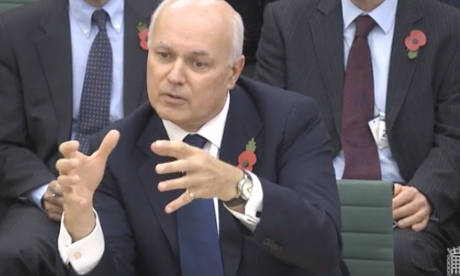
Iain Duncan Smith gives evidence to the Commons work and pensions committee
Iain Duncan Smith is giving evidence to the Commons work and pensions committee.
The Conservative MP Jeremy Quin starts the questioning.
Q: How is the roll-out of universal credit going?
Duncan Smith says the live service is in 60% of job centres.
By next spring, he wants the live service in all job centres, he says.
Hague says government should amend the Parliament Act to stop peers deciding finance matters
In his Telegraph column today William Hague, the Conservative foreign secretary, is particularly critical of the Lib Dems for the way they voted in the Lords on Monday on the tax credit cuts.
It was David Lloyd George, one of the greatest of all Liberal leaders, who enunciated this principle with clarity and passion. “The right of the Commons to grant supplies,” he declared in 1909, “is a franchise won through generations of sacrifice and of suffering. The Commons of England stormed the heights after many repulses, many a failure, with heavy losses, but they captured them.” On another occasion he thundered that “measures… put forward by men elected by a majority of the people” should not be “rejected or mutilated by a House with no responsibility to anyone, not elected by anyone”.
If Lloyd George could see his party this week he would not only turn in his grave but jump out of it. He would remind them of the epic struggle he waged to confirm the sole right of the Commons to determine taxation. And he would probably inform them that he was not then enunciating a new principle but legislating for one established over centuries.
And Hague has a simple proposal as to what the government should do to ensure it does not suffer a defeat like this one again.
The formal restrictions on Lords’ powers were set out in the Parliament Act of 1911, forced through by the Liberals and amended by Attlee’s Labour government in 1949. The Act makes it clear that the upper house has no power to block or amend a Bill designated as a “Money Bill”.
Now the solution is for the Government, calmly and in the next session of this parliament, to bring forward a Bill to amend the Act once more. Such a Bill could be very short indeed, but would specify either that the same system of designation would be extended to secondary legislation of the type defeated this week, or that the supremacy of the Commons on matters of finance is an overriding principle of law.

Here’s my colleague Patrick Wintour on one of the key questions Iain Duncan Smith faces.
IDS at work and pensions sel comm today and he needs to explain what tax credits cuts do to work incentives in Universal Credit. Big problem
— Patrick Wintour (@patrickwintour) October 28, 2015
Iain Duncan Smith, the work and pensions secretary, is giving evidence to the Commons work and pensions committee this morning. These encounters always used to be quite sparky affairs in the last parliament, but the committee has now got a new chairman - the Labour former minister Frank Field, arguably parliament’s pre-eminent welfare expert - and so Duncan Smith should find himself subject to particularly sharp scrutiny.
It is the first time Duncan Smith has given evidence to the new committee. Here are the issues the committee says it wants to cover.
The session can span the range of DWP’s responsibilities and expenditure, including:
the impact of spending cuts on claimants; administrative spending; impact on capability and capacity; and high levels of fraud and error in benefit payments
the Department’s preparedness for implementing pension reforms, including auto-enrolment and small businesses, Pensions Freedoms; and the New State Pension
delays in processing benefit claims, including Personal Independence Payments and Employment and Support Allowance
Welfare-to-Work and tackling the disability employment gap; and
the rollout of Universal Credit: the Department’s plans and milestones
I will be covering the hearing in detail.
Then we’ve got PMQs. Here is the agenda for the day.
9.30am: Iain Duncan Smith, the work and pensions secretary, gives evidence to the Commons work and pensions committee.
12pm: David Cameron faces Jeremy Corbyn at PMQs.
Around 12.40pm: MPs begin debating a Labour motion on the steel industry.
2.30pm: Greg Dyke, the Football Association chairman, and Fifa sponsors give evidence to the Commons culture committee about Fifa.
As usual, I will also be covering breaking political news as it happens, as well as bringing you the best reaction, comment and analysis from the web. I will post a summary at lunchtime and another in the afternoon.
If you want to follow me or contact me on Twitter, I’m on@AndrewSparrow.