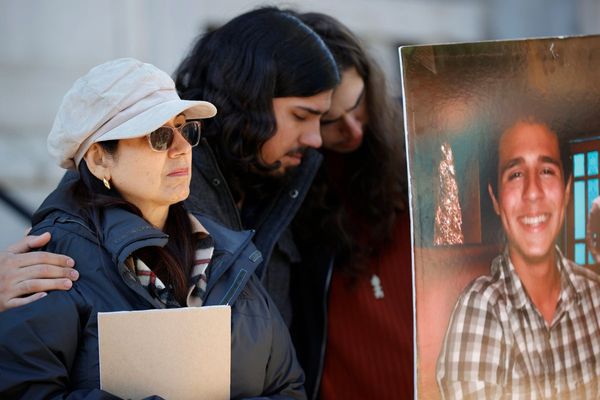
A baby girl who died hours after a mishandled breech birth 41 years ago in Shrewsbury hospital has been identified as one of the first known victims of the biggest maternity scandal in the history of the NHS.
The death certificate of Kelly Lydia Dunne said she had suffered a brain haemorrhage on 30 August 1979. But that description concealed suspected fatal medical negligence that continued for decades and which is only now being fully exposed.
Her mother, Barbara Slatford, said she wants to tell Kelly’s story to help hundreds of other mothers who have lost babies at hospitals now run by the Shrewsbury and Telford NHS trust in Shropshire.
Slatford, who was 17 when she had Kelly, was wrongly led to believe her baby’s body had been discarded at the hospital. After decades of feeling traumatised, guilty and angry, she has recently discovered the truth.
The breakthrough came when she contacted Donna Ockenden, a midwifery expert leading an independent review into almost 2,000 serious maternity cases, including still births, maternal deaths, baby deaths and brain damage. After seeing news coverage of the review and its focus on cases from 2000 to 2018, Slatford wrote to Ockenden. Her letter began: “I am writing to you about the failings at the Royal Shrewsbury hospitals and to let you know that negligence goes back further than 20 years in the maternity unit.”
Ockenden, who is due to publish her interim findings in December, discovered that Kelly had been given a proper burial in a cemetery away from the hospital.
Slatford, speaking from her home in Birmingham, said: “I was so pleased to find out she wasn’t buried in the hospital. I just didn’t want her to be associated with the hospital after how she was treated.”
With Ockenden’s help she found the grave in February 2019, at Shrewsbury’s Longden Road cemetery, near a plaque that read “In memory of those babies who died at Royal Shrewsbury Maternity hospital”. It is understood that Ockenden is also examining a handful of other cases going back to the 1960s and 70s.

Slatford and her family cleaned up the grave and installed a vase engraved with Kelly’s name. Now they regularly visit the cemetery, which has become a place Slatford can talk to her first daughter. She said: “I’d felt really guilty not knowing exactly where she was. When we first found the grave I told her ‘I’m sorry it’s taken this long to find you’.”
In a front room decorated with pictures of her two surviving children and five grandchildren, Slatford added: “When we go to her grave now it’s a really lovely occasion because we tidy it all up, and we’ve put some flowers on and I talk to her. Last time I told her: in a couple of months time your little sister is going to be 40 this year. I’ve always talked to her and now I have a place for it.”
While the discovery of the grave has brought some closure, Slatford is still furious about the treatment she and Kelly received at the hospital. She said: “I’m less traumatised by it now, knowing that she’s away from that hospital. But I’m still angry because it’s buried deep and no one has been held accountable.”
She was told that Kelly’s arms had been broken and her head fatally crushed when she was delivered by forceps by a doctor who had never dealt with a breech birth, and who had worked for 27 hours without break.
After Kelly’s death, Slatford was made to have breakfast on the ward with all the new mothers. “It was really cruel to put me there with all the other mothers. I just wanted the floor to open up. But there was no counselling and no sympathy.”
She added: “I was just told: ‘you’re still young, you’ve got plenty of time to have other children. Just shrug it off.’ I did have two more children, but I have thought about Kelly every day since.”
Slatford, a former school cleaning supervisor, said contacting Ockenden had helped make up for her lack of counselling. “I felt better for writing the letter, because I’d never written it all down before. And when I met Donna, I said it’s been like therapy. It really helped.”
Like many other mothers who lost babies at the trust’s hospitals, Slatford wants a formal apology. “They should acknowledge how cruel they were. I just hope there’s some justice for all of us and an apology for what happened. Donna’s report should help a lot of parents. It will put our minds at rest.”
Hayley Flavell, Director of Nursing at The Shrewsbury and Telford Hospital NHS Trust (SaTH) said: “On behalf of the Trust, I apologise unreservedly to Barbara Slatford for the loss of her baby, Kelly Lydia. We know that our maternity care has not always been what it should’ve been.
“We have been working, and continue to work, openly with the Independent Maternity Review, led by Donna Ockenden into our Maternity Services. It is important that we let this review conclude to ensure families get the answers they deserve, and so that we can take on the learnings and improvements that are identified.
“I would like to reassure all families using our Maternity Services that we have not been waiting for Donna Ockenden’s report before working to improve our services.We are working hard to deliver high quality Maternity Services to the communities that we serve.”