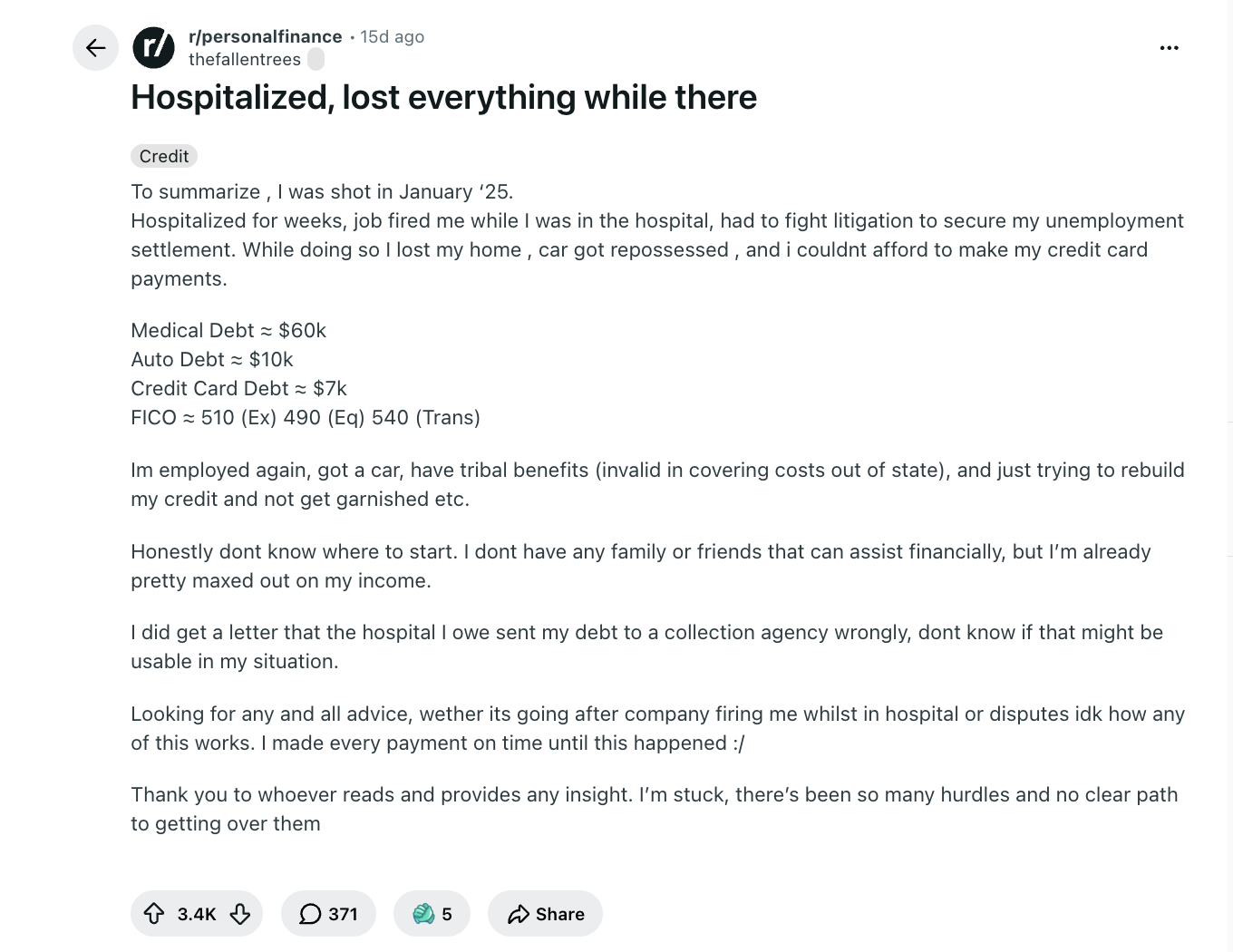
A gunshot wound in January 2025 set off a chain of losses that left one American man without a job, a home or a car, and buried under roughly $77,000 (£57,300) in debt.
He laid out the wreckage in a widely shared post on the r/personalfinance forum on Reddit, where his account drew more than 3,400 upvotes and over 370 replies.
The poster, writing under the username thefallentrees, said he was shot at the start of last year and hospitalised for weeks. While he was still being treated, his employer dismissed him. He then had to fight through litigation to secure an unemployment settlement. In the meantime, the bills did not stop.
'I made every payment on time until this happened,' he wrote.
By his own tally, the damage breaks down into three parts: around $60,000 (£44,700) in medical debt, roughly $10,000 (£7,450) tied to a repossessed car, and about $7,000 (£5,200) in credit card balances he couldn't cover after his income disappeared. His credit scores dropped to between 490 and 540 across the three major US bureaus, deep in subprime territory.
He lost the home, too. He said he has tribal benefits that do not cover costs run up out of state, and no family or friends able to step in. 'I dont have any family or friends that can assist financially, but I'm already pretty maxed out on my income,' he wrote.
One detail drew particular attention. He received a letter indicating the hospital had referred his debt to a collection agency in error. 'I did get a letter that the hospital I owe sent my debt to a collection agency wrongly,' he wrote, unsure whether it might work in his favour.
Inside the $77,000 Medical Debt Spiral
That error could matter. Under the Fair Credit Reporting Act, consumers can dispute inaccurate entries on their credit files, and a wrongful referral to collections is precisely the kind of mistake the law is designed to catch. A successful challenge can remove a damaging mark and, in some cases, lift a score noticeably.
He is far from alone. More than 100 million people in the United States, including 41% of adults, carry some form of health care debt, according to a landmark investigation by KFF and its newsroom, KFF Health News.
A separate KFF analysis of government figures put the national total at no less than $220 billion (£164 billion), with roughly three million adults owing more than $10,000 (£7,450) apiece. His $60,000 hospital bill places him among the most heavily burdened.
Medical debt also behaves unlike most borrowing. It is usually involuntary and unexpected, and can mount while a patient is too unwell to manage it. Medical costs, and the income lost to serious illness, rank among the most common triggers of US bankruptcy.
The Vanishing Safety Net for Medical Debt
For a brief window, federal policy moved to protect people in his position. In January 2025, the Consumer Financial Protection Bureau finalised a rule that would have stripped about $49 billion (£36.5 billion) in medical bills from the credit files of roughly 15 million Americans and barred lenders from weighing such debt in credit decisions.
The protection did not last. A federal court in Texas vacated the rule in July 2025, agreeing with the bureau's new leadership and industry plaintiffs that it overstepped the agency's authority and clashed with the Fair Credit Reporting Act. As of 2026, it is no longer enforceable.
Some relief survives. The three main credit bureaus, Equifax, Experian, and TransUnion, voluntarily agreed in 2022 and 2023 to drop paid medical collections, remove unpaid medical debts below $500 (£370), and keep new medical bills off reports for a year. A $60,000 (£44,700) debt, however, sits well outside their reach.
The road back for thefallentrees is narrow: rebuild the credit, fend off wage garnishment, pursue the disputed collection entry, and weigh whether to challenge the company that fired him while he was in hospital.
'There's been so many hurdles and no clear path to getting over them,' he wrote.