

I’m afraid that’s all we have time for, here’s a parting note from Sergei:
Thank you so much for all your wonderful questions! I have just arrived in London (greeted by particularly London weather) and really look forward to spending the next few days here. Do svidaniya
Look out for more Soviet space coverage on Guardian New East tomorrow or join the Guardian’s science team for a live discussion on the latest Pluto next Monday.
Full details below:
The Guardian’s science editor Ian Sample will be joining experts to look at some of Guardian Live event the latest images of Pluto from the NASA New Horizons probe at aon Monday 21 September. The panel will also discuss the latest findings from the Rosetta mission, what’s next for New Horizons and other groundbreaking missions planned for the coming decade.
Updated
The Soviets vs the US
The Soviets used to train for the long duration flights and our style was tailored to that. Today, I don’t see much difference, we work together on international programs and the styles are less distinctive
Other cosmonauts

Dear Sergei,
I was 12 when Valentina Tereshkova became the first woman in space !
I wrote to her, and a month later I got a card from her, duly signed, which I cherish to this day.
Do you communicate with Cosmonauts of bygone eras, and how can I say hello to her again ?
Yes, many of the cosmonauts are good friends and we get together fairly often. Today I was actually on the same flight as Valentina who has come to the opening of the cosmonauts exhibition at the Science Museum in London. Her Vostok-6 capsule and ventilation garment is on display
Space perspective?

How has seeing the earth from the perspective of being in space affected (if at all) the way you perceive Russian geo-political issues today?
I think that everyone who has been to space gains a global perspective, you stop seeing things simply as national issues.
Will you fly again?

Good evening Sergei,
What are you looking forward to the most in the future development and deployment of space travel and exploration? Will you have any part in it?
I am really looking forward to seeing new spacecrafts which are being created both in Russia and America. This is what I am working on now. I’ve seen them being built, I would love to see them finished and I am not ruling out the chance of another flight one one of them!
By email John Fuller asked:
Given the success of the International Space Station and the announcement in March that an agreement for cooperation in the development of a successor to the ISS will likely be reached, are you hopeful for the prospects for the China National Space Administration joining future joint Human Spaceflight missions?
Sergei said:
China is actively developing human space flight, but its ambitious future will only happen with international collaboration. I’m sure they will join these programs one way or another
Comparing modules

Dear Sergei,
Are there any material differences between ISS modules in terms of quality of equipment, ergonomics, comfort, etc. for you as a user?
Thank you.
Each module is different, created for a specific purpose. For example the first module, Zarya, was used for carrying loads. Node had hatches to connect other modules. The Service module was made for habitation and carried all the life support systems
Updated
The space soundtrack

Hello Sergei,
Do you listen to music while in space?
If yes, then do you have any favourite songs to listen to while looking at Earth?
We do listen to music, mostly while we are training. We have a lot of different recordings but I am not picky so listen to whatever is around
Updated
Private or public?

Sergei,
Is it better for space exploration to be funded by the private sector, or the public sector?
Is space exploration becoming a gentlemans' hobby for billionaires like Elon Musk, Jeff Beezos and Richard Branson? If that means more investment, and innovation, then could that be a good thing in the long run?
Thanks so much!
I believe in both - private and public investment - are very important. States should be responsible for the complex and ambitious programs, which are hard to achieve. They should also formulate long term plans and look after research. The private sector has a role in space exploration
Gorbachev’s cosmonauts

What was it like to be a cosmonaut during the Gorbachev era? Did policies like Glasnost mean more opportunities to work with organisations like NASA? Was it easier to travel to the West and meet your fellow space travelers and discuss your experiences?
You should not forget hat the first major international collaboration started much earlier, in 1975. I can say that I didn’t feel much difference, leaders change but the space remains. International collaboration was a very natural development of space exploration which continues to this day
Space exploration

Sergei, what in your opinion are the highs and lows of space exploration and what do you see the future of such endeavours being?
It’s still a very risky business and a very complex one. But the exploration of new spaces brings us extra opportunities and chance to achieve something significant
The modern day space race
@GuardianNewEast @MoscowTimes do you think think a space race is necessary in this day and age?
— Barbara Lee Gale (@barbhappy) September 16, 2015
I don’t think we need a space race but collaboration. Having said that, it is a good idea to race ahead together slightly faster
Recovery

How long did it take you to recover physically from 804 days, and what did the programme entail?
The 804 days were not on a single mission. The longest flight was a little over 300. After a long duration in space the first stage of recovery normally takes two-three weeks as you get used to things back on the ground. After two-three months you are fully recovered

Have you regained the bone and muscle mass you lost in space?
That's something that I'm worrying about regarding longer space missions, like going to Mars.
Yes, good news, bone and muscle mass are regained! Besides, we used various techniques and exercise on our flights to prevent loss. This is very important for any long-duration flights including a mission to Mars
Dreams

Did you dream differently in space than on earth? If so, in what ways?
I don’t dream a lot, in space or on the ground – i’m always too busy or working. But no, it’s not too different,
Interstellar

Did you watch Interstellar? And do you believe humanities future lies beyond our own atmosphere?
Sorry, I haven’t watched Interstellar. Space will be playing a huge role in our lives - this is for sure - we won’t all move to live in space, but will be travelling more, researching, exploring, and pushing the boundaries
The best bit about space

Sergei, what was you're favourite part of being up in Space??
Two things. Firstly, the view of Earth from the viewing port. Secondly, the sense of freedom which you experience in weightlessness, you feel like a bird that is able to fly!
The last Soviet: a poem

Sergei, I wrote this poem must be more than 20 years ago. It was inspired by watching a documentary about you and your endeavours. Hope you like it. My question: do you recall your very first emotion when you came back to earth and set your foot on the ground?
THE LAST SOVIET
At Senate House library I chance on Soviet astronauts, get sucked in.
But it’s too quiet, even for a library. Then it hits me: it’s after hours.
Locked in. I sit by a window to speculate on Krikalev, shut away
inside his hot, meandering cubicle for five roasting months,
hovering amid two sun-blinded windows, ionic particles, space storms,
above cyan lands he would never set his foot on.
Months on, a hero’s touchdown, helped up by old faces
in strange uniforms. Krikalev, a pale-faced cosmic parachutist
smiling like a newborn babe. 'The sun is blinding up there!'
He is handed a reddish passport and sent to history.
I earn my own freedom. Somehow I break the window glass,
slip out and run as far as legs would take me.
Thanks very much for the poem - it’s very touching! As for my emotions - I think I felt satisfaction that I had done my job, and done it well. The second one was a sort of relief as I had held a huge responsibility for many months
The end of a golden era?
 Guardian staff
 There have been a lot of reports about failed launches and rocket malfunctions - is it a sign that the golden years of Russia's space exploration are over?
I don’t think so, I think you get that feeling because negative things are much more evident than the the positive. But I think when we do see the negative, it’s down to the lack of experts working in the sector
Updated
Soviet space pride

Sergei. Thanks for doing this!
Do you think that people in the Soviet Union were more aware of the achievements of cosmonauts than Americans were of their astronauts?
I ask because when I was chatting to an elderly Russian woman in VDNKh in Moscow. She knew everything about the space rocket displayed there, which surprised me.
Hi thanks for the question. I think on the contrary - Americans may have been even prouder of their country’s achievements, especially during in the 1990s when the state really promoted the space programme. Everyone was more or less aware of what was happening
How did your work change?

Sergej, was the Russia you came back to markedly different to the one you left? Did the changes make an immediate difference to your work?
After the landing I left Russia a few months later to train for the joint shuttle program [with the US]. My work didn’t change significantly, it was straight back to training.
The fall of the USSR
@GuardianNewEast When were u actually aware the soviet union had fallen, how did you find out n what were ur 1st thoughts immediately after
— Ned-Kellys-Revenge (@sitatra1988) September 16, 2015
It was a long process and we were getting the news, not all at once, but we heard about the referendum, for example. I was doing my job and was more worried about those on the ground - our families and friends - we had everything we needed!
Updated
Hi all, apologies for the delay but we are now ready for the Q&A to start. Please continue to leave your questions in the comments and Sergei will do his best to answer as many as possible. We will also be feeding in questions from Twitter @GuardianNewEast, or you can email maeve.shearlaw@theguardian.com
Updated
Hi all, Sergei’s flight has been delayed so we’ve had to push the Q&A back by 30 minutes. Please continue to leave questions in the comments and we’ll let you know as soon as we are ready to go.
Updated
Until recently Sergei Krikalev held the record for the total number of days in space – 804 days, nine hours and 39 minutes to be exact, a number only surpassed a few months ago by Gennady Padalka, who clocked up 879.
The Russian cosmonaut was integral to the Soviet Union’s contribution to space travel and its love of all things cosmic which, according to the Calvert Journal, was the closest thing you could find to religion in the atheist state. In 1957 Russia became the first country to send an artificial satellite in to space, Sputnik. Four years later it sent up the first human in the form of Yuri Gagarin.
Sergei Krikalev returned to space in March 1991 as history was being rewritten back down on Earth. By December the USSR had collapsed and a new Russia was born. Sergei Krikalev became “the last Soviet citizen” until his return home in May 1992.
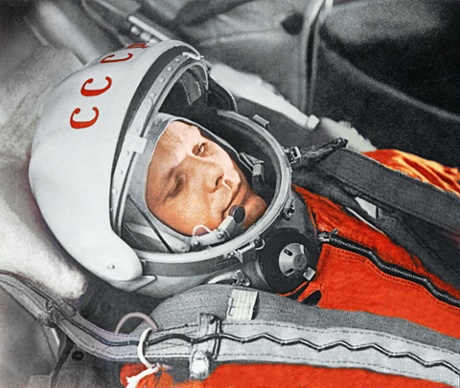
Any questions?
Sergei Krikalev, who was also part of the first joint US-Russian mission in 1994, is currently in London for an exhibition being held at the Science Museum to celebrate Russia’s role in kickstarting the global space race.
He’ll join us for a live Q&A today 16 September, between 4.30-5.30pm BST to answer your questions about the twists and turns of the Soviet space race, that lasted for more than two decades.
Use the comments section below to post your questions, tweet them at @GuardianNewEast or email maeve.shearlaw@theguardian.com.
Updated








Good Day Sergei,
Can you tell me on the joint mission , what were the main differances between the soviet and US style of doing things, both appear to have very different ways of working and thinking and how did this change the way of working as a team on the whole, or your way of working compared to a soviet 'team'
many thanks