

Few guitarists from the Britpop era had a trajectory quite like Richard Oakes’. For one, he came into Suede, who had two hit-and-miss albums in 1993’s Suede and 1994’s Dog Man Star, as a replacement for Bernard Butler, a six-stringer widely regarded as the finest of his era.
So, there was that… and the fact that when he entered the fold, he was just 18. Oh, and despite the quality of Suede’s records, critics kinda, sorta hated them.
Oakes was talented, but he was also very inexperienced – and he had a mountain to climb in the form of showing the world that he had the chops to make fans and pundits forget what Suede had done before.
But not just that – Oakes and company needed to better it. Looking back on 1996’s Coming Up, which dropped in the heart of musical hysteria bred via Oasis, Pulp, Blur, and The Verve, that mission was accomplished.
Suede looked monster cuts like Oasis’s Wonderwall, Blur’s Country House, and Pulp’s Common People in the eye and matched them with the sneering Trash and the shimmering Beautiful People.
Oakes admits he had a hard, heavy learning curve, making mistakes – and achieving triumphs – for all the world to see. Now 49, he looks at his playing from a purely pragmatic perspective, telling Guitar World, “Sometimes I still feel like a beginner, like I still have so much to learn, so many different things to try.”
“I’m proud of what I have achieved,” he says. “But I can’t imagine getting to the point where I say, ‘Okay, I’ve done everything I wanted to do with the guitar, time to hang it up now.’ I see the limitations of my own technique and am forever wanting to improve.”
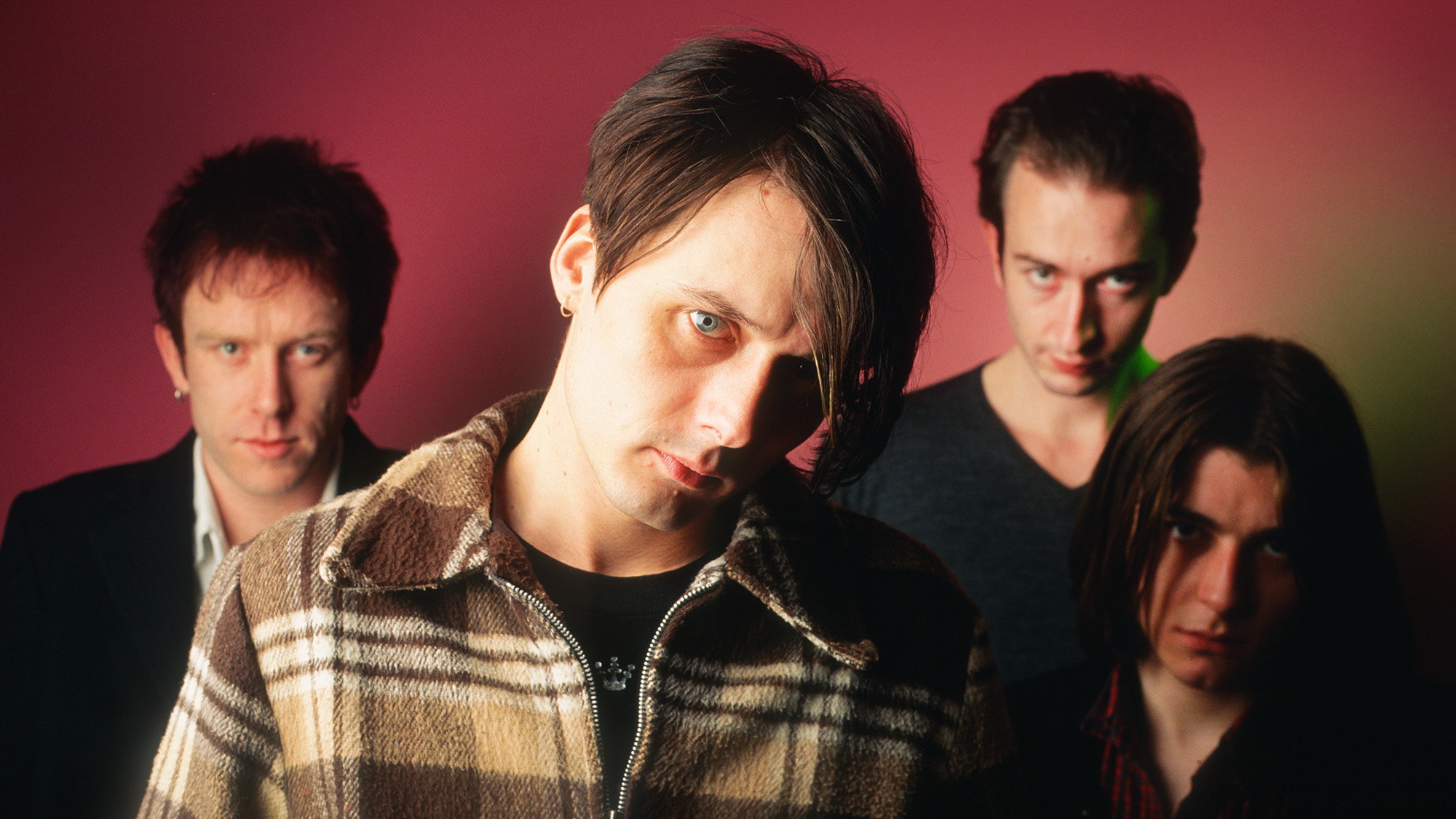
Coming Up reached number one on the UK Albums Chart, produced five top 10 singles, and went platinum. Not too shabby for a first pass at recording for Oakes.
The guitarist nods in agreement, saying, “It would be a long time before we were all once again in such close alignment artistically. And a long time before I felt the same pride in an album as I did with Coming Up.”
“I do get the same feeling now when I hear a finished album,” Oakes says. “But of course, with age and experience, it feels different. In 1996, I was a kid with very little experience and a huge amount to prove. Critics had basically written Suede off before Coming Up came out, and no-one took me seriously as an artist. I don’t have those battles now.”
You came into Suede as a replacement for Bernard Butler. What sort of style did you bring to the band, and how did that shape the guitar sound on Coming Up?
I grew up on post-punk and proto-goth records; it was that music that made me want to play guitar. PIL, Banshees, Magazine, The Cure, Joy Division, The Fall, Wire. Anti-rock, anti-posturing. When I first came to Suede, none of them were listening to that stuff, so I couldn’t really channel that inspiration.

They were all about [David] Bowie, [Marc] Bolan, Prince, and Scott Walker. So had to learn all their back catalogues in order to be on the same page when it came to writing. But also, they loved punk, especially the [Sex] Pistols.
So they wanted the third album to be distilled, direct, sharp, and bright, everything that the previous album wasn’t – and my playing style fitted pretty well with that remit. Ed Buller is solely responsible for the guitar sounds on Coming Up; I just concentrated on the parts and performances.
Seeing as you were just 18 or 19 when you were working on Coming Up, one can imagine that you were very receptive to what Ed had to say as a producer.
Yes, he has taught me to see which parts are the most important. I tend to layer everything I write. I like dense harmonics and atmospheres, creating a shifting sound world with parts. But sometimes that doesn’t leave room for anything else. Ed taught me to identify the important bits and get them right first.
What were the first songs that you worked on for Coming Up?
The first thing I wrote for Suede was the music that became Picnic by the Motorway, but the first thing we recorded was [the single] Together, and that was an incredible experience.
To be at Wessex Studios in Highbury, where some of my favorite music has been recorded, working on music of my own… that was far more of a wow moment than any gig we had done up to that point.
I was still only just 18, and it was difficult to take in everything that was happening to me in 1994, but that recording session sticks in my head as the first time I realized the magnitude of the opportunity that had been offered to me.
What guitars, amps, and effects pedals did you bring into Suede that ended up as part of the Coming Up sessions?
Nothing at all. I turned up at my first audition with my Squier Telecaster, as that was all I owned. They quickly put a rig together for me, based vaguely on what had been used previously; it was all about getting a “Suede sound” so we could go on tour. I didn’t experiment with guitars or amps; there wasn’t time for that.
But I have stuck with using a [Vox] AC30 over the years as I just find them so expressive with my playing, and so classic. I started off with Gibsons, but by the time we recorded Coming Up, I had started using Fenders as they fit better with my natural style. At first, things like chorus, modulation, and reverb were pretty much banned as “too shoegaze” early on.
What do you remember about recording Trash?
I remember recording the guitar break in the middle straight into the desk; it was meant to be a first draft idea that I would improve on later. But everyone loved how it sounded, so we kept it
Trash was a latecomer to the album. I remember we spent a lot of time rehearsing different verses and choruses for it. When it was finally nailed, we started recording, but my guitar parts sounded a bit fruggy at first, especially in the verses. So, Ed added the top line on his Moog Modular, and it was like it finally found its identity.
I remember recording the guitar break in the middle straight into the desk; it was meant to be a first draft idea that I would improve on later. But everyone loved how it sounded, so we kept it. Then Brett [Anderson] finished the lyrics and the title, and it became the obvious first single. A huge relief to everyone!
And how about Beautiful Ones?
Beautiful Ones was really mostly trying to get the intro right… the verses were just acoustic and one melodic line on the electric. And the choruses had the wiry lead line running through them – I remember we used a [Fender] Jaguar and a [Fender] Twin turned up and fed through an Auratone [Monitor] in the control room to get the right level of feedback.
But the intro took forever, I remember us spending a lot of time at Mayfair and Masterrock studios trying to get it right. I think in the end it’s a Jaguar and a [Fender] Telecaster.
The first time you heard Coming Up, did you feel you had a winner?
I felt we had achieved exactly what we wanted to achieve with Coming Up. None of us had any idea it would be such a success, but we were so much on the same page during that period that it almost didn’t matter. Almost.
Since you recorded Coming Up at such a young age – and theoretically, at an early stage in your development as a player – have you ever considered what your guitar playing would be like if you’d never joined Suede?
If I had been in a different band, of course, it would have been different to an extent. I would have always worked hard to be on the same page as the person or people I was writing songs with.
But I would have developed my own style, too. I was so young when I started with Suede that I was still trying to work out what kind of musician I wanted to be. I did that journey of self-discovery in public; the mistakes are all there.
What has been your most important lesson as a young working artist?
The day I learned how to write spontaneously in the room with other people was probably the biggest lesson. Up until then, I had always written everything alone, at home
The day I learned how to write spontaneously in the room with other people was probably the biggest lesson. Up until then, I had always written everything alone, at home, waiting until I had gotten it [the song] to a finished state before allowing anyone to hear it.
But learning how to brainstorm with other musicians – whether the moment is right or not – has really helped me and Suede. We do so much composing in Hanwell together now, Neil and I. We fire off each other and understand each other’s ideas. In the past, it was wholly separatist. No, I never stop learning; there is always so much more to learn.
If you could go back and do Coming Up again, would you change anything, given the knowledge you have now?
I don’t think I’d change any of the actual music because I’m not into revisionism, but I can see that teenage me was very eager to impress with my playing. And there are just so many notes. I have learned since then to create space, minimalism, and just breathe a bit.
- This article first appeared in Guitar World. Subscribe and save.