

Press play on First Day, a standout from Far Caspian’s phenomenal new album, Autofiction, and you’ll have a couple of reference points, if you’re coming in cold.
The jangling guitars and obscure atmosphere’ll be music to the ears of those partial to early R.E.M., the spider web layers of the former instrument a selling point for anyone with a taste for shoegaze.
Now, Joel Johnston – the Irish singer/songwriter behind the Far Caspian curtain – does take care to point out to Guitar World that for Autofiction, he dialed the guitar tracking down from the Kevin Shields-like levels of his 2023 breakthrough, The Last Remaining Light, while also expanding his library of open tunings.
“I was really conscious of the fact that I wanted to play as many of [the Autofiction tracks] live [as possible],” he tells GW. “We would do live sessions after [The Last Remaining Light] came out for YouTube or whatever, and we always struggled to make it sound anywhere close to the record, because I'd put 40 different guitars on it!”
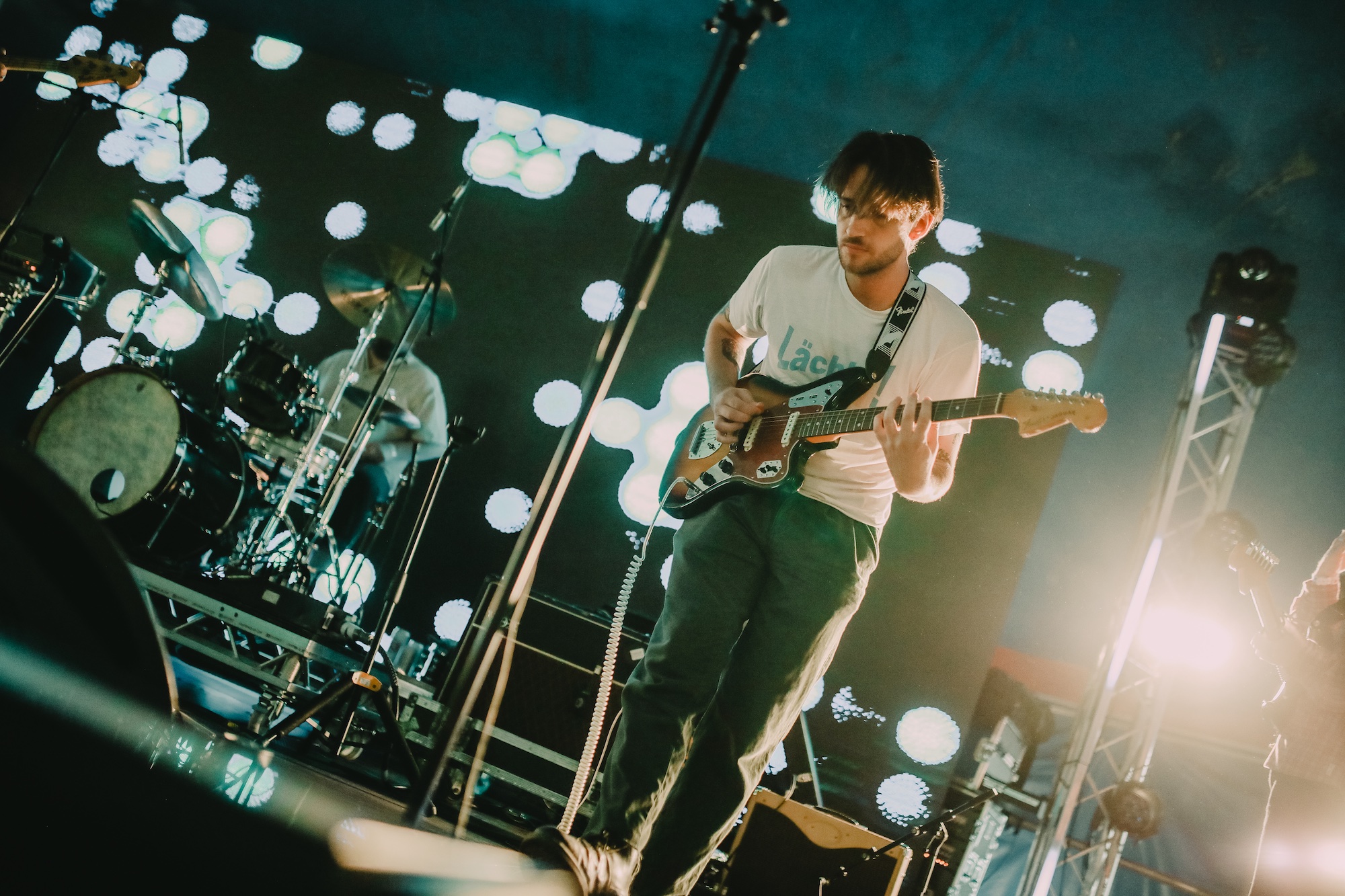
Johnston is a one-man band in the studio, but live, Far Caspian take to the stage with a three-guitar attack.
“So for this album, I was like, ‘I'd love to be able to play the whole album through,’ and I realized what I needed to do was just record three guitar parts [per song]. So a lot of the album is just that – three different guitar parts.”
But oh the things you can do with three guitar parts. Listen to how Johnston closes the album on the succinctly-titled End. Uptight but hypnotic in an almost Krautrock-like way, the song explodes into a veritable guitar hurricane in its final minute.
So how does that climatic eruption go live?
“I just figured that if I'm just playing the same [part] and I'm just layering it up, I can get away with that live, because we can just put on all our pedals and hope for the best.”
Onstage and off, Johnston is a Fender offset man, and has been since the absolute beginning – a byproduct of his unusual guitar journey.
Johnston was a drummer in his childhood and teens and didn’t start seriously playing guitar until he was 19. Whenever the curiosity struck him before then, “there were always guitars laying about,” thanks to his older brothers.
When “the necessity of writing a song” made guitar a must, Johnston’s first purchase was a Mexican-made Mustang, with a Japan-built ‘96 Mustang soon to follow. The latter made him not only a Fender offset loyalist, but a Japanese-built Fender offset loyalist.
“I now strictly [buy] Japanese Fenders, because they're so good, and obviously a fraction of the price of, say, an American Vintage,” he explains.
It was when Johnston tried the beefier, more versatile Jaguar, though, that everything clicked.
“I tried a friend's Jaguar out, and then I got a '94 Japanese Jag, and that's kind of just been the staple for me, mainly because of the three pickup options, and being able to roll off the low end,” he says.
“Especially going into the [Fender] Princeton I use – it works so well for that sort of stuff. It's a really easy neck, and I feel like the bigger body is nice as well. The Mustang felt a bit small on me.”
On the ground, Johnston runs a JHS 3 Series Compressor into a TC Electronic Hall Of Fame with the Mod Reverb all the way up (“I always put that pretty much right at the start, so that it gets affected by whatever else is on and feeds into that”), with an always-on Hudson Broadcast, a Boss SD-1 'drive “for squeals and feedback”, an EHX Canyon for looping, and a Boss DD-6 digital delay at the end.
An EHX Memory Man and a Fairfield Circuitry Barbershop overdrive (rare in the UK) – both of which Johnston picked up at the DC area mega-guitar-store Atomic during Far Caspian’s recent trek through the US – can also be found.
Johnston admits that even that pedalboard is “still sort of minimal compared to some people I know,” but for him, it’s a marked progression from the dogmatism of his early career.
“I used to be really obsessed with being, like, super clean, almost DI clean,” he tells us. “I used to use a [Vox] AC 15 and just have the gain all the way down, so there was no breakup at all. And then I kind of realized that was really boring, and I properly discovered fuzz.
“Now, it's kind of all based around that and gain-staging throughout the pedalboard; having those options to just flick it on – and then also having the delay afterwards, and being able to feed into the fuzz, that's now my favorite thing to do when we play.”
So then, what’s next?
“I've got a couple of majority-acoustic songs that I'm working on,” Johnston says.
“I don't know what I'm going to do with them, but I'm quite interested in bringing a bit more acoustic guitar in, because I've only done a couple songs with that sound, and it'd be nice to try and figure out how [to] record an acoustic guitar, but try and make it sound like it's non-acoustic. That interests me at the moment.”
- Far Caspian's new album, Autofiction, is available now.