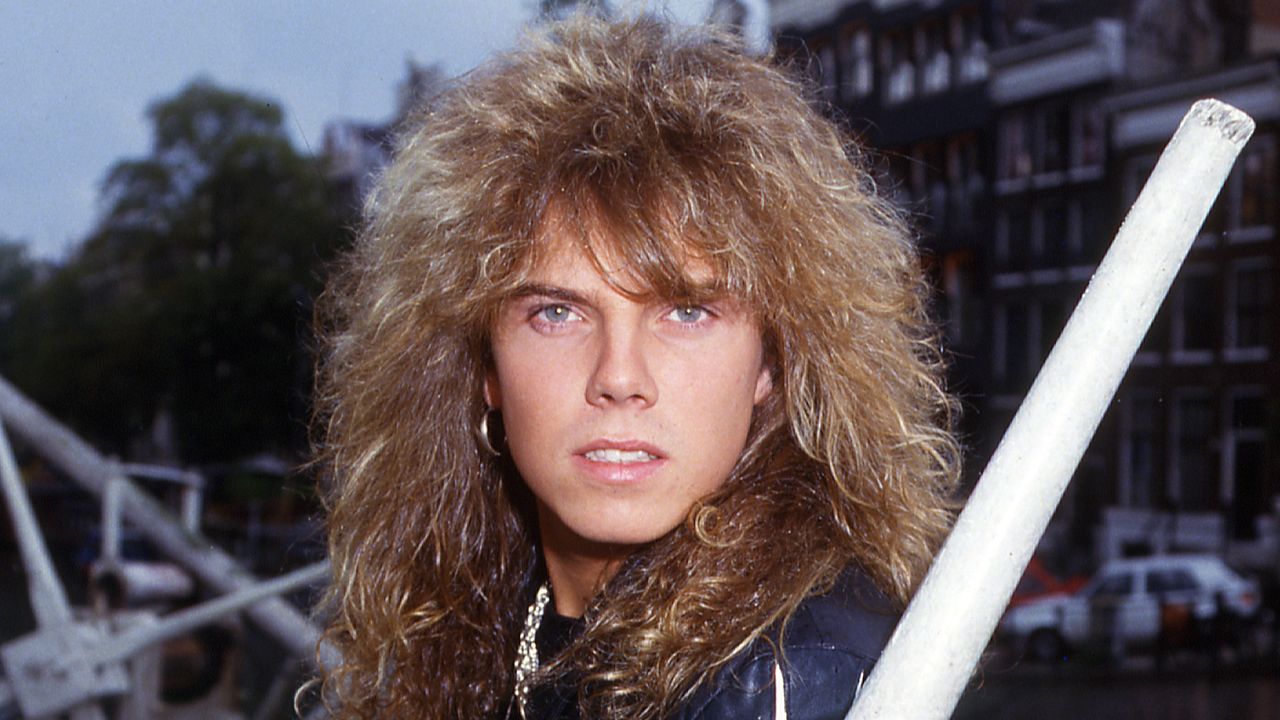
In 1986, Joey Tempest, the singer for Swedish rock band Europe, was riding the crest of a wave as his song, The Final Countdown, shot to No.1 in 25 countries. But just a few years later his band had split and a new rock hero, Kurt Cobain, had scrawled the taunting message: “Who the fuck is Joey Tempest?”
It was in 1979 that Tempest formed his first band, Force, with guitarist John Norum in their hometown of Upplands Väsby. The band was then renamed Europe in tribute to Deep Purple’s classic live album Made In Europe.
Deep Purple were a key influence for Tempest, along with other British rock acts such as Led Zeppelin, Queen, Thin Lizzy and UFO.
Tempest wrote pretty much all of songs on the band’s self-titled debut album from 1983, and so it continued with the follow-up Wings Of Tomorrow in 1984 and The Final Countdown two years later.
For The Final Countdown’s title track – a dramatic rock anthem built around a blaring synthesiser riff – Tempest drew from two very different elements of British music: heavy metal and art rock.
As he told Classic Rock magazine in 2012: “The Final Countdown has that very English galloping tempo. I took inspiration from Iron Maiden’s Run To The Hills and UFO’s Lights Out. And for the lyric, the story of the last days on Earth, I went back to David Bowie’s Space Oddity. That was the first single I ever got. Bowie’s dream world was so fantastic.”
Tempest had written the song’s main riff many years earlier, around 1981 or 1982, after borrowing a Korg Polysix from a friend who would end up as Europe’s keyboard player, Mic Michaeli.
For the recording of The Final Countdown, Michaeli used a Yamaha TX-816 rack unit and a Roland JX-8P synthesizer. “I made a brassy sound from the JX-8P and used a factory sound from the Yamaha, and just layered them together,” Michaeli said.
The success of this song had a huge impact on the five members of the band.
“We were thrown into this weird pop world,” Tempest recalled. “It was madness. But at the same time our dreams came true. The world opened up for us.”
It was all too much for guitarist John Norum, who quit Europe in November 1986, complaining that Europe had become a “teeny-bopper bubblegum band”.
But Tempest was determined to push on. “I had to take control,” he said. “My attitude was: ‘We have to keep it together, guys. Come on!’”
The Final Countdown – the album – reached No.1 in Sweden and several other countries. In the US it peaked at No.8 and sold three million copies.
The follow-up, 1988’s Out Of This World, was another success, selling a million in the US alone and featuring the hit single Superstitious.
But when the band’s next album, Prisoners In Paradise, was released in 1991, rock music was in the throes of a revolution. Grunge had arrived in the mainstream.
1991 was the year of Nirvana’s Nevermind, Pearl Jam’s Ten and Soundgarden’s Badmotorfinger. And that spelt disaster for Europe and other big-haired stars of the ’80s.
As Tempest told Classic Rock: “You knew there was a change in the air. And I felt that some of the hard rock of the ’80s had become a bit one-dimensional.”
When Tempest visited the New York offices of Europe’s record label Epic, he sensed that the game was up. “The people at Epic were very friendly,” he said, “but now there were Pearl Jam CDs lying around. It hurt, because you want your label behind you.”
He recalled another low point: “Kurt Cobain allegedly wrote ‘Who the fuck is Joey Tempest?’ on a wall in LA.”
On 15 March 1992, when Europe completed a UK tour at Portsmouth Guildhall, they decided to split up.
Tempest felt exhausted. “We’d done five albums in 10 years,” he said. “I was just so tired.”
He also felt, at the age of 29, that he was yesterday’s man. “It was an empty feeling,” he admitted “All of a sudden, I was lost.”
However, even at his lowest ebb, he never believed that his career in music was finished.
“After the last Europe record, I knew we needed to have a break for many reasons,” he reflected. “We’d irritated a lot of people by being in everybody’s faces for a while. And I wanted to make a solo album. I wanted to try something different.”
After disbanding Europe, Tempest made three solo albums, inspired by songwriters such as Bob Dylan, Neil Young and Jackson Browne. “It was a reaction against that whole hard rock thing,” he said.
But on Millennium Eve, Europe reunited to perform The Final Countdown in a live Swedish TV broadcast.
“It was a magical feeling when we played,” Tempest said. And in 2003 the band were officially reformed and back in business, with the classic line-up that had recorded their biggest hit so many years before.
They’ve made six studio albums since then. And this year they head out on tour to celebrate the 40th anniversary of The Final Countdown.