Lying in a hospital bed, Grant McIntyre was struck by a terrifying realisation – he was going to die.
It was the third time dental consultant Grant had been admitted to hospital in just a few days having contracted the virus that had brought the country to a standstill.
Twice he had been discharged – but it seemed unlikely he would get home a third time.
“I don’t remember being in the ambulance or being in hospital until the middle of the night when it dawned on me that I was dying,” 50-year-old Grant told the Perthshire Advertiser. “It was overnight that night I had this out-of-body experience. Having had that I gave myself a big shake, put the bed upright and concentrated on breathing as hard and as fast as I could because I realised without something changing it was heading rapidly towards death.
“It’s not something I would want to feel again, nor anyone else feel. It was quite a bizarre sensation. For me it wasn’t particularly scary or worrying. I have resolved it in my own mind that because my blood oxygen was so low, my brain wasn’t working properly and was not able to process the severity of the situation.
“I remember having a conversation with the doctor on the ward round that morning and I told him ‘I think I’m going to die here, can you save my life?’ I don’t think I said anything else that day, it’s probably the most important thing I have ever said in my life.”
Grant would go on to spend 128 days in hospital – making him Scotland’s sickest COVID survivor.
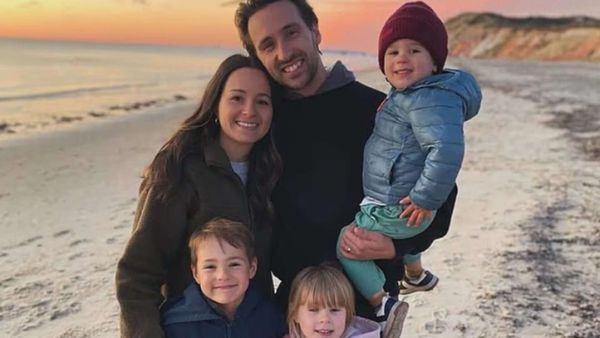
It is this experience that has prompted Grant and his wife Amanda (52), who stay in Perthshire, to release a book, ‘Dying to Live: The Remarkable True Story of Scotland’s Sickest Survivor of COVID-19’.
Grant had first fallen ill on the week starting March 23, 2020, when the national lockdown came into force.
However, he was discharged from hospital the first two times he was taken in, much to Amanda’s disappointment who felt he was too sick.
As the days passed, the situation became progressively worse. Grant’s body went into a cytokine storm – where the body’s immune system releases an excessive amount of pro-inflammatory cytokine molecules – and this immune response nearly killed him.

He suffered multi-organ failure, a collapsed lung and sepsis, spending 50 days on ECMO life support in Aberdeen.
For Grant, much of what happened was a blur, but the memories are much clearer for head teacher Amanda.
And while the doctors thought Grant would eventually succumb to his conditions, she never lost hope.
“It was a very, very difficult period. There were multiple phone calls,” she says. “It was a very harrowing and difficult time, but I never allowed myself to believe [he would not make it]. I had this really strong belief he was going to make it.
“Every day a nurse would arrange a video call but he was unconscious for eight weeks so I would have this one-sided conversation for about 45 minutes to an hour and I told him every day, ‘You are going to make it and we’re going to get through this’.”
Amazingly, Grant did survive and a turning point came when the doctors tried to get him off the ECMO machine.
“They had attempted to get him off it over a period of a couple of weeks and it was not going at the pace they hoped,” Amanda said. “There was a fading hope that Grant was going to be able to get off ECMO.
“Even though they had got him to the point where he was conscious, he was not able to make the gas exchange in his lungs to be able to just be on ventilator support.
“They decided they would actually focus on his rehabilitation. So they started to increase the physical activity he was doing.
“They would get him to sit up in a supported chair for short period of the day and started to focus on that and moving his limbs. That seemed to actually help.”
Even when they were able to take him off the machine which had kept him alive for nearly two months, Amanda could not relax.
“That was itself quite a worry and a concern in that this machine had kept him alive for months and they were now going to remove it,” she said. “In your head you are playing all these ‘what ifs’ – ‘what if he starts to decline again, will they put him back on ECMO’?
“It was a momentous step forward, just a few weeks before that the doctors had been telling me they didn’t think he would make it.”
It proved to be the start of better times and Grant was able to return to Ninewells, although he remained on a ventilator.
Being in Dundee did mean he could see his loved one in person again and on July 6 they were able to spend their wedding anniversary together.
Speaking on his anniversary this week, Grant said: “Last year it was spent in the Ninewells fresh air garden, which is really the smokers garden.
“The physiotherapy team managed to clear all the smokers out the garden and allow us to have a little bit of time together. It was a rather surreal wedding anniversary.”
Amanda added: “I very much did not see him for about 10 weeks until he returned to Dundee.
“And then the amazing ICU staff would take Grant outside to the ambulance bay near the ICU and allow me to be in the vicinity at the same time for five to10 minutes.
“This was an amazing feat of engineering because Grant was still on the ventilator at that point. Out would come eight members of staff to bring him outside for about five minutes.”
Grant would leave ICU on July 28 last year and eventually returned home on August 6, being applauded out by staff at Ninewells.
“In total, it was 128 days from beginning to end, around about 50 of which were spent on ECMO. There was another chap who was in one of the Glasgow hospitals who was in 124/126 days so obviously people are having a go at the record,” he joked.
It was while in hospital the idea of writing a book about their experience was first planted for Grant and Amanda, who have four children between them.
His rehab team had suggested it and after being asked to write an article about his journey, it soon took off.
It proved to be a cathartic experience, which was helped by Amanda having kept plenty of information.
“One of the things I did when Grant was in hospital was I kept everything – the names of the professionals that had been involved in his care, a timeline of what had happened - and I made it into a scrapbook because I knew that he was going to have a period of his life that was completely missing and he would struggle to make sense of that,” she said.
“So I made this scrapbook-timeline of events with some of the lovely things that people did during that time when he was on ECMO in Aberdeen, recordings that people made were transcribed, songs that people recorded. The pianist at our wedding recorded the music that he played, things like that.”

Grant added: “There are a lot of details that we did not know and in writing the book we had to find out some of the stuff we had been protected from and that was a bit of an eye-opener to realise how many times my body had been right on the edge and was close to falling over the edge.”
While Grant is now out of danger and back in his role as consultant and honorary professor of orthodontics and clinical director for Dundee Dental Hospital and School, he still suffers from the after effects of his ordeal.
He tries to get gentle exercise and has bought an eBike to help with his rehabilitation, but his lungs will never be the same again.
“Whenever I go up three or four flights of stairs I know all about it while before I could run up them in the years gone by,” he said.
“But I am able to do that and able with help from my friends to do a bit of hillwalking at a slower pace than I used to do.
“I still get a bit of joint problems in my hands and feet which we think is post-viral arthritis, which isn’t great. I still have an issue with a neuropathy pain in my feet which troubles me at night quite a lot.
“But, even taking those three things into account, if someone had said this time last year, ‘right mate, you are going to have three long-term complications and symptoms to deal with,’ then I would have taken them without any problem at all.
“Yes, I want them to improve but if I have to live the rest of my life with them, I will take that as an outcome bearing in mind the number of people who have sadly died due to COVID and the families that have been ripped apart.”
• ‘Dying to Live: The Remarkable True Story of Scotland’s Sickest Survivor of COVID-19’ by Grant McIntyre and Amanda McIntyre has been published by Tippermuir Books and is available from https://tippermuirbooks.co.uk/ priced at £9.99.




.png?w=600)