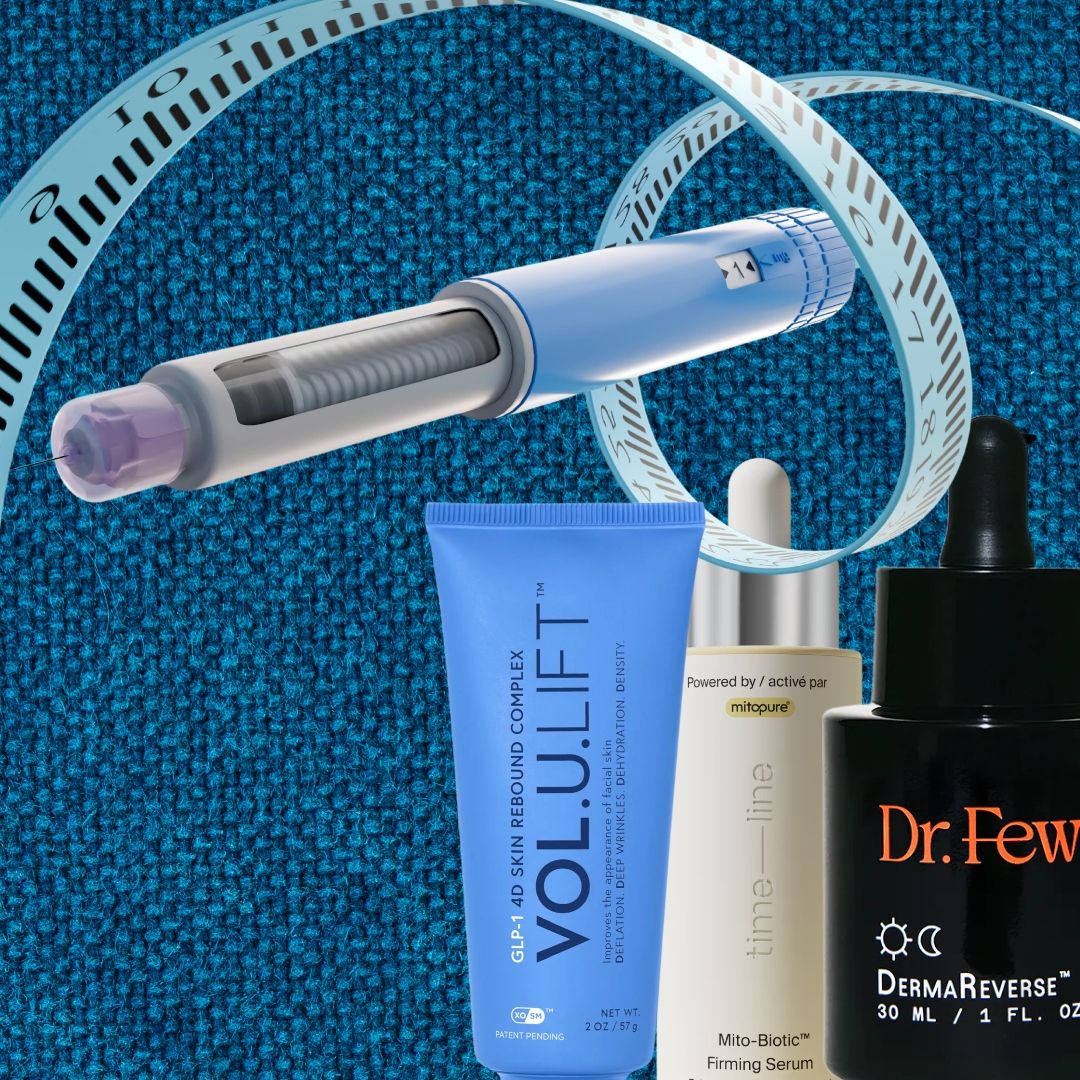
One in 12 Americans have tried a GLP-1 drug, including me—I’ve been on one for six years. So it’s not exactly shocking that nearly every industry is scrambling to stake its claim. There are “GLP-1 support” supplements from Thorne, Sakara, and Cymbiotica; Ozempic menus popping up everywhere from downtown Manhattan to José Andrés restaurants in DC; even metabolic-tracking apps and electrolyte packs tailored to users navigating a slowed digestive tract.
Beauty hasn’t just joined the party—it’s carving out a new category. Some of the discourse has, candidly, veered into clickbait territory (see: Ozempic Vulva, Ozempic Earlobes), but there is actually a need for innovation around Ozempic Face, a zeitgeist-y catchall for gauntness and skin laxity that can often accompany large weight loss. Its effect on aesthetics is well measured. The American Academy of Plastic Surgery reports a 50 percent spike in fat-grafting procedures, and one in four surgeons anticipate that GLP-1 medications will drive a growing demand for non-surgical treatments like injectable fillers and skin-tightening procedures.
But it’s not just aesthetics—topical skincare brands like Dr. Few and Vol. U. Lift are forging a new frontier. When they first crossed my desk, I thought they were nothing but clever marketing capitalizing on a buzzword. But after diving into the category, consulting experts, and reviewing research, I’ve changed my view. “There is no hoax in wanting your skin to look and feel its best,” says board-certified dermatologist Sabrina Fabi, MD. These medical-grade brands are formulated with intention and address evolving needs. In other words, GLP-1 skincare isn’t a gimmick—it’s a response to a real, fast-growing shift in how skin behaves on these medications.
To get the full breakdown on everything to know about GLP-1 skincare, read ahead.
What Happens to Skin on a GLP-1?
TikTok would have you believe that taking a GLP-1 is a recipe for “Ozempic Face,” which has evolved into a catch-all term that points to “readily noticeable reduction in the facial volume and fullness,” says board-certified dermatologist Alicia Zalka, MD. But that’s not always the case. How your skin responds is largely determined by the percentage of body weight you lose, your genetics, and your facial structure. For some faces, this can lead to a more streamlined jawline or greater definition of the cheekbones, whereas for others it can be associated with loss of elasticity, which results in a sagging appearance. Because GLP-1 medications lead to weight loss that includes fat and muscle, “the skin will lose some of its collagen content,” explains board-certified dermatologist Raja Sivamani, MD, MS, AP. “The faster the weight loss, the more collagen is lost.”
Despite volume loss being the skin side effect dominating the public discourse, there are other, less-discussed changes—such as dryness and dullness—that most people on a GLP-1 experience. This is partly because GLP-1s slow the digestive tract, reducing hydration. While not studied extensively, there appears to be “a series of internal skin factors that are turned off by the GLP-1 drug that cause skin to look duller than usual, more wrinkled, and have more sun-induced pigmentation. Does this always occur? To some extent, yes. People with thinner or older skin will be more likely to show the signs of GLP-1 skin changes,” says board-certified dermatologist Julius Few, MD. “People with darker skin tend to have more resistance to the effects due to the natural tendency for darker skin to be more resistant to sun damage.”
How Does GLP-1 Weight Loss Affect Skin?
In my experience, GLP-1s get blamed for a handful of aesthetic side effects that are actually a result of weight loss itself—not the drug. Hair loss, for example, is common in any individual who loses a substantial amount of weight. But! A new study conducted by Galderma—and one of the first aesthetics companies to examine how GLP-1 agonists specifically affect the skin—found that GLP-1s do indeed cause a different type of fat loss than traditional weight loss.
The study, conducted over nine months, revealed that GLP-1-induced weight loss has a greater effect on superficial fat pads—the ones that house our stem cells and are responsible for producing collagen and elastin. “This leads to the changes seen after a certain degree of weight loss has occurred, such as volume loss in the temples and cheeks and dull, sagging skin,” says Dr. Fabi, who was involved in the clinical study.
Some patients look less radiant and even appear older than their age, up to five years older for patients who have undergone massive weight loss.
Dr. Fabi
There’s also a hormonal component to consider—especially in women who are perimenopausal or menopausal, aka a large proportion of patients put on a GLP-1. Fat supports “hormonal homeostasis,” says Dr. Fabi, as they’re largely responsible for regulating changes in estrogen, testosterone, and progesterone. “If too much fat is lost, it can alter estrogen derivatives that support skin health, which leads to some patients looking less radiant and even appearing older than their age, up to five years older for patients who have undergone massive weight loss,” she says.
While more research is certainly needed, some researchers believe that GLP-1s may have beneficial effects on the skin as well. Because these medications can reduce overall systemic inflammation, they also reduce the presence of advanced glycation end products (AGE’s), which are linked to yellowing or browning of the skin, wrinkling, or sagging. “When these AGE’s are turned down, so too is the oxidative damage to the skin,” explains Dr. Zalka. “Less oxidative damage means skin cells are protected.” Think of it like this: AGEs act like wayward cars, causing lots of fender benders to other skin cell cars. The more bad drivers there are, the more cells like elastin and collagen can suffer.
If this sounds like a contradiction to the proof that superficial fat pad loss causes a decrease in collagen and elastin, well, it is. The reality: GLP-1s are affecting the skin in numerous ways, and current research is insufficient to support large-scale generalizations.
Is GLP-1 Skincare Different Than Regular Skincare?
I’ll be honest: when I first saw GLP-1 skincare brands popping up, I thought it was smart marketing slapped on traditional anti-aging skincare that firms, lifts, and boosts collagen. While the ingredient profiles are the same (more on that later), there actually is a big difference. GLP-1 skincare has been tested on GLP-1 patients. Compare it to medical-grade skincare like Skinceuticals or SkinBetterScience; companies like Dr. Few and VOLU-LIFT have invested the money and done the clinical trials to unequivocally prove that their products deliver on their promises.
“Skincare that is formulated specifically for use in a GLP-1 environment has been studied in that specific population that is on GLP medications as opposed to general skincare that is studied in a generally healthy population,” says Dr. Sivamani. “It’s rare to have a company study the full formulation rather than focus on one or two ingredients.” The short of it? You know what you’re getting.
Who Should Use GLP-1 Skincare?
Excuse me while I state the obvious, but there’s a very clear target demographic with GLP-1 skincare: people taking GLP-1s. Even though these products are tailor-made (and proven to work) on GLP-1 consumers, they’re certainly not off limits to those not using GLP-1s. The science is there, the ingredients are efficacious, and the results are proven.
When Should I Start GLP-1 Skincare?
A great skincare routine is always a good idea, so it’s never too early to start. But if you anticipate losing weight on a GLP-1, it’s a good idea to start your revamped skincare routine in tandem with the medication. “Early intervention can really improve outcomes, especially when maintaining skin quality and minimizing accelerated facial aging,” says Dr. Fabi. “New international consensus guidelines supported by Galderma recommend starting a combination of biostimulatory injections, hyaluronic acid fillers, energy-based devices, and topical skincare regimens during the weight loss process to prevent the signs of premature aging.”
It’s a multi-pronged approach that is most successful. That said, it's important to note that you don’t need GLP-1 skincare just because you’re on a GLP-1. A solid skincare regimen that includes clinically-proven ingredients like retinol, hyaluronic acid, and vitamin C will be helpful in combating dullness and sagging skin, too.
What to Look for In GLP-1 Skincare
Finding effective GLP-1 skincare is a balancing act. You want to supplement the skin with ingredients that will trigger it to produce more of what the medicine is causing it to lose. “Fat, hyaluronic acid, collagen, and elastin are some of the building blocks of the skin that may be compromised while on GLP-1 agonists, so it's helpful to look for products that can promote hydration, firmness, and texture,” says Dr. Fabi.
Start with a cleanser, a treatment serum focused on collagen promotion or lifting, and a hydrating moisturizer. Don’t forget to include powerful active ingredients—like a retinol or bakuchiol, exfoliating acid, and/or vitamin C—that will help speed up skin cell turnover.
Will GLP-1 Skincare Help With Ozempic Face?
The answer: yes and no. For some people (think: younger patients or those losing less weight over a longer period or time), a solid skincare routine is enough to keep skin looking bouncy, healthy, bright, and plump. For other people—namely those experiencing weight loss greater than 30 to 50 pounds, says Dr. Few—skincare is just a starting point. “Topical skincare will not address volume loss and structural changes,” says Dr. Fabi.
When that’s the case, the sagging, dullness, and accelerated aging (or “Ozempic face”) often need to be enhanced by adding in other non-surgical applications. There are ultrasound skin-tightening devices such as Ultherapy, Sofwave, and Xerf; collagen-boosting lasers like Halo or Morpheus 8; and, most notably, biostimulatory fillers. “Patients should speak with a licensed aesthetic provider and consider incorporating SCULPT & LIFT (a combination of Sculptra and Restylane Lyft or Restylane Contour) to help regenerate your skin's own collagen and elastin to improve glow, contour, and structure,” says Dr. Fabi. There’s also a possibility that a surgical intervention, like a facelift or a necklift, could be your best bet. As always, make sure to consult with your board-certified dermatologist or plastic surgeon for the best plan of action.
Turns out GLP-1 skincare isn’t a solution in search of a problem. The problem exists—and the products are finally catching up.
Why Trust Marie Claire
For more than 30 years, Marie Claire has been an internationally recognized destination for news, fashion and beauty trends, investigative packages, and more. When it comes to the products Marie Claire recommends, we take your faith in us seriously. Every product that we feature comes personally recommended by a Marie Claire writer or editor, or by an expert we’ve spoken to firsthand.