Among the “enhanced interrogation techniques” authorised by the CIA in the early days of the war on terror – alongside waterboarding, sleep deprivation and ear-splitting broadcasts of David Gray’s song Babylon – US officials were advised to place detainees under stress by forcing them to stand for four hours.
The US secretary of state Donald Rumsfeld, famously, considered this a laughably feeble form of non-torture, scribbling on a Pentagon memo that he stood for up to 10 hours every day – so why should these wimpish prisoners be spared? But after attempting to enact new advice that office workers should stand for four hours every working day, I begin to see what the interrogators were on about.
True, the new guidance advises standing initially for at least two hours to reduce the risk of heart disease, diabetes and even some cancers. But its authors are clear that they believe this to be only an interim target. All of us, they argue, should eventually aim to stand for half of the standard eight-hour working day. My (seated) editor suggested I give it a try.
Standing to work is not a new thing: Leonardo da Vinci, Ben Franklin, Winston Churchill and Vladimir Nabokov are all said to have done it. Philip Roth wrote his novels on his feet, while James Murdoch, now chief operating officer of 21st Century Fox, is a self-confessed “big believer” in standing while you work.
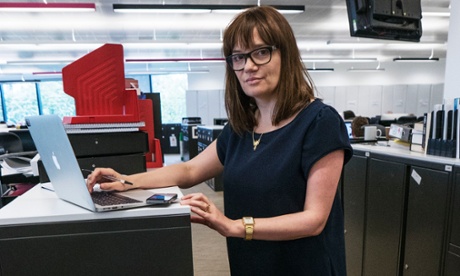
I’m assuming, however, that they each had a workspace that made it possible. Unfortunately, when I stand at my desk, I can’t reach my keyboard without crouching, or see my screen without squinting. And so I install a laptop on top of a stack of lockers in a corridor, which places my keyboard at low chest height, and attempt to crack on with a normal day.
This is fine for a while – I do an interview on my mobile, leaning louchely against the locker while colleagues shoot me quizzical looks as they pass. After about 40 minutes, however, I’m feeling it in my knees, and take a sneaky 10 minute break. After returning, I try leaning forward against the locker, taking some of my weight on my kneecaps, but am then far too low to type, and also look like an idiot.
An hour or so later, I reach Gavin Bradley, one of the report’s authors. It turns out I am doing it all wrong. “We don’t promote prolonged standing either,” says Bradley, whose organisation Active Working CIC commissioned the research along with Public Health England. Instead of standing for hours on end, he says, they advise “mixing it up” with bursts of sitting and standing throughout the day – but never sitting for more than 30 minutes at a time.
Fundamentally, says Bradley, sitting should not be our default position at work, but a rest position for when standing becomes tiring. I thank him, and sit. It’s bliss.
Bradley – in common, he says, with 90% of Scandinavians – uses a “sit-stand” desk that adjusts in height when he gets to his feet or returns to his backside. Not being in possession of such a device, I improvise back at my desk with a couple of box files, several magazines and a tower of reporters’ notebooks.
This is better, but I can’t see it catching on at Guardian HQ without a radical office redesign. My four hours done, I am, truthfully, relieved to slump back into my ergonomically supportive chair. Maybe I’ll try again tomorrow.