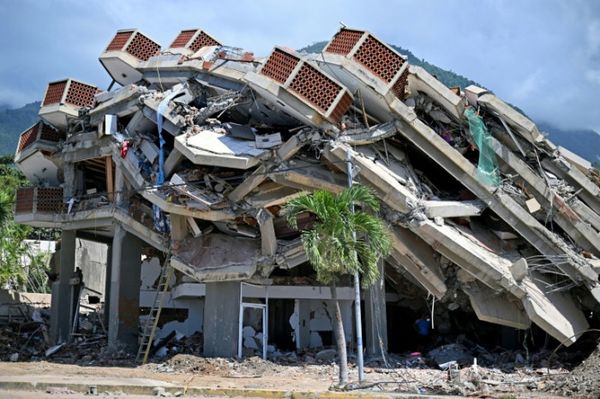
An air of civilisational wipeout hangs over the Gehrenseestrasse complex, an abandoned housing estate on the north-eastern outskirts of Berlin, where the city still looks shabby without the chic. The insides of the nine prefabricated blocks have long been gutted; six floors of empty window frames stare hollow-eyed over multi-lane carriageways. In the courtyard, paintballers have left behind wooden barricades from when they played at World War III.
Yet in one of the second-floor rooms of Berlin’s largest ruin, artist Sung Tieu is waltzing across the concrete floor and reliving scenes from her childhood. “Here was the single bed I shared with my mother for three years,” she says, pointing into a corner of the small room. “Two metres by 90cm, can you believe it?” There in the corridor is where her neighbours used to make bánh bao dumplings on camping stoves, for lack of private kitchens. “I still remember the smell.” Here was the door through which she used to entertain her best friend when his mother locked him in during working hours. “We played cards through the gaps,” she recalls with glee.
But she also still remembers where neo-Nazis tried to throw molotov cocktails into the building: “They eventually set up a net because the windows kept on getting smashed”.
These days, few people have heard of the Gehrenseestrasse complex, whose last tenants left in 2002. But if Tieu had her say, it would be as essential a stop on the tourist trail as the Brandenburg Gate, the Reichstag or Checkpoint Charlie. There is, in her view, no place that better tells the story of the Vertragsarbeiter generation – the oft-forgotten workers who were hired on fixed-term contracts from socialist “brother states” in Vietnam, Mozambique, Angola or Cuba to boost the East German economy. “To me, this place is a monument,” says Tieu.
By the end of this summer, many more people in Germany – and art enthusiasts around the globe – will know about her childhood home. For this year’s Venice Biennale, Tieu has clad the German pavilion with a like-for-like replica of the complex’s facade, recreating the grey concrete and smudges of graffiti with three million mosaic stones made in Ravenna. She conceived the pavilion in tandem with the artist Henrike Naumann, who died in February from cancer aged only 41.
Tieu, 38, is not yet a household name in Germany, but millions have seen her face on their TV screens. Dabbling in acting in her late teens, she had a supporting role in Turkish for Beginners, an at the time groundbreaking comedy series about a German-Turkish stepfamily. Tieu played a vampish and vain student straight out of a Manga cartoon, the love interest of the character played by Elyas M’Barek, now one of Germany’s most popular film actors. Her character was called Ching, which is not a Vietnamese name.
The woman I meet at a Vietnamese restaurant in Berlin’s Lichtenberg district is the antithesis of that exoticised cliche: modest, dressed all in black, analytical in her answers to my questions. She talks me dispassionately through the more experimental food options on the menu, but comes alive when explaining bilateral treaties and labour regulation.
“I really try to avoid the pure post-migrant diaspora narratives. By focusing on individual experience you can lose sight of the bigger picture. Contracts, state treaties, floorplans – that’s what I am interested in. There has to be a certain formal toughness.”
Looking through her catalogue raisonné you are reminded of Marcel Duchamp. You see an artist dedicating her career to seeking ever more minimalist ways to express the same idea, from Cubist painting to readymade to annotations of chess moves. And in Tieu’s case, that big idea is bureaucracy. In 2015, she reprogrammed the scrolling LED displays at a shop inside the Dong Xuan Centre, Berlin’s largest Asian market, to display the texts of immigration treaties. For a group show at Berlin’s Haus der Kulturen der Welt in 2024, she transcribed by hand documents from the national archives on the East German porcelain industry, authenticating them with her own ornamental stamp. Her website, fittingly, is just a long index of file names and a deadpan biography section: “Sung Tieu is an artist.”
“I think it’s also a childhood trauma,” she says when I ask her where her interest in bureaucracy comes from. “I’ve had to fill out forms for my mother since I was five, since she didn’t speak any German. And by the time I was seven my German was better than hers. Bureaucracy was part of my childhood – I studied politics and administration because I wanted to understand it.”
Born in 1987 in Hai Duong, northern Vietnam, Tieu moved with her mother to what was by then the formerly socialist East German regions in 1992. They were joining up with her father, who had moved to the GDR five years earlier via a bilateral agreement for factory workers from the socialist republic.
Initially announced in the romantic spirit of ideological solidarity, the treaty between the two states soon became a more hard-nosed deal, addressing ongoing labour shortages in East Germany while helping to rebuild a war-ravaged Vietnam, which took a 12% cut of the workers’ earnings. Around 60,000 to 70,000 workers from Vietnam arrived in the GDR between 1980 and 1989, making them the largest non-white ethnic minority in the country. But the one-party state tried its best to ensure they did not stay permanently: language courses were reduced to a minimum; women who got pregnant were offered abortions or asked to leave the country.
After the Soviet Union collapsed and many of the factories that employed the Vietnamese contract workers were closed, a reunified Germany did not know what to do with this sizeable minority either. “We were left stranded, because the Vietnamese government didn’t want us back either and slowed down the requests of those who wanted to return,” says Tieu. “In a way, we were left behind by three countries: the GDR, the Federal Republic, and Vietnam.”
The Gehrenseestrasse complex where Tieu and her mother moved after her parents separated in 1994 was symbolic of that attitude: a container for people, isolated by busy roads from Berlin’s native population – and a perfect blank canvas for scapegoating.
Tieu’s creative partner Naumann and curator Kathleen Reinhardt were both born in the GDR and have wrestled with East German identity in their shows, which makes it tempting to frame this year’s Venice pavilion as the first ossi edition. But Tieu, who gave up Vietnamese citizenship to acquire a German passport in 2007, hesitates when I ask if she feels East German. It might make more sense to see her project as the first Biennale show to explicitly thematise what has come to be talked about as the “baseball bat years”: the post-Wall period when the communitarian ideals of the socialist republic were melting away and friendship between nations rapidly turned to aggressive hostility.
Neo-Nazis regularly attacked the Gehrenseestrasse complex and beat up workers walking home from factories, even before the notorious 1992 race riots targeting Vietnamese people in Rostock-Lichtenhagen. “There was a lot of resentment against Vietnamese workers who sent sewing machines and other white goods back to their families at home,” Tieu recalls. “Technically, there had been no racism in the GDR, because it wasn’t documented. But of course it always existed.”
Being chosen to represent Germany at the world’s foremost contemporary art olympiad can be a poisoned chalice, given the troubled history of the building that houses the national representation in the Giardini. Originally built in a neoclassical style in 1909, it was given a more bombastic exterior at Hitler’s personal behest in 1938. “It’s not like a normal exhibition where you are filling a neutral room, a white cube,” says Tieu. “You can’t really exhibit here without thinking about the building.”
In the postwar era, each German artist at Venice has been forced to enter that dialogue with the Nazi period in their own way. Some have let guard dogs pee all over the stairs, others covered the awe-commanding entrance in pedestrian scaffolding or closed it up entirely. Often, dialogue involved destruction, to peel back layers of history: Joseph Beuys drilled a hole in the pavilion’s ground; Hans Haacke smashed up the marble floor; Maria Eichhorn exposed the brick walls and dug up the foundations.
Tieu’s pavilion still alludes to all the long-running debates around German national identity. Its title, Ruin, references the ruin lust of Romantic painters such as Caspar David Friedrich, and one piece of graffiti spells the word “Wald”, meaning “forest” – that mythical place of fairytales and Tacitus’ old Germanic tribes. But she has dared to do what no artist has done before her: to dress up the building to give it a new identity, rather than to chisel away at its past. “Other artists have taken parts of the pavilion away,” she says. “But I thought: ‘Hey, how about I add something?’ After all, I came to Germany as a migrant and added something to the country too.”
• The Venice Biennale continues to 22 November