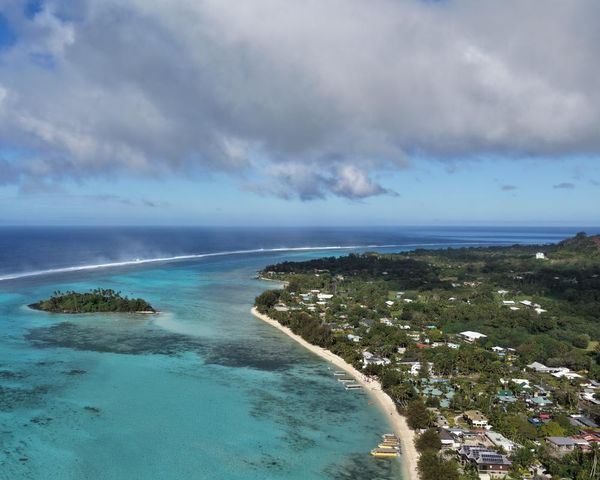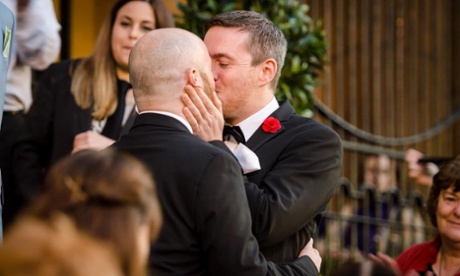
Last Friday night was culture night in Belfast, as it was elsewhere in Ireland. I officiated at the marriage of two men on the front steps of the Merchant hotel before an audience – make that congregation – of several hundred people. (Several hundred times two, for we went through the ceremony twice, at 7.30pm and 9.30pm). The wedding had been organised by the Irish Congress of Trade Unions, the Rainbow Project, and Amnesty International, in order to highlight the fact that Northern Ireland is now the only place in the UK and Ireland where same-sex marriage is not performed or even recognised, putting us on the same footing as Niue, Tokelau and the Cook Islands, territories that have opted out of New Zealand’s legislation.
The couple standing either side of me on the steps of the Merchant were Malachai O’Hara and Michael McCartan, who have been together for five years and had put themselves forward. As I said on Friday night, we were there to make a point, but that did not mean we were messing about. I had even had myself ordained for the occasion – in the United States, admittedly – by the American Marriage Ministries (AMM). The AMM has but three tenets, the first of which states that all people, regardless of race, gender, or sexual orientation, have the right to marry. In this, it puts most of the churches in Northern Ireland to shame.
Back in June, after 20,000 people marched in Belfast in favour of equal marriage, I took part in a radio discussion with a representative of the Evangelical Alliance who evidently thought the fact that 170 countries in the world did not permit gay marriage (he repeated the figure often enough) trumped the marchers’ wishes. The other way of looking at that, of course, is that until the historic yes vote in the Republic of Ireland on 22 May, 171 countries did not. Ten days after that radio discussion, on 26 June, when the supreme court legalised same-sex marriage across the United States, that number came down to 169. It is not going back up.
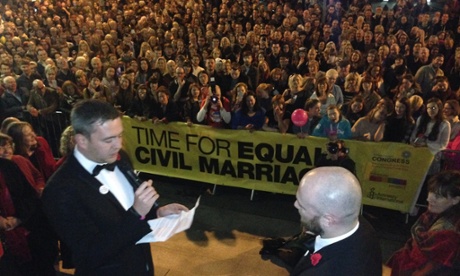
A recent Ipsos Mori poll suggested that 68% of Northern Irish adults supported bringing the law here into line with the rest of the United Kingdom and Ireland. Unfortunately our current political structures do not allow for a referendum of the kind they had in the south. Any attempt to bring about change through the Northern Ireland assembly is likely to be thwarted by a petition of concern, which ensures that legislation be passed by a cross-community – rather than simple majority – vote, which in turn amounts to a sectarian veto (something both nationalists and unionists have used liberally … or illiberally, indeed). Our best hope would appear to be to challenge the Northern Ireland opt out in the courts.
There is, of course, another option. After all, politicians in Northern Ireland are like politicians the world over. They want only one thing from us: our vote. Call me old-fashioned here, but before our lot get what they want from us in future, there are going to have to be rings on fingers: wedding rings that is, on the fingers of all those who want them and want their right to wear them enshrined in law. Our message should be simple: no rings, no votes. Who knows, by putting policy before national identity it might help change more than just our marriage laws.
Malachai and Michael, though they exchanged vows on the steps of the Merchant on Friday night, though they said “I do” before all those people, and kissed as newly married couples the world over do, did not exchange rings. Friday night, after all, was just a rehearsal. They are saving the rings until their next wedding day. Until, as Malachai said to me, they are truly equal. It can’t come soon enough.