THE GRAND FAMILY REUNION
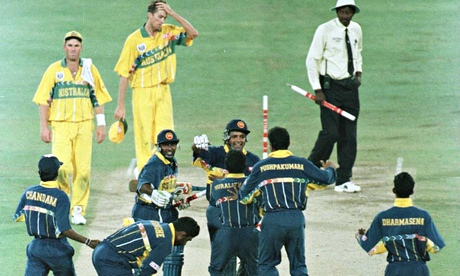
Nineteen years now, to the very day as I type this, since the night Sri Lanka won the World Cup. A generation ago already. There are adult fans around now who think of that tournament in the same way I once did the ones of the ’70s; as something starring legendary players long since retired, whose deeds you can read about in books and watch in sepia-tinted footage. Another era. Monday was only the second empty day in the schedule of the 2015 tournament since the opening match way back on 14 February; it felt like an opportune moment to rewatch the extended highlights of the final. It seemed the best way to keep the real world at bay until the cricket starts again on Wednesday.
Last night was the first silent one in a while. The radio commentary has been on every night these few last weeks, a low burble in the background, competing with the soundtrack of birds, binmen, cars, sirens, and shouts that bookend sleep in the city. Curse whoever it was at ABC radio that decided its coverage should have musical interludes during the handovers, heedless of the fact that on the far side of the world each 20-second blast of The Beatles would be snapping cricket fans awake over and again at 20-minute intervals.
Watching the highlights of the ‘96 final seemed just close enough to work to allow me to convince myself I was doing something constructive. I thought I might find an idea for an article in there somewhere. Something to do with the associate nations most likely, addressing the question of whether one of the four that competed in 2015 could ever conceivably do so well as to one day win the cup, as Sri Lanka did only 14 years after they played their first Test match. No doubt I could have strung it out. But it would have been a fiddle, something written for the sake of filling the space on a page that seemed as empty as the sleep-deprived mind behind the eyes sat staring at it. Each of the competing countries has its own story, and comes to the game in its own way, so comparisons between them aren’t especially useful.
In Sri Lanka, for instance, they’ve been playing first class cricket since 1938, whereas Ireland have not yet concocted a domestic competition deemed worthy of the label. The MCC toured Ceylon, as it was then, in 1927, and Ceylon sent their own team to India five years later. If there is a moral there it is that it was a mistake for the authorities to make the Sri Lankans wait so long for full membership. That even though Sri Lanka only won four matches out of the 26 they played in the first five World Cups. It took New Zealand 40 years to win a Test series. Pakistan, forged in the aftermath of partition, blessed with players who had first class experience in India, drew two and won two of the first five series they played. It’s the International Cricket Council’s job to encourage new nations along the way, and that end is reason enough for them to reject the plan to cut the cup back to 10 teams.
Watching that 1996 final over felt like flicking through the pages of an old photo album. It stirred fond thoughts about the familiar faces. The rows, strops and passions that seemed so pressing then now have all been folded back into the lore of the game. That was the year the UAE turned up and got hit on the head, remember? And Kenya were the hot associate outsiders, and bowled the West Indies out for 93.
There were England, inept and out of their depth, struggling to keep up with the conversation and then making an early departure after being thrashed to all parts by the Sri Lankans, who seemed to be playing a different game altogether, charming everyone with their guile and cunning and composure and elan. Australia, the eldest sibling, so swaggering and sure of themselves, and the South Africans offering up an unconvincing version of the same act, like a younger brother playing copycat but not pulling it off. Old uncle West Indies: so handsome in the days before his belly grew out and he went bald on top, but still able to entertain you with a ribald tale or two. The Kiwis a young cousin who never seems to get any older, always about to come of age without ever quite getting there. Pakistan: wild, erratic, charismatic and cool. And in the middle of it all, formidable mother India, settling her bulk at the head of the table.
Looking at it, the Cricket World Cup began to feel less like global competition, but rather like a quadrennial family reunion. Unsurprising, this, given that seven of the 14 teams have been at every edition since the first in 1975, and that Zimbabwe, South Africa and Bangladesh have appeared in every tournament since they made their debuts in 1983, 1992 and 1999 respectively. Extraordinary that the ICC wants to make the party smaller and more incestuous still. Though the clamour against the decision has grown so loud now you would hope they’d struggle to push ahead with it. The petition is here if you want to sign it.
Still, looking at ’96 reminded me that much as I’m irritated by aspects of cricket, I love the World Cup. In England at least this seems to put me in a minority. It is only the committed who care about it, especially when it’s being played at these hours. Casual sports fans don’t seem to get it. I’ve been asked twice in the last week why the thing is still going on, and who is winning it anyway? There’s little of the hype and hoopla that accompanies the football World Cup, no sense that the tournament has become a national preoccupation. But for devoted fans, it’s great fun. The fact that the cast never changes means you feel you know the teams so well. It’s just another opportunity for the fans, players and press, a dysfunctional bunch, to get together to argue with each other, celebrate the old bonds, and remark how, though we’re all a little older, we’ve hardly changed at all.
• This is an extract taken from the Spin, the Guardian’s weekly cricket email. To subscribe, just visit this page, find ‘The Spin’ and follow the instructions.