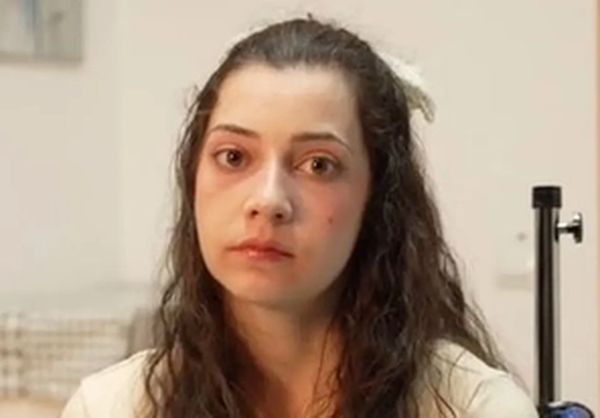
Sara Crowley says she lives in constant fear of losing her sight.
She was diagnosed with diabetic retinopathy almost a decade ago due to complications with her type one diabetes.
The condition became so severe that in 2014 she lost all sight in her right eye.
Thankfully, following a series of laser treatments and operations, she was able to see out of it again.
Ever since she has needed regular check-ups at the University Hospital of Wales in Cardiff.
But the Aberdare resident claims postponements and cancellations have become such a frequent occurrence that she fears going blind altogether.

"Every time you get one of those letters you think 'Could this delay be the reason I lose my sight forever?'" said Sara, 31.
"I wish letters cancelling appointments came with cameras built in so they could see what sort of impact this can have on people.
"It isn’t just a normal letter, it can be the catalyst for a real emotional breakdown if you’re living in fear of losing your sight."
Sara, who claims she lost her job as a result of her deteriorating sight, says the cancellation letters are often ambiguous and fuel her anxiety.
"They often refer to appointments being cancelled due to 'unforeseen circumstances' with no reason behind it," she said.
"There's also the added issue of having to rely on family to take time off to take you to and from those appointments.
"They are often appointments that require drops which means you’re unable to drive yourself home."
This grandmother suffered serious complications after her cataracts operation went wrong
Sara says her diabetic retinopathy is currently under control and she is able to drive and lead a normal life but she fears she is always one cancellation away from her sight deteriorating.
On Tuesday a new waiting times measure was published for ophthalmology patients by the Welsh Government.
The data shows, for the first time, the number of people who are at risk of irreversible sight loss in every health board in Wales.
It revealed that 100,223 R1 (risk one) patients – meaning they are "at risk of irreversible harm or significant patient adverse outcome if patient target date is missed" – are currently waiting for an appointment.
Some 34,500 of these R1 patients have already waited significantly longer than is clinically safe.
However the true numbers waiting at dangerous levels are likely to be even higher due to the way the statistics are presented.
Even if a patient waits longer than the target time they can still be classed as hitting it if they "only" wait less than 25% longer than they should.
Wales is the first UK nation to introduce a measure of this kind for eye care patients alongside the existing referral to treatment target.
RNIB Cymru director Ansley Workman said: “For the very first time we now know that nearly 35,000 patients who are at the highest risk of irreversible sight loss are waiting too long for their appointments.
"Thousands of people in Wales are at real risk of going blind because they aren’t getting the right care and treatment at the right time.
“This is a turning point for every health board in Wales, in fact not a single one has met Welsh Government targets.
“This is an extremely worrying situation for patients. Health boards must work with Welsh Government to prioritise transforming their eye care services and supporting their healthcare professionals to deliver timely care and treatment."

Ms Workman added that health boards cannot continue to let people with treatable conditions languish on waiting lists while they risk losing their sight.
She said: "Whilst we know that there is some good work happening in areas of Wales to address this, the extent of the problem makes it clear that this simply is no longer enough and needs to be more ambitious.
"We need to see detailed plans being put in place by each health board to redesign services so that people receive the right support from the right professional at the right time."
RNIB Cymru estimates that there are 111,000 people living with sight loss in Wales, a figure that is set to double by 2050.
Following the publication of the figures, Health Minister Vaughan Gething has put £10m of support into eye care services in Wales.
This includes £3.3m to enable health boards to make the necessary changes to meet the new guidelines. The additional £7m will go towards a new digital system for eye care in both primary and secondary care services across Wales.
Mr Gething said: "We don’t want people to risk their sight by having to wait a long time for a follow-up appointment after having their initial assessment.
"This is why we are introducing the new performance measure together with £10m funding to transform the way we deliver eye care.
"A year ago today we launched our long-term vision for health and social care, A Healthier Wales, which sets out how we need to transform the way we deliver services to meet the demand of the future.
"These changes, developed with ophthalmologists and the third sector, including RNIB Cymru, are an excellent example of the vision set out in A Healthier Wales.”

However, Plaid Cymru health spokeswoman Helen Mary Jones AM said that "brilliant frontline staff" were being led by poor management and lack of delivery.
Ms Jones said her father lost his sight due to long waiting times 30 years ago.
She added that it was an "abject failure" of the government that the same issue had not been tackled three decades on.
She said: “The funding announced today to transform eye care services in Wales is not a new announcement and simply throwing more money towards health boards will not solve the current problems of lack of delivery.
"In the long-run, this poor performance costs the taxpayer significantly more dealing with the consequence of sight loss, keeping somebody healthy is always cheaper.
“We have brilliant frontline staff being led by poor managers. We need a radical transformation of our NHS in Wales with a focus on delivery and achieving waiting times so that, in this instance, people with treatable conditions do not lose their sight unnecessarily."