Describe your role
I work in the space between business needs and technical implementation, taking business requirements and turning them into specifications and/or systems.
It is easy to disappear down a rabbit hole when developing new IS solutions, and part of my job is to ensure this does not happen.
The business may say, “We need this…”, but this perfectly valid requirement is not connected to the wider environment. It may have already been developed by someone else, or it could be more much more effective if it is synchronised with another product or service.
What’s your career pathway?
I did a degree in oceanography and electronics at Bangor. Oceanography was my real passion and computing was the compromise. We still know less about the ocean than we do about the moon! I was (and still am) committed to the need for environmental change and thought the course could set me on that path.
It may well have done, but my enthusiasm for student life meant my grades suffered and I ended up using my technical expertise to specialize in ground probing radar and sewerage inspections. Around the same time I also started working for the oil industry conducting geophysical explorations of the sea bed. I ended up being stuck on a ship for six weeks at a time. It really was an awful environment, but I took advantage of these trips to teach myself programming, which led me to where I am today.
Since 1993 I’ve been working as a freelance systems architect in the healthcare sector, initially developing a GP database and then going on to work on a wealth of prototyping, pathfinding and production systems at regional and national levels, winning a couple of awards on the way and with a four-year period as an information systems (IS) director in a national health research project.
In 2009 I was asked to join the National Institute for Health Research IS function and I’ve been based in Leeds ever since.
What’s your biggest challenge?
Implementing a strategic system in an environment in which people usually only think about their own domains.
I’m working on a major project at the moment that perfectly illustrates this challenge. It’s called the reference and terminology service (RTS) and it’s attempting to introduce a common source of shared content for research data.
For example, it will act as a terminology index for all researchers and provide a map of clinical services too. At the moment we’ve got multiple organisations using slightly different versions of the same data sets. If we all used the same coding, it would mean the clinical research community can interact more effectively and deliver clinical research more efficiently. But persuading stakeholders to embrace this solution and see the broader impact it could have is a challenging process.
What do you most like about your job?
The variety of work and the people. I genuinely like the people I work with. That’s not always been the case in my career. In some ways that’s why I recently did a health informatics MSc, to get greater credence with the hard core academics I sometimes work with.
What impact would you like to have?
I’d like RTS to change the way we do research by helping us to identify, systematically, where the centres of excellence are and where we should channel funding.
The Clinical Research Network has already made near real-time recording of data possible. The next step is predictive analytics and that’s where RTS can take us.
What are you most proud of?
Definitely my family. I can’t take all the credit of course, but I think they are wonderful!
Tell us a secret
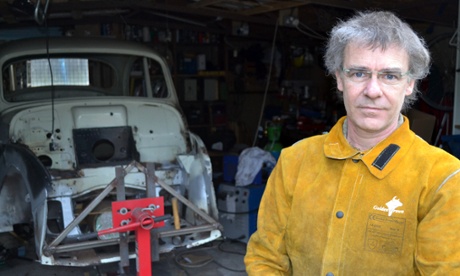
I’m restoring a 1969 Morris Minor and converting it to electric drive.
The car was a present from my dad. We thought it was in great shape, but it turned out to be a complete rust bucket and I’ve spent the last five years rebuilding it. I’ve learned how to weld out of necessity, but it means the project is a little behind schedule.
I’m now in a position to do what I’d intended in 2009, but am approaching a major financial hurdle. Electric motors and batteries cost a lot of money!
Content on this page is paid for and provided by the NIHR Clinical Research Network, sponsor of the Guardian Healthcare Network’s clinical research zone.