We've all seen the warnings about AI data centers. Erin Brockovich is even mapping out locations of the latest booms as they drive up electricity bills, sucking up local water supplies an overwhelming communities all while creating very few jobs in return.
At the same time, tech companies insist the concerns are exaggerated. The industry's main trade group, the Data Center Coalition, calls the facilities "not optional" but "foundational" infrastructure powering everything from telehealth to banking, and has launched a public campaign to counter the perception that data centers are driving up power bills. Developers point out that the industry's water use is a fraction of what agriculture consumes, and companies like Microsoft have pledged community commitments including covering costs so facilities don't raise local electricity prices and replenishing more water than they consume.
So I decided to dig into the evidence — everything from government reports, peer-reviewed estimates, state audits, and national polling.
What I found was more complicated than either side wants to admit. The fears aren't entirely overblown. But neither is the industry's pushback entirely spin.
Claim #1: AI data centers use enormous amounts of electricity
This is probably the strongest claim critics make — and the best documented.
The most authoritative numbers come from a congressionally mandated 2024 report by Lawrence Berkeley National Laboratory, published by the U.S. Department of Energy. It found that data centers consumed about 4.4% of all U.S. electricity in 2023 — roughly 176 terawatt-hours, up from 58 TWh in 2014 — and projected that share could climb to between 6.7% and 12% by 2028, driven largely by AI servers. The same researchers noted that demand had stayed nearly flat for a decade before AI hardware caused it to more than double between 2017 and 2023.
Does that mean AI is raising your power bill? That's murkier. A 2025 Congressional Research Service analysis found that states with the largest data center growth actually saw electricity prices decrease between 2019 and 2025 in many cases — possibly because spreading fixed utility costs across more sales can push rates down. Meanwhile, Brookings notes that residential rates rose about 32% nationally between mid-2020 and mid-2025, a period that also included broad inflation, making it hard to isolate AI's contribution.
What's not in dispute: the public is worried. In a June 2026 Reuters/Ipsos poll of more than 4,500 Americans, 77% of respondents — Republicans, Democrats, and independents in similar shares — said they worry AI will make electricity more expensive.
That's not proof your power bill is rising because of ChatGPT. But it shows AI's energy appetite is now large enough, and growing fast enough, to draw scrutiny from utilities, regulators and voters alike.
Claim #2: AI data centers are draining local water supplies
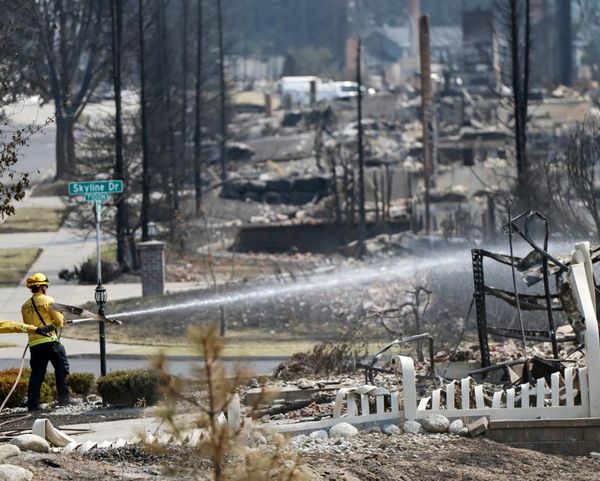
This is where the story gets more nuanced. The same Berkeley Lab report estimated that U.S. data centers directly consumed about 17 billion gallons of water for cooling in 2023, with consumption projected to double or even quadruple by 2028. The MOST Policy Initiative, a nonpartisan science-policy group, puts the 2023 figure at 17.4 billion gallons — about what 160,000 American households use in a year.
But the direct figure is only part of the picture. Berkeley Lab also estimated that data centers consumed an additional 211 billion gallons indirectly in 2023 through the power plants that generate their electricity — roughly twelve times the cooling figure.
The concern sharpens when you look at where facilities are being built. A June 2026 Guardian analysis found that about two-thirds of the 809 data centers planned across the U.S. — 517 facilities — are slated for areas that experienced drought in the past year, according to NOAA drought data. An earlier Bloomberg analysis reached a similar conclusion: more than two-thirds of data centers built since 2022 sit in water-stressed regions.
Individual facilities can have very real local footprints. Google reported that its data center in Council Bluffs, Iowa, consumed about 1 billion gallons in 2024 — the most of any of its sites. In one widely reported case, an AI data center project drew roughly 29 million gallons over 15 months before residents complaining about low water pressure uncovered it.
At the same time, industry defenders make a fair point about scale: nationally, data centers use a small share of water compared with agriculture and power generation, and design matters enormously. Google's air-cooled facility in Pflugerville, Texas, used just 10,000 gallons in a year — about what a single Texas household uses in two months — while its Iowa site used 100,000 times more. Some newer facilities use closed-loop or recycled-water cooling that consumes almost nothing.
In other words: the national numbers are manageable. The local ones, in the wrong place, are not.
Claim #3: AI data centers don't create many jobs
This claim contains more than a grain of truth — but the full picture cuts both ways.
The construction phase is genuinely big: building a hyperscale facility can employ 1,000 to 6,400 workers for a year or more. The permanent operation is genuinely small: Virginia's Joint Legislative Audit and Review Commission found in 2024 that a typical 250,000-square-foot data center employs roughly 50 full-time workers — about half of them contractors — far fewer jobs per acre than competing uses of the same land. Independent analyses put most hyperscale campuses at 50 to 200 permanent staff, regardless of how massive the buildings are.
However, jobs aren't the whole economic story here. A 2026 Brookings analysis of county-level data found that hosting data centers was associated with roughly 2,000 to 4,000 additional jobs in a typical county after six years once indirect and induced effects are counted, and noted that a single hyperscale campus can become one of a county's largest taxpayers. The industry's trade group claims data centers contributed $162.7 billion in local, state, and federal taxes in 2023, though that figure comes from the industry itself.
Brookings also flagged a troubling wrinkle: state subsidies are largest, relative to investment, for exactly the facility types that create the fewest jobs.
So my honest verdict is that if a community is promised "thousands of jobs," that's construction-phase math. The permanent payroll will be modest. The tax revenue, however, can be substantial, which is why the real question is what a community negotiates in return.
Claim #4: Communities are pushing back against new AI facilities
This one is more than a claim, it's something we see in news reports nearly every day. Public resistance is no longer limited to environmental groups. It's now measurable in polls, statehouses and canceled projects. The Stratos Project, which is said to be the size of 20,000 Walmarts, caused an uproar in a Utah community, yet was just recently approved.
The June 2026 Reuters/Ipsos poll found that 57% of Americans, including two-thirds of Democrats and half of Republicans, would oppose a data center in their own community. Just 14% said they'd be fine with one nearby, and only 33% agreed that the rapid pace of construction is mainly a good thing.
The opposition is winning real fights. Data Center Watch, a tracking project, found that opponents blocked or delayed at least 75 projects worth about $130 billion in just the first quarter of 2026, roughly matching the total for all of 2025, while the number of active opposition groups more than doubled to 833 across 49 states.
Of course, lawmakers are responding. More than 300 data-center bills were introduced in statehouses in the first six weeks of 2026 alone, moratorium bills appeared in at least a dozen states, and as of spring 2026, 69 local jurisdictions had active construction moratoriums. Senator Bernie Sanders and Representative Alexandria Ocasio-Cortez have even introduced a federal moratorium bill.
But the politics are genuinely local, not uniformly hostile. When Maine's governor vetoed a statewide moratorium in April 2026, the case in point was a data center planned for a shuttered paper mill site, in a town of fewer than 5,000 people that had lost hundreds of jobs when the mill closed. At the local approval hearing, not a single resident spoke against it.
Claim #5: Every AI prompt is wasting huge amounts of water
This one is someone misleading. You've probably seen viral posts claiming that every ChatGPT query consumes a bottle of water. The underlying concern is that yes, AI systems do consume water through cooling and electricity generation. But the per-prompt numbers floating around vary by a factor of more than a thousand, and the gap is mostly about what's being counted.
The bottle-of-water claim traces back to a 2023 academic estimate by researchers at UC Riverside and colleagues, who calculated that 20 to 50 ChatGPT queries consumed about 500 ml of water, including indirect water from electricity generation, and based on older, less efficient models.
The companies' own numbers are dramatically lower. In 2025, OpenAI's Sam Altman stated that an average ChatGPT query uses about 0.34 watt-hours of electricity and roughly 0.3 ml of water, a fifteenth of a teaspoon. Google disclosed a similar figure of 0.26 ml per Gemini query. Critics rightly note these corporate figures count only on-site cooling, not the water embedded in electricity generation or chip manufacturing, and that complex "reasoning" queries can use 50 to 100 times more energy than a simple one.
The honest answer is that a single query uses somewhere between a fraction of a milliliter and a couple of tablespoons, depending on the model, the data center's cooling design, its location and whether you count indirect water.
So are AI data centers really draining towns dry?
After going through the evidence, I don't think the answer is a simple yes or no.
The strongest concerns are real and well documented. Federal researchers project data centers could consume up to 12% of U.S. electricity by 2028. Direct water use could quadruple over the same period. And roughly two-thirds of planned facilities are headed for places that have recently experienced drought, which is precisely where the "draining towns dry" discussions stem from.
But the most dramatic claims circulating online routinely strip out context. Data centers use a small fraction of national water compared with agriculture. A facility's footprint can vary by a factor of 100,000 depending on its cooling design. The per-prompt water statistics are among the least reliable numbers in the whole debate.
What surprised me most was just how much the answer depends on geography, design and negotiation; important context that the news and social media doensn't always capture.
So what do you think? Should AI data centers be more transparent with their numbers? Let me know your thoughts in the comments.
Follow Amanda Caswell and stay ahead of the AI curve