When the light faded, John "Stinker" Clarke's limbs grew tired and his body cold.
The Port Stephens fishing identity was rescued on June 24 after spending five hours in the chilling water off Fingal Island.
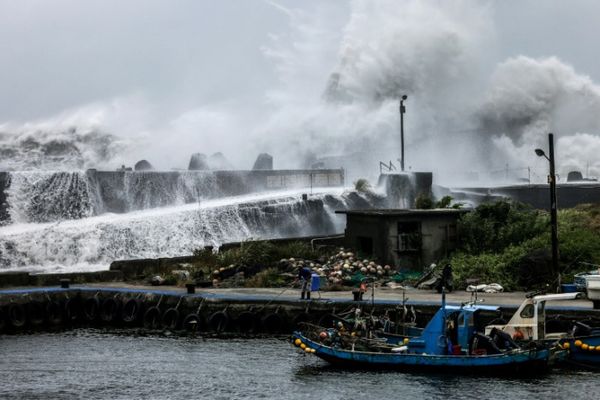
His boat had capsized in wild seas, leaving him clinging to debris and life far from shore.
The famous fisher was on Tuesday reunited with his rescuers over tea and cake at the Westpac Rescue Helicopter's Lake Macquarie headquarters.
Mr Clarke said during his time in the water, he knew he only had two chances of survival: the rescue chopper and his old friend Clint Brown.
NSW Police Sergeant Clint Brown had known Mr Clarke for decades, since the latter taught him at school and served as his rugby coach.

In a twist of fate, it was Sergeant Brown who hauled in the fading fisherman from the water last week after he was spotted by the rescue helicopter.
"I didn't think he was alive when I first saw him," Sergeant Brown said.
"He was not in a good way, he was pale white and covered in seaweed and tangled in debris.
"He was in a perilous position close to the rocks, but we knew we had the chopper overhead watching us as we pulled him on board."
Sergeant Brown knew rescuers had to get Mr Clarke to shore as quickly as possible.
"He probably only had another 10 to 15 minutes," Sergeant Brown said.
"He didn't recognise me and was pretty incoherent, he was just holding on. All he could say was how cold he was.
"We knew we had to just hook it into shore."
Police said the boat headed back to Nelson Bay, with another vessel moving ahead of it to break the wild seas.
Mr Clarke said he doesn't fully recollect the moment they came to his rescue.
"I just remember seeing the light, the good light, when they found me," he said.
"I just remember feeling myself being pulled aboard and then later that feeling of warmth coming back over my body as I was being treated."
Stinker said although he was in the water for close to five hours, he didn't feel scared or panicked.
Despite keeping a level head, he knew he was "not in a good spot".
"I was calm and knew I had to just do what little I could and hope someone was coming to find me," he said.
"Once it got dark, I knew I only had two chances of surviving, and that was the chopper and Clint Brown.
"I hadn't given up, but I was close to gone."
Stinker entered the water around 3.30pm.
After an extensive search, he was finally spotted by Dr Hannah Hall from aboard the Westpac helicopter around 8pm.
He was clinging to an upturned bucket and a pair of rowing oars.
Rescuers have credited Mr Clarke's life jacket and notifying his loved ones of his plans before setting out with saving his life.
"I saw the light coming up the coast before I heard it," Mr Clarke said.
"When it had gotten dark, I felt something bump up against me and it was the oar, so I put two arms over it before I also found the second as well as the bucket.
"They missed me on the first pass, but they did a U-ey and that is when they found me."
Dr Hall said that despite the rest of the crew wearing high-tech night goggles, it was her and a trusty spotlight torch that first spotted a floating esky before locking onto the man they were all looking for.
"The conditions were very difficult with lots of wind and swell creating lots of whitecaps on the water," she said.
"I saw the esky and it was actually the bucket that I saw first.
"I could see that he was still kicking and moving.
"We were able to keep the spot on him so the police boat could pick him up.
Dr Hall said information provided by Mr Clarke's loved ones had been vital "because we knew where to begin searching".
"We now know his secret fishing spot," she joked.
Dr Hall said the helicopter was landed at a nearby football field before she was rushed to begin treating Mr Clarke dockside.
"He had severe hypothermia and his blood sugar was extremely low, but we were able to get him stable and ready to rush to the John Hunter."
Mr Clarke was loaded into a pre-warmed ambulance and transported to the John Hunter.
He spent less than 24 hours there after his ordeal.
Paramedic Liam Beal said the first step had been getting Mr Clarke warm and addressing his blood sugar.
"He was pretty cold to say the least," he said.
"He was in pretty bad shape but he was in good spirits."
Fellow paramedic Ryan Hockey said Mr Clarke's temperature had been dangerously low.
"A normal range is 36-37 degrees and Stinker was down to 25, which we don't really see conducive to life for very long," he said.
Mr Beal said they could only watch as the charismatic fisher came back from the brink as his levels stabilised.
"We thought he was chatty at the start but then he came back to life telling us about the fish he had caught before all the trouble," Mr Beal said.
Mr Clarke said his survival that night was dependent on a chain of events that went in his favour.
"I knew I was in trouble but thankfully my wife raised the alarm when I didn't come home and they knew where my usual spots were to start looking," he said.
"I am so grateful to everyone, I knew I just had to do what I could to improve the situation, and hopefully that just gave me a little more time for them to find me because there was no plan B."