
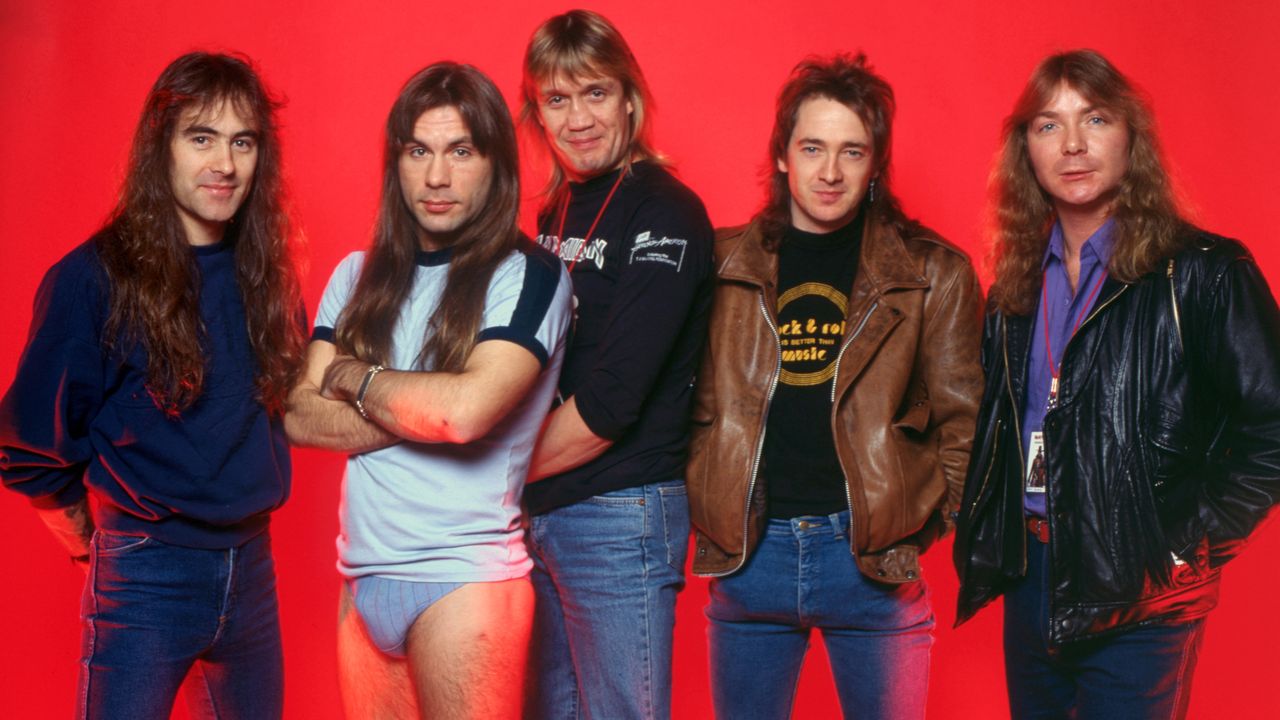
On 5 July 1985, when Iron Maiden walked off stage at Irvine Meadows Amphitheatre in California, singer Bruce Dickinson wanted to quit the band – and the music business – for good.
Irvine Meadows was the final stop on Maiden’s aptly named World Slavery tour, the 189th gig in a 13-month marathon. This had been a test of physical and psychological endurance that took a heavy toll on every member of the band – but Dickinson most of all.
“I genuinely thought I should just pack it all in completely,” the singer revealed in a 2025 interview with Classic Rock. “Not go solo. Not do anything. Just stop being part of music, because it’s just not worth it.”
He went on to describe the effects of the band’s gruelling workload during that decade.
“All through the ’80s we were working so hard, like eight shows in ten days over the course of eight months,” he said. “That’s not great if you've got a kind of high-performance voice. It can't perform at that level with that amount of attrition.
“And then at the end of one year of that, you get to do it all over again. And this goes on for five years…
“You're under constant stress every night. You’re suffering from a lack of sleep and self-induced shit, whether it's chasing after women, whether it's drugs, whether it's alcohol. And every day you just get up and do it all again.
“You're a bunch of lads together against the world. And nobody's going to help you if you fall down, so you're just going to crack on, crack on, crack on…”
In that hectic period, Dickinson did manage to hang in there for a few years. He didn’t leave the band until 1993. But when it came to writing for the 1986 album Somewhere In Time, his mind was elsewhere.
In October 1986, in the week that Somewhere In Time was released, Dickinson admitted to Sounds magazine: “I haven’t written anything on the new album. I started to write ‘very heavy metal’ things, but I ended up writing for bagpipes, folk things like Jethro Tull. Oh well – bang go my royalties!”
He later reflected to Classic Rock: “There was none of me on that record. I was just AWOL mentally.”
Back in 1986, Maiden’s bassist Steve Harris also spoke to Sounds and stated unequivocally that he would never consider quitting the band.
“I can look you in the eye and say that,” Harris said.
He said of his role as band leader: “I used to get pissed off about having to rehearse new people all the time. But then, if a change is for the better then of course it’s worth the trouble.
“I mean, some people in the band at certain times just weren’t into it. Instead of being in, say, Budapest, they’d rather be in London down the pub somewhere.
“It's all very fine and I’m into that as well, but we’re here to play on stage and we should go out and enjoy it.”
Without Dickinson’s involvement, all of the songwriting for Somewhere In Time was split between Harris and guitarist Adrian Smith, save for one song, Deja-Vu, co-written by Harris and the band’s other guitarist Dave Murray.
But in the Sounds interview in 1986, Dickinson also spoke with great pride about two Maiden classics he had written alone – Revelations, from the 1983 album Piece Of Mind, and the title track from 1984’s Powerslave.
“Most of the stuff on Powerslave was a follow-on from Revelations,” he said, “and I did a lot of research for that. The idea of Revelations was to tie together lots of imagery from different religious systems.
“The stuff I dug out on that song, about Egypt and the Osiris cult especially, I thought, ‘Well, this is weird, it’s like a dead ringer for Christ – the death and resurrection bit.’ And I went back and sussed out that virtually every religion has exactly the same thing going through it.”
Dickinson did, however, admit that when writing lyrics he sometimes tried to be too clever for his own good.
“I think there comes a point where you can disappear up your own bum a bit by coming up with deep and hidden meanings to everything,” he laughed. “You end up doing, like, retrospective hidden meanings – ‘Oh, wow, look at that! I didn’t realise it had so many deep and hidden meanings – even though I wrote it!”