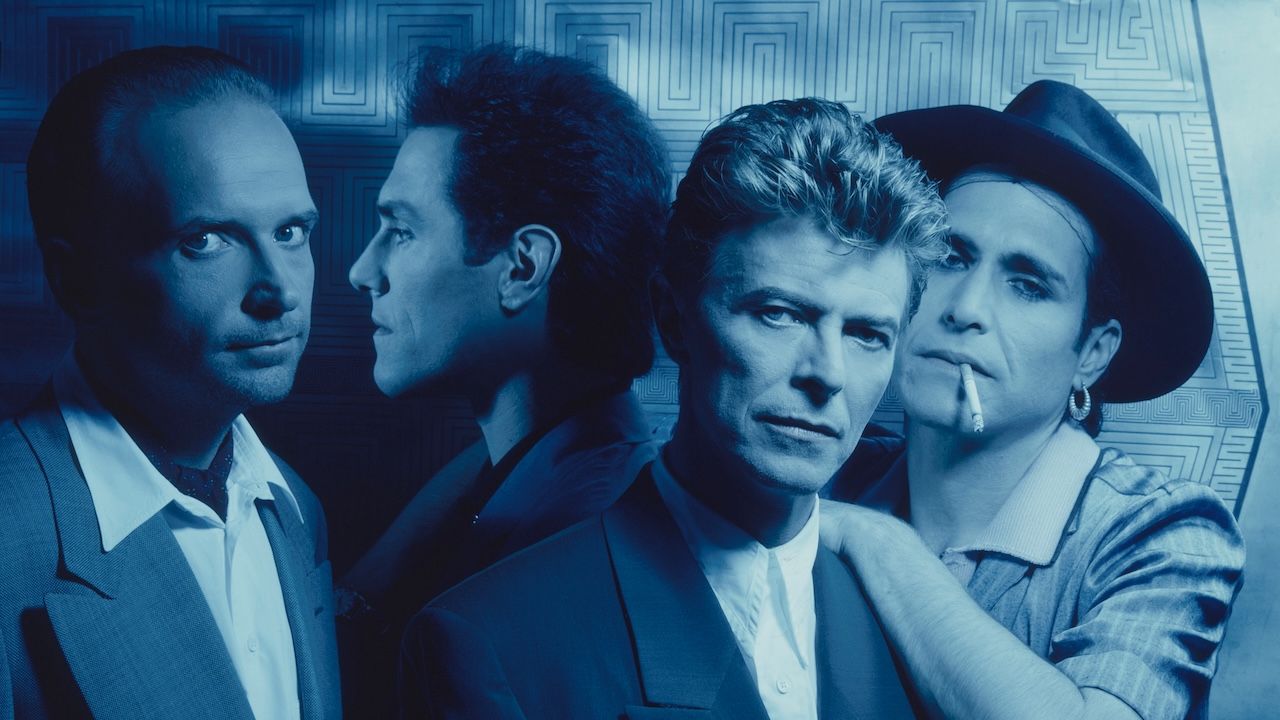
In the mid '80s, by his own admission, David Bowie hit a creative wall. Having revitalised his career with assistance from Chic's Nile Rodgers on 1983's ten-million-selling Let's Dance, the chameleonic English artist seemed uninterested, or unwilling, in pushing forward to break new ground, and the listless Tonight (1984) and Never Let Me Down (1987) were greeted with either critical derision or - worse - apathy. In his own words, Bowie had "lost his vision" and needed a creative re-boot.
"I could quite easily have gone reclusive and just worked on visual stuff, paint and sculpt and all that," he acknowledged in a career-spanning interview with Uncut magazine in 1999. "I had made a lot of money: I thought, well, I could just bugger off and do my Gauguin in Tahiti bit now. But then what do you do – re-emerge at 60 somewhere?"
The catalyst for Bowie's next chapter was a new musical foil, New York-born guitarist Reeves Gabrels. When the pair first met in 1987, Bowie was unaware that Gabrels was a musician: to Bowie, the guitarist was simply the husband of his publicist, Sara Terry, who handled media relations on his 1987 Glass Spider world tour. Upon the completion of the tour, Bowie asked Terry if there was anything he could do for her in recognition of her work on his behalf: in response, she passed on a tape of her husband's music, which led Bowie to invite the guitarist to write with him.
According to Gabrels, Bowie told him, "Basically, I need somebody that can do a combination of Beck, Hendrix, Belew and Fripp, with a little Stevie Ray Vaughan and Albert King thrown in. Then, when I’m not singing, you take the ball and do something with it, and when you hand the ball back to me, it might not even be the same ball."
"He was done with Let's Dance and that sort of music," Gabrels recalled in an interview with music writer David Buckley, author of the Bowie biography Strange Fascination. "I said to him, If you have creative control over your albums, then you're the only one you have to answer to. They have to put it out. You just have to be ready to deal with the criticism."
The duo's new songs took influences from late '60s rock (Cream, Jimi Hendrix, The Jeff Beck Group), '70s punk and '80s noise-roock (Sonic Youth, Glenn Branca). When the pair discussed who they might approach to play drums and bass on the songs, Terry Bozzio (Frank Zappa, Missing Persons) and Percy Jones (Brand X) were considered. But one day Gabrels came home to find a message from Bowie on his answerphone, stating, "I've found our rhythm section. Go and listen to Lust For Life."
Bowie had first met Tony and Hunt Sales when producing Iggy Pop's second solo album in Berlin in 1977. And when he bumped into Tony Sales at a Glass Spider tour wrap party in a Los Angeles club a decade later, he invited the bassist and his drummer brother to be part of his new band.
"It was just inspired guesswork that there'd be chemistry between these four people," Bowie told Q magazine. "I just knew that I enjoyed working with each and every one of them, and that was the priority for me, having had some fairly unenjoyable experiences in the '80s working with others."
Ironically, playing with the Sales brothers wasn't initially a very enjoyable experience for Reeves Gabrels.
"Their attitude," Gabrels told Q, "was kind of, He's David Bowie, we're the Sales brothers, who the fuck are you?"
It was only after Gabrels exploded with anger at the brothers in the studio, after being given one too many direction as to how he should play, that mutual respect was forged. Taking their band name from the first song they wrote together, Tin Machine was born.
The band's aggressively noisy, uncompromising self-titled album, released on May 22, 1989, was not met with universal acclaim, it's fair to say. Q magazine would list it among Fifty Albums That Should Have Never Been Made, while UK weekly Melody Maker included it in a feature on The 20 Worst Albums Of All Time. "
Nonetheless, Tin Machine reached number. three on the UK albums chart - eventually selling 100,000 copies - and number 28 on the Billboard 200. Had it been released in the early '90s, when 'alternative' rock was in vogue, it might have fared even better. Revisited in 2026, there's a thrilling swagger and intensity to the likes of Heaven's In Here, and the quartet's bracing cover of John Lennon's Working Class Hero.
Bowie seemed to enjoy the confusion that the album generated, and committed fully to the band, who released a second album, Tin Machine II, in September 1991. Reviews this time around were even harsher. "They are an uneasy listening band who come across with chips on their shoulders," wrote the Daily Mail. "It's as if the '80s never happened as they grope around in punk and metal." Promotion for that record included an appearance on Dutch music TV show Countdown, which can't have been a hugely enjoyable experience for presenter Wessel van Diepen.
"The first Tin Machine album wasn't a commercial success," he pointed out at one point. "Were you disappointed by that?"
"Bitterly," Bowie responded. "It hurt us so much that we never made another album."
Ouch.
Tin Machine broke up in 1992, due to what Bowie called "personal problems within the band", which included addiction issues. Seven years on, in 1999, Bowie discussed their experiences during a wide-ranging interview with UK music magazine Uncut, spanning his 30-year career.
"I look back on the Tin Machine years with great fondness," Bowie told writer Chris Roberts. "They charged me up. I can’t tell you how much... "After Let’s Dance, I succumbed, tried to make things more accessible, took away the very strength of what I do. Reeves shook me out of my doldrums, pointed me at some kind of light, said, ‘Be adventurous again.’ I’ve been finding my voice, and a certain authority, ever since."
When Roberts asked if the band was "a kick up the backside" for Bowie, he replied, "It was."
"I had to kickstart my engine again in music," he admitted.
"The reaction to Tin Machine, I used to laugh about it," Reeves Gabrels told David Buckley, as recorded in Mojo magazine in 2015. "I can go pretty far out, and I do like avant-garde music, but very often David was the one who was trying to blow things apart, and I would hold it together. I don't think he was trying to loser himself so much as he was just trying to have some fun. Who says you can't be in a band if you're already famous in your own right?"
"The whole being-in-a-band experience was good for me," Bowie told Uncut. "I know it looked… it really is a strange thing to think about now, that I actually did that to myself… but it was very useful."
"I found out that, around 1988, David spoke to a corporate image consultant to find out how to restart his image," Gabrels told Mojo. "One of the things they had supposedly said was he needed to do something which was such a departure it would destroy everything that went before. It would reset his career. That made me feel a little weird and bad... if its true."