
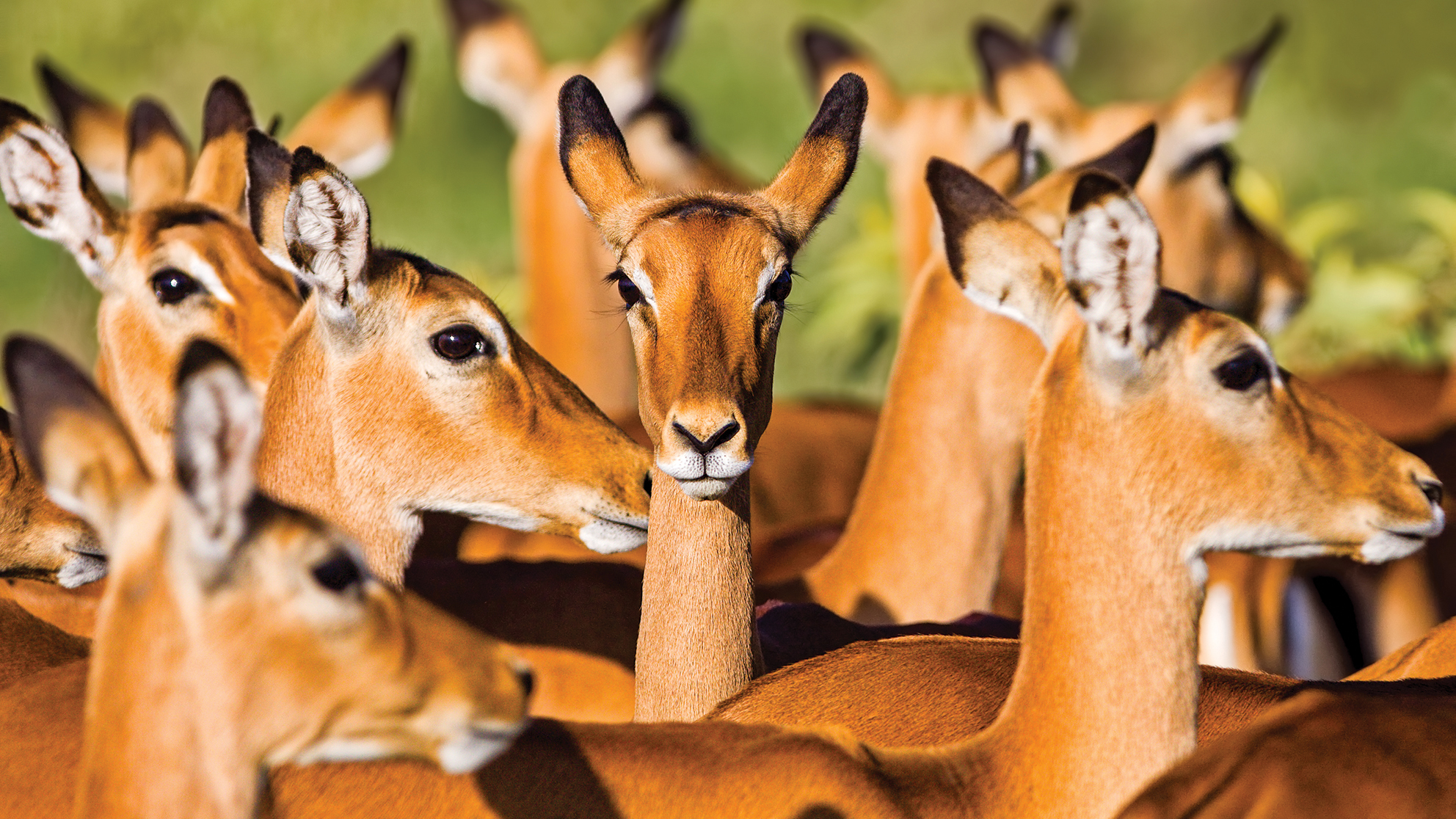
This wildlife photo demonstrates how preparation, observation, and extensive knowledge of the subject are key when it comes to capturing the perfect moment.
Titled Center of Attraction, photographer Ujjwal Mukherjee shot the scene with a Canon EOS 50D and a EF 300mm F/2.8L IS USM lens (at 1/4000sec, f/3.5, ISO400).
1. The right moment
Ujjwal’s initial goal was to capture the extraordinary, but wildlife photographers can often wait for hours for that perfect moment. “Good wildlife shots are the ones that have some elements in them that stand out from the more familiar and common scenes,” Ujjwal says. “I was happy I had pressed the shutter at just the right time, otherwise this image would have lost its uniqueness.”
2. Crucial focus
The focal point is clearly in the centre of the shot, which is important for creating some kind of balance for the eye in this busy environment. Sharp and out-of-focus elements make the impala in the middle stand out, directing the viewer’s gaze towards it. To achieve this result, Ujjwal adjusted the camera settings. “I used a longer focal-length lens and a larger aperture and, hence, I could keep the background blurry and soft mostly by using the in-camera settings,” he explains.
3. Decisive composition
The standout element of the shot is the impala in the centre, even though there are many other subjects in the frame. “This image is an example of where a considered composition of breaking the ‘Rule of Thirds’ has produced a better image,” Ujjwal says. “The Impala making eye contact with the viewer while the rest of the herd is evenly distributed left and right breaks the pattern and gives the image strength.”
4. Defined crop
Without Ujjwal’s decision to tightly crop the original shot, the image as a whole would lose its effect. The repetitive shapes are essential and it is through these that a connection is made between the viewer and the eye contact from the impala. “It was important not to keep much empty background space behind the impalas,” he says. “That would have gone against my visual strategy and affected the overall balance of the composition.”
“My inspiration for creating photographs always comes from the observation of the wonders of nature”
- "On this shoot, the rain and the strong wind were my biggest enemies”
- Photographer tells story of getting up close and personal with a python
- “I chose the ND filter to avoid overexposure and control the powerful glow"
- Urban street photographer reveals his candid capture secrets
- "I don't use any external flash, this image is shot purely with natural light"
- Photographer tells story of his amazing shot of wallabies fighting
- The 4 photographic decisions that take this motorsport shot to the next level













