
It started with the realization that I couldn’t focus for more than a few minutes without reaching for my phone. Not for anything urgent, but more for a fear of missing out. Whether it was for breaking news, a quick scroll, a text notification or anything else, it was all just a hit of dopamine.
I'm not alone. According to a report from the Washington Post, 66% of Americans use their phone within 10 minutes of waking up. The same report also suggests that if you pick up your phone more than 110 times a day, you may have a problem.
While I'm not counting, I knew I needed a reset. So, I asked ChatGPT to do something that I didn’t think would actually work: “Create a 48-hour dopamine detox plan to help me reset my focus.”
Had I known it wasn't going to give me a flip phone ultimatum, I would have done this a lot sooner. Instead of telling me to stay off social media forever, it created a structured path through the discomfort of "needing to know" or "being bored." I followed it exactly for a weekend. Here is the breakdown.
The 'Scaffold' prompt
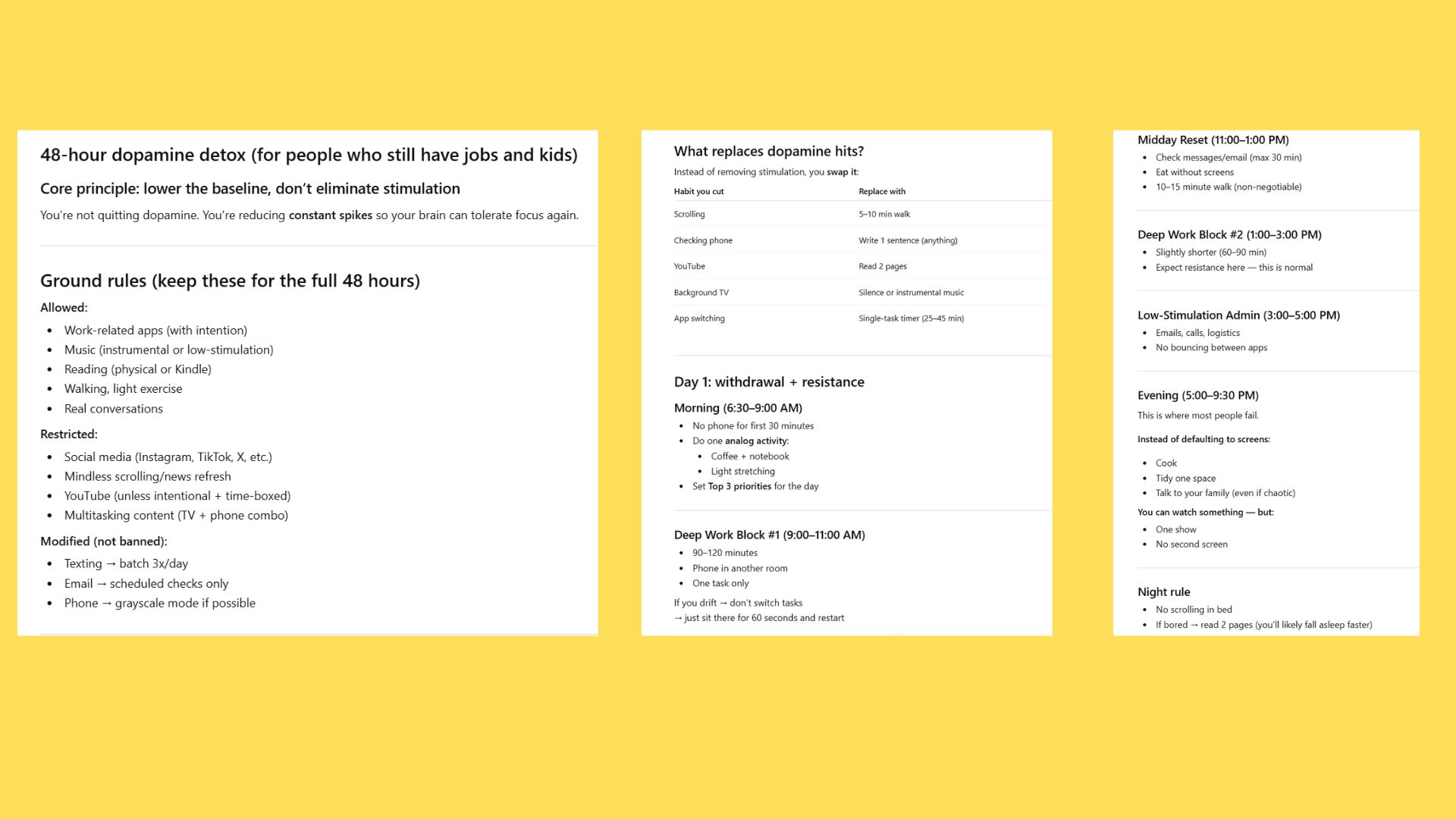
To get a plan that actually worked, I didn't just ask for a "detox." I used a "scaffold prompt" to ensure the AI understood my professional constraints.
The prompt: "Create a 48-hour dopamine detox plan for a professional who cannot go 'dark' but needs to reset their focus. Prioritize 'low-dopamine' replacements for digital habits and include a schedule for 'Deep Work' blocks. Avoid extreme or 'monk-mode' suggestions; focus on realistic cognitive recovery."
What I got back were rules to lower the stimulation baseline. The AI’s plan focused on one core idea: Stop chasing the spike. To reset my attention span, I had to stop the constant flood of low-effort rewards.
ChatGPT's "No-Go" list for me:
- Social media: No "just checking" TikTok, IG or X.
- Background noise: No "comfort" music. This was insanely difficult at first because I always need music, TV a podcast or something in the background.
- The "check" reflex: Turning off all non-human notifications (apps, news alerts).
It then gave me a list of replacements. It suggested 60-minute single-tasking blocks and instead of scrolling during downtime, I needed to make my breaks more intentional. I filled them with low-stim activities such as walking without headphones and reading physical books.
I did not think I was going to make it. The first few hours were a wake-up call. I didn’t realize how "wired" I was until I tried to stop. Every time I hit a moment of friction — a slow paragraph or a pause between tasks — my brain screamed: “Check something.”
I had to actively catch myself dozens of times. It was a constant, itchy reflex. It revealed the uncomfortable truth: Most of my day was driven by habit, not intention.
The 35-hour mark
Once the 24-hour mark hit and I physically called friends and family to let them know I hadn't fallen off the planet, I felt a sense of relief. I wasn't feeling as anxious, but the urge to grab my phone didn't disappear. It did, however, get quieter. I had replaced the "noise" with cognitive endurance.
Another thing to note is that I wasn't suddenly a productivity superhero, but the "itch" to switch tabs every three minutes vanished. I could sit with a difficult task longer because there was no competing high-speed stimulation to run to. I was more present with everything. I enjoyed getting outside more, crafting and trying a few new recipes.
The 3 biggest shifts

- Increased attention: Without the distraction loop, the "resistance" to starting a new task dropped significantly. I was far more present, whether it was spending time with my kids or working on a personal project.
- Fragmented no more: My anxiety and scattered thoughts felt like a single beam rather than a fractured light. My focus was wildly better once I let go.
- Comfort in silence: By hour 40, I enjoyed the silence and felt like I was thinking clearer and feeling far less burned out.
Bottom line
At a time when traveling is expensive, this 48-hour project felt like a vacation. I felt like I had "gotten away" because I truly reset and regained focus. I hadn't realized how desperately I need this powerful system reboot.
And while a two day detox won't change a person's brain chemistry forever, it did offer a calmness that I hadn't felt for a while. My focus is better and I'm less tempted to pick up my phone because I enjoy things so much more without it.
The irony of using AI to guide the process is not lost on me. ChatGPT removed the "decision fatigue" of the detox itself — I didn't have to negotiate with myself; I just followed the plan it set for me.
It showed me exactly how much of my focus I was giving away for free and more importantly, how to take it back. If you try this prompt let me know how in the comments how you make out. I recommend trying it on a weekend so you can fully recharge.