
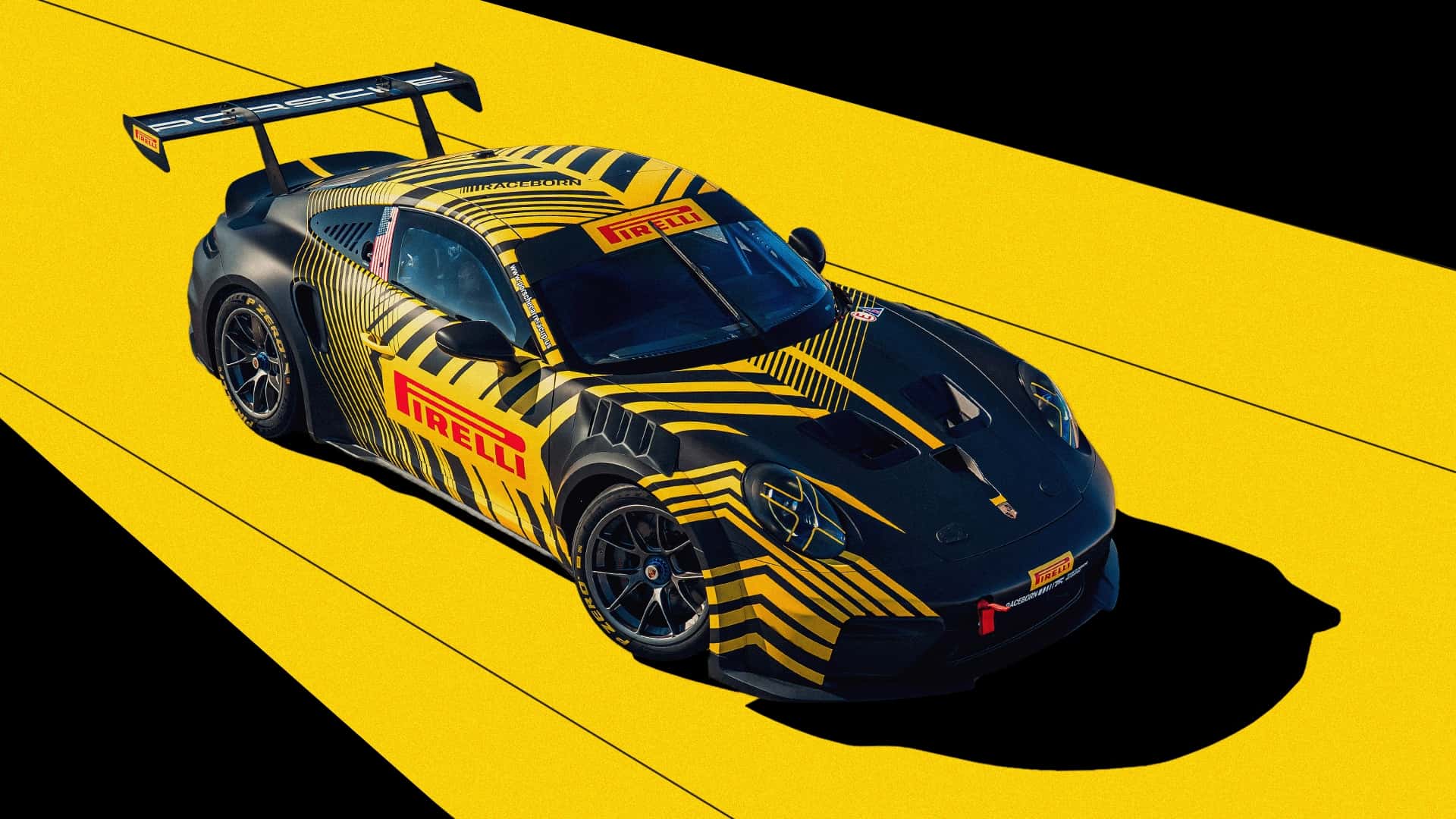
Don’t call it a GT3 Cup.
While the newest 911 for a single-make race series may now be known simply as the 911 Cup, the idea behind it hasn’t changed. This is still a 911 GT3 at its core, just one honed for racing.
That means the heart is still a 4.0-liter flat-six, now with 520 ps—Porsche measures all of its race cars’ power in PS—an increase of 10 over the last car. That’s linked to a six-speed sequential gearbox—no PDK here—and puts power to the rear wheels through Pirelli slicks.

Being a sequential box means it needs a clutch to set off. But now there’s an auto-restart after a stall, to help keep people from sitting still out there too long. There’s even an engine map to let it run on pump gas.
It has refinements everywhere you look, including some changes that you will never notice, but teams certainly will. While this is still a road car dressed up as a race car, it falls much lower on the price ladder than something like a full-on GT3 racer. For the 2026 car, Porsche made some moves to reduce costs for teams on the parts that are damaged the most.
The splitter is now a three-piece unit, which lets teams replace the piece that’s broken, rather than an entire car-width piece. Splitting it into three pieces also reduces the shipping costs. The daytime running lights move from the bumper to the headlights, which are borrowed from the road car. Now, there’s less of a chance of a DRL breaking.
The rear-wing endplates, another frequently broken piece, are plastic rather than carbon fiber. It also runs the same wheels as the 992.1, so if you buy a new car, you can keep your old wheels. Who says Porsche isn’t thinking about costs?
My first run in the new Cup came at the Porsche Experience Center outside of Los Angeles. This is a tight course, more of a handling circuit than a full race track, but still a great place to get familiar with the new car. Runs were also lead/follow, with pro driver and Porsche ambassador Patrick Long leading in a GT3 RS on Pirelli’s new Trofeo RS.
Pat is a seasoned pro and the winner of everything that matters in sports car racing. I’m a middle-aged man who mostly bounces his fingers off a keyboard and occasionally gets in a little track time. I’m not worried about being held up.
My first laps in the Cup are all about getting familiar. This is a track I never saw until today, with some sighting sessions in a 2026 GT3, so I leave the settings alone and concentrate on learning.
The new Cup has 11 different settings for traction control and ABS, each with different thresholds for how much slip they’ll allow from the wheels. There is no stability control, so the traction is only there to reduce wheel spin, not to keep you out of looping it. The TC is also a true motorsport system, not one you’d see on the street, so instead of shutting you down with brakes, it uses the ECU to cut power, creating a sort of juttering shotgun when it engages.
Thing is, this car probably doesn’t even need the TC; it’s such a sweetheart. That’s also likely thanks to the tires.
The new Pirelli slick is excellent for this car, mainly because it has to be. Single-make racing like this attracts all sorts of people, from kids climbing the ladder of sports car racing to enthusiasts who have no dreams of going pro, but still want to tell friends what they raced last weekend.
Thing is, this car probably doesn’t even need the TC; it’s such a sweetheart.
This slick can last the full race distance, and on a day that constantly got hotter, it didn’t lose pace or grip at an unacceptable rate. It also feels very much like a high-end street tire, forgiving and progressive in breakaway, not a sudden snap. Though much of that has to do with the setup of the Cup as well.
With wider rubber, less weight, and a different aero program, the Cup dives to an apex with purpose while the road car requires a lot of patience. It can hold a tighter line without any push and get back to power sooner. The result is a change in how you drive the car.
It’s no longer a waiting game for the front end to take a set, which continually brought the Cup car closer to the tail of Pat Long’s GT3 RS. After the first session, Pat and I spoke about the car a bit and what to expect.
First, in addition to the shift lights on the dash, there’s another set of vertical lights on the side that were lighting up blue. In some cars, those are brake lock-up lights; in others, they’re for wheel slip or traction control. In this car, depending on the color, they’re both. Blue was for TC interaction.
What I most wanted to find out was the car’s behavior in a high-speed corner, and what to expect. A 911 traditionally has all that weight dangling beyond the rear axle. Of course, the pendulum effect has been mitigated over the years thanks to developments with the chassis and suspension, but it’s not 100 percent gone.
Something interesting Pat said is that a lot of the time, the car is still driven nearly exclusively on the throttle. You take a first crack at the wheel, get back to power, then the wheel returns to zero degrees of lock, and you get through the turn like that. Of course, I wasn’t yet going fast enough for that to happen.
Over three sessions at the PEC, I continually turned down the TC when I started to feel it hold me back on corner exit or when I saw those lights on for a prolonged amount of time, and each degree lower came with a higher threshold for slip, but didn’t make power down into a risky or scary moment. I also got quite a bit quicker.
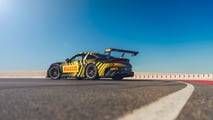
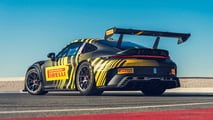
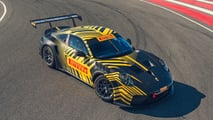


In the faster corners at the track, and there are two that are high-speed in third, I started to see what Pat was talking about. I began to trust the car more, to give it a bigger initial input and then get right back to throttle, and it floated eagerly around the corner on power. And the times where it did get a little loose mid-corner weren’t jarring or scary. Just a quick catch of correction fixed the slide and kept it going. I could’ve lapped all day.
I kept coming back to just how friendly this car was and how it so perfectly served a dual purpose. For aspiring pros who want to climb the ladder to a GT3 car, this is the ideal training ground. There’s more power than a GT4 Clubsport, costs are somewhat economical when compared to pro racing, and the platform is run in every pro series.
For an amateur or enthusiast who wants to get out there and run single-make racing, the 911 Cup is a perfect platform. Parts are plentiful, support is everywhere, and even if you aren’t on the edge, this car is engaging and teaching you something every lap.
There are now about 1,000 911 Cup cars out there, and that’s just from the 992 generation. There’s a reason why it’s so popular, and the latest Cup will continue the trend.