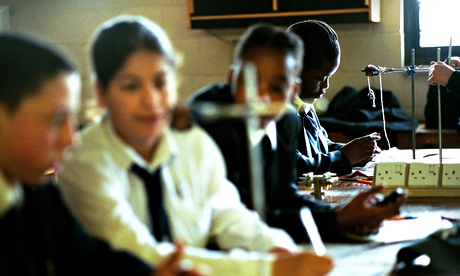
Today thousands of parents seeking a secondary-school place for their children will be having a final mini-panic. The fiercely competitive application process for admissions is at an end, along with the seemingly endless school open-day trips and the scrutiny of Ofsted reports and league tables. They’ll have to wait until March to find out whether their child is to be offered a place at their first preference.
Among them will be middle-class liberal-progressive types who could afford private education but choose to send their kids to state schools as a sign of solidarity with those of less privileged backgrounds. In their eyes, they’re doing their bit to address Britain’s huge and growing inequality gap. But what impact does this really have on equality? Do children from rich, middling and poor backgrounds all enjoy similar life chances by attending the same state school?
David and Samantha Cameron’s public embracing of the state school system for their 10-year-old only serves to underline the common myth. The couple’s favoured list of state schools has so far included “outstanding” and “exceptional” Church of England girls’ state schools in some of the wealthiest parts of London. It’s unlikely that their kids will end up at a standard mixed-sex comp – or one of the many poor schools that have failed to improve even after formal intervention, as the National Audit Commission revealed today.
At the redbrick university where I teach, as in universities up and down the country, students who’ve been educated in tougher inner-city school environments are in a small minority.
But while it’s easy to take a pop at aristocrats who pass privilege through the generations, the very wealthy aren’t the only ones who enjoy advantages. How many families on an income of £47,000 a year – or whatever the latest definition of middle-classness is these days – produce kids who grow up to become cleaners or lorry drivers? I’ve never met any. Downward mobility is a rarity, even in these economically tough times. According to a YouGov survey last year, a mere 2% of people born into middle-class families said they had joined the working class. And seven out of 10 people say they still belong to the same social class as their parents. The gap between haves and have-nots continues unabated. The Social Mobility and Child Poverty Commission has warned that the UK is on the brink of becoming a nation permanently divided between rich and poor.
I have never bought into the idea that our state education benefits all children equally. That’s why I send my child to a private school. I don’t want my kid to risk being assigned to the scrapheap, as I pretty much was. At my local comprehensive I sat tests without bothering to revise because no one expected me to do well, and I read books that I had long ago mastered. Don’t get me wrong: the vast majority of state school teachers do great jobs in difficult circumstances. But if I felt more confident of my social standing and that of my child in the future, my decision about her education might be different.
Liberal middle-class acquaintances, equipped with far more resources than me, accuse me of cheating the system for my child. These are the same parents whose children attend extracurricular activities every day of the week, and who spend fortunes on private tuition. For the most part, they are in complete denial about the social, cultural and financial opportunities afforded to middle-class kids from birth, whatever type of secondary school they go on to attend.
The reality is that our society is designed to favour the better off, so I’ll be damned if I don’t do everything I can to equip my child. If the day ever arrives that a British government is truly committed to promoting equality of opportunity, I’ll gladly cough up the extra taxes or do whatever’s required to support it. In the meantime, I’ll attempt to snaffle whatever advantages I can possibly afford for my child.
Perhaps my real crime is failing to participate in the myth of meritocracy. What’s crucially important to a child’s life chances, surely, is the opportunity, or lack of it, afforded to each child at birth.