In 1992, Bill Clinton told an Aids activist, “I feel your pain”. Five years later, Tony Blair described Diana as “the people’s princess” and spoke of a “grief that is so deeply painful for us”. Both these apparently from-the-heart pronouncements have been widely ridiculed but there has been no going back from what they represent: the contemporary desire for politicians to demonstrate emotional as well as economic competence.
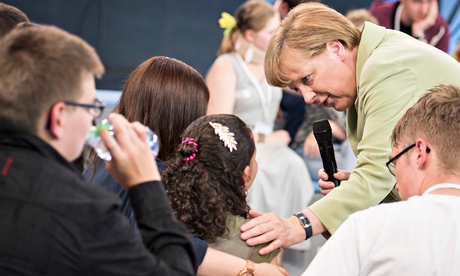
That is why Angela Merkel looked so awkward when she tried to comfort a young Palestinian refugee on German television, after explaining to her why she was going to be deported. “Politics is sometimes hard,” she said to the crying 12-year-old. “If we were to say you can all come, we just can’t manage it.” Merkel’s political logic might have been faultless but her attempt to show some heart looked cold and unsympathetic to many.
The rise of empathy in politics is part of a much wider social trend. Empathy and compassion have been touted as the solution for pretty much everything, from classroom bullying and international conflict to boardroom success. These are the essential “soft skills” that are now considered to be as important as sheer brainpower and technical expertise.
But the fact that Merkel does not come across as the kind of person you’d want to share your problems with over Kaffee und Kuchen does not make her any less fit to be the leader of the most powerful country in Europe. In fact, it might make her more so.
Just because something is good, that does not mean more of it is better, and empathy is no exception. As Aristotle taught, every virtue has its corresponding excess as well as its deficiency. What’s more, where the perfect mean between too much and too little lies depends on the person and their circumstances. Whereas a therapist would be severely hampered by low empathy, a politician might be helped by it. That’s because a politician has to make judgments that are in the best interests of all, without being swayed by her or his personal feelings. If they are led too much by feelings of empathy, their decisions are going to be skewed in favour of those whose needs just happen to command their attention.
We should not be surprised if the ideal degree of empathy for a politician is less than that of an otherwise decent human being. Politicians have to make decisions on broadly utilitarian criteria, deciding to do what best serves the interests of the greatest number, while not acting against the interests of minorities. This requires a cool head and a hard nose. These are not necessarily qualities I would want in a loyal friend, life-partner or relative. Whereas a politician must be quick to go back on a promise if circumstances change, a friend who too readily does the same is not worthy of the name. And while we need health ministers to weigh up the cost-effectiveness of life-saving interventions, a parent who did the same for a child would be some kind of monster.
In Merkel’s defence, it should also be remembered that empathy comes in cognitive and affective varieties. It is one thing to feel someone’s pain, quite another to understand it, let alone to know what to do about it. Much altruism is misguided because people have been moved too quickly from feelings to actions that either fail to help or only add to the problem. Merkel’s awkwardness might show she doesn’t easily resonate with the feelings of others but it is silent about her ability to really understand their suffering.
The real test of a politician is not how they emote but how they act. Gordon Brown was not exactly the warmest of politicians but he was responsible for reducing child and pensioner poverty as well as increasing foreign development aid. Whether he felt our pain or not, he did something about it – and that’s what counts.