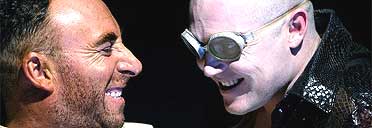
Assassination, said Disraeli, never changed the history of the world. But it always provokes psychological speculation. And, even if Antony Sher's first play doesn't fully explain what motivated the killer of South Africa's Hendrik Verwoerd, it nevertheless offers a compelling portrait both of a complex character and a crazed nation.
Sher himself plays the knife-wielding Demetrios Tsafendas who attacked the architect of apartheid in parliament in 1966. Through kaleidoscopic flashbacks Sher unravels the assassin's tortured history. Born to a Cretan father and a mulatto mother in Mozambique, he emerges as a down-at-heel Ulysses driven to Capetown by an Homeric belief that he will there find his waiting Penelope. Rejected by the black community and classified as European by officialdom, he inexplicably lands a job as a parliamentary messenger in the House of Assembly and there fulfils his historic destiny.
Was he a sane man who, after a lifetime's displacement, committed a political murder? Or was he, as the state decreed, a madman filled with paranoid fantasies? Sher, you feel, favours the former explanation; and, as confirmation, he shows how Verwoerd classified an earlier would-be assassin as insane on the Kafkaesque grounds that opposition to apartheid was itself a sign of madness.
But Sher complicates the argument by turning the tapeworm whom Tsafendas claimed infested his innnards into his on-stage alter ego. It's a clever theatrical device suggesting Tsafendas was constantly haunted by some malign other self; but its very vividness undercuts the idea of the assassination as a purely political act.
In the end, what you get is a play about the mystery of identity: not only that of Tsafendas but of Verwoerd, a Hitler-worshipping Dutchman driven by a fatalistic vision of racial purity, and of the South African state itself. Many of the best scenes are those showing the bewilderment of officialdom when confronted by an itinerant global reject like Tsafendas. At one point a desk-clerk is driven berserk by the hero's multi-racial origins and his desire to be re-classified as coloured. And there is a bitterly satirical scene when Vorster rejects psychiatric evidence that Tsafendas may have been spurred by injustice. The real madness, Sher implies, lies in the topsy-turvy state.
That seems the key to Nancy Meckler's production which creates a graphic impression of 60s South Africa as a fragmented nightmare. Sher's own excellent performance also suggests the hero is a shambling, scuttling figure of no fixed abode or identity who thereby exposes the confusions of a disordered country. And there is good support from Alex Ferns as the embodied tapeworm and Marius Weyers as the inflexible, Caesar-like Verwoerd in a play that vividly conveys the absurdity of arbitrary power.
· Until October 18. Box office: 020-7359 4404.