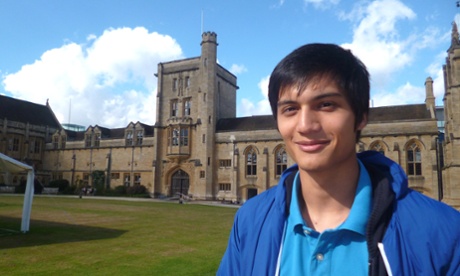
Lothar Sebastian Krapp, 21, is in his fourth year of a maths degree at Mansfield College, University of Oxford. He comes from Königslutter, Lower Saxony, and is co-president of the Oxford German Society
What were your main reasons for leaving Germany to study in the UK?
The standard of education – Oxford is one of the best universities in Europe, together with Cambridge, and a teacher told me I should apply to one of them. This standard of education wasn’t available in Germany.
What have been the biggest benefits?
I’m doing only mathematics and don’t have to choose a minor subject, which you have to do at many German universities. It’s a master’s in four years, whereas in Germany it would take five.
What have you found most difficult about moving to the UK?
Because people are more specialised in their subjects, it is harder to talk about different topics. Mathematicians and scientists know hardly anything about politics, history and how the country works. In Germany, people get educated more widely at school, so that everybody has an opinion on the politics of the country.
Political education starts in year five or six and from then on you have to study politics and a range of other important subjects – including two foreign languages – until the age of 18.
Are there many differences between Germany and the UK in terms of social life?
I wouldn’t say so – students in both countries are up for trying new things and being sociable. But when it comes to partying – students here are much more immature than German students.
What do you miss most about Germany when you’re in the UK?
I don’t like travelling in the UK. The cities aren’t as nice as in Germany, where each one has a historic centre. That’s missing here – especially in the big industrial cities.
The public transport also isn’t that good – you don’t have good roads or good trains. I miss cycling – you have hardly any cycling paths, especially cross-country cycling paths, whereas I used to go on a lot of cycling trips in Germany.
Oxford is good for cycling relative to other UK cities, but it’s still bad compared to Germany. Cycling paths are usually on the road and cars don’t respect that. In Germany, the lanes would be separate.
How do you combat homesickness?
I make a list of things I miss, for example German food that I can’t get here, and when I go back to Germany I buy those things and take them with me. I go to Germany three times a year, during the vacation.
Which foods do you miss most?
You have Kinder chocolate in the UK, but Germany has many more different varieties. There are also certain kinds of meat that you hardly get here – for example, small sausages that they only sell at Lidl. You can’t really get schnitzel in the UK either, so I brought a meat hammer to make my own. There’s also a German sauce I like, which is like ketchup with curry powder.
How does fish and chips compare to schnitzel?
It depends on whether it’s from a fish and chip shop or a pub. The food from a fish and chip shop is the worst thing you can get. I live next to one, and can see how much oil they use because they block our doorway with their empty buckets. Chip shop chips aren’t even crispy, they’re just oily and greasy. But the fish and chips in pubs is quite acceptable.
All over Europe they say British food is the worst in Europe and that’s probably true. There are some things that are alright – fish and chips is one of them – but of course I’d prefer to eat a proper schnitzel with German fries.
Do you like any British food?
Crisps – there are some here that I don’t think you can get in other countries. Normally I eat British crisps because you have natural flavours, such as salt and vinegar. I always bring some home for my family because they like them too. And Cadbury chocolate and fudge – that’s a standard present for people in Germany.
Do you ever cook for your fellow students?
It’s uncommon here, because we have dining halls, but I do it when I have the chance. With one group of friends we eat a lot of healthy things – one of them is Indian and the other is an Arab, so we things like bean salad with hummus and bread.
Are you still in touch with your German friends?
Yes many, I’ve kept more friends in Germany than I’ve found here. Usually one German friend per month visits me and they get a cheap holiday out of it. I have a few good friends here, but in Germany I have more friends that I can be myself with.
Do you prefer to interact with Germans than others at university?
I’ve made some good friends in the German society, but many people are really career-focused and it’s hard to become friends with them. You never know whether they’re just networking for their career. But there are also many people I like, otherwise I wouldn’t want to be president.
How long did it take to get your English to the high standard it is now?
I was 11 or 12 when I started learning English. I’ve learned a lot since coming here. I hardly understand how I could write as badly as I did three years ago.

What were your expectations for studying in the UK?
I expected it to be similar to studying in Germany. I thought people would cook together and do things together, but the social life is organised by the university, which is very strange. I didn’t expect the colleges to offer social events like parties and field trips.
In Germany, there aren’t many societies – here you have them for every hobby you can think of. You might have a knitting society, for example, but in Germany you’d just ask friends, and they would ask other friends, and start a knitting circle.
How does your university experience compare to that of your friends in Germany?
They’re more relaxed about everything, because retakes are normal if you fail an exam, and you might get your degree after four years rather than three. No one would think you’re a loser or that you’re stupid. But here, especially at Oxford, when someone fails an exam, the tutors think about kicking them out.
What advice would you give to other Germans heading for the UK?
Join the societies. In the first few terms, people think they have to work very hard and they might not have any social life. But once people join societies, they realise there is time for social activities and sports clubs. It helps you to relax and makes studying easier if there’s something to do in the evening that isn’t work.
Read more stories in the series:
• International students in the UK: who are they really?
• Meet a student from... Malaysia: ‘I miss how, in Malaysia, everything revolves around food’