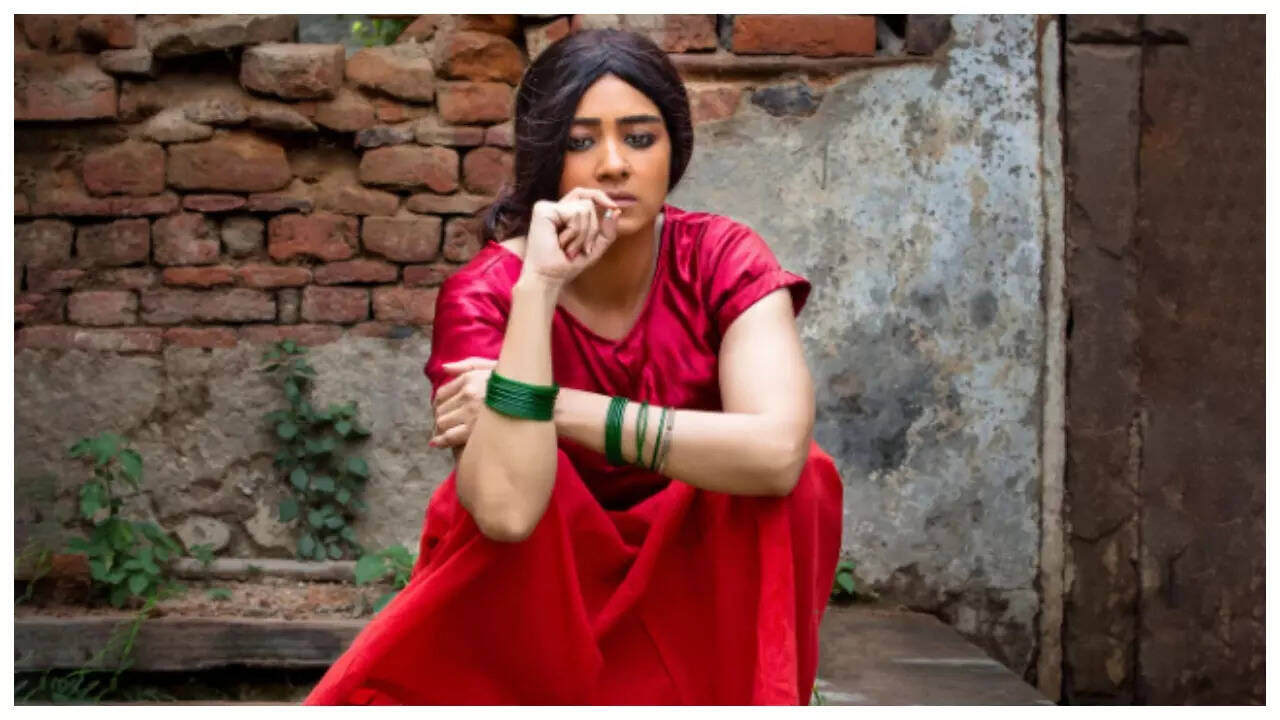
Barkha Bisht, in an exclusive interview with ETimes, addresses the recent criticism from trolls regarding her stance on transgender issues. As the versatile actress delves into her upcoming film 'Safed,' centred around the poignant love story between a transgender individual and a widow, she reflects on her two-decade-long career and the thought process behind her diverse choice of roles. Join us as Barkha Bisht candidly shares insights into her experiences and the meaningful narratives she continues to champion. Excerpts:
The subject of transgender finding love is an interesting one and could be a good point of discussion, even post the release of your film 'Safed'
Well, it's a subject that's definitely going to be a point of discussion. But I think the whole purpose of the film was to start a discussion about it because we are talking about certain communities that are not talked about, that are shunned. Honestly, it's not like we're going to bring a sea of change over here, but we're hoping that at some level, there is some amount of acceptance that can come through this film. I think that's what we're aiming at.
You made some statements yesterday that you're still being trolled. Would you like to elaborate?
It's very interesting. I've been in the industry for some years and it's the first time I've been trolled. They pick up one statement from a whole interview and then that thing is taken out of context. I'm not playing a privileged transgender. There are a lot of transgenders who've trolled and commented. Those are the ones who got sex change operations done. Those are the ones who have beautified themselves to become women, who have had the privilege and financial aid to do that, and probably even had families that have supported them.
I was asked to play a transgender prostitute living on the streets where I have to sell my body to eat. Some references were discussed and there were references of people that are scary to look at. There is a line in the film that the heroine says, “Mujhe hijron se darr lagta hai.” We are showing those kinds of transgenders that people would look at and be scared. And my mind was actually in context to that, “How am I going to look like that?” It was not out of confidence but insecurity as an actor. I thought 'Oh my God! I'm going ahead and agreeing to do something completely diverse. There is so much that I can do with my acting and try to be convincing as a character.'
I think the physical aspect was so important, “How are you going to make me look like that?” Because people will look at me first and then say whether I have acted well or not.
If I was offered the role of a wrestler, I would say, 'How are you going to make me look like a wrestler? Look at me. I'm a small-framed, petite woman. How are you going to make sure that I make sure that that I look like that?' Or if I was told that I have to play a Kashmiri Pandit girl, my first question would be 'I'm too dark to play a Kashmiri Pandit.' Because the general image is fair, sharp features. I'm not fair, I don't have sharp features.
What would you tell the trolls?
A lot of people from the media spoke to me about it and I think, you cannot change the mindset of so many people. Beyond a point I even stopped reading comments because I didn't know the the point was anymore. We've dared to make a film like this. It is a very serious topic.
How have we shown transgender in cinema? Loud, villainous, negative or comical. We are showing the real side to them. We're making such a serious film with such a good intention. Why do you think I would say something as stupid and frivolous 20 years into the industry that 'You aren't pretty enough to be transgender?' I mean, come on. You have to be stupid to say something like that.
Twenty years on, how do you look yourself? Are you happy with the way your career has panned out?
I don't think I have any regrets like something else could have happened. I have never been an overtly ambitious person. My profession was just a part of my life, it wasn't my whole life. I've always been more family-oriented. I wouldn't even say I like to strike a balance. The scales are tipping more toward my family life always. I don't think I have been an overtly ambitious person and thus I think I don't feel today I could have been somewhere else because I don't think I wanted to be somewhere else.
For me to be somewhere else would mean that I would have to then tip the scale again and move more towards my career than my family, and I think that's something I was very clear about from the beginning. I was very happy doing television. I owe everything that I have to television. And I'm really glad that now the past couple of years with the OTT platforms coming in, I think it's a great time for actors. It's a great time for writers and directors as well, but more for actors because we are getting to do different content, we're getting to do diverse stuff.
I think while television gave me a lot of fame and popularity and money, I think the satisfaction of being an actor is now coming forth with OTT and maybe a couple of films that I'm doing here and there. So broadly, I think it's just working out fine.
What is your process of choosing proects?
Everybody is telling me that I have done out-of-the-box characters. It's not like I have intentionally done that. I think I have been boxed for a very long time whilst doing television, and now that I have moved out of it, people are thinking Barkha is now doing different stuff. But in television, unfortunately, there is very a slight variation from one character to the other. You're pretty much playing the same thing.
OTT and films allow you to do different stuff. Luckily, I have been getting diverse characters to play as well. So yes, I do pick my subjects for sure, but I wouldn't say I'm an overly picky or choosy person. I love working, I love what I do. I love to dwell into different characters, and I think with each character, I just get to know that yeah, I can do this as well. And at the end of the day, I think if I'm proud of what I have done, that is my only motivation. I should be happy and I should be proud of what.
Did Safed weigh heavily on you?
Oh, it definitely did! I don't think I realized it till I met the whole community because all our co-actors on this, besides the main five characters, all the other artists, they're all transgender. When I met them and spent time with them during the shoot, in between shots, talking to them, I think then it weighed down on me that, “Oh, my God. I am not just playing a character, I'm just portraying somebody who is actually real and is right there."
When you spend time with them and you talk to them, the magnitude of what we are trying to portray on screen, touched me.
Did any of them share any stories with you?
Yeah, there was this young transgender called Salman, who now was by the name Salma, she was supposed to be with me 24/7 because Sandeep (director) said I need you to be with her all the time to just observe. It was very interesting when on the first day I reached my hotel and got a call that Salma was waiting for me.
I came down expecting again that image of a typical transgender-looking person. I'm looking in the reception and I can't see anybody except one girl, fair, long hair, simple salwar-kameez. She's just sitting there, coiling in a corner, and I just look at her and I'm like, “This is a woman, can't be Salma”. I go to the reception and asked “Where's the person?” And they said, “Right there”. I was shocked. I just looked at her and I'm like, "Oh, my God, you are so pretty." This was a realization that these people can look pretty.
Salma lost her mom. Her her dad was there, but her step-mom threw her out of the house at the age of 10, because of embarrassment over what people started saying. The father did nothing. They threw her out of the house saying, “Go, fend for yourself.”
What can you tell us about the importance of inclusivity in society?
Inclusivity is very tough. Some of the members of the transgender community are getting educated, and some of them are in our industry, right from actors to make-up artists. But still, I would say amongst the community, we are still the privileged lot because there are people who've been educated or people who have had the back-up of families. What we are showing are people whose families don't back them up, who don't have any such privileges.