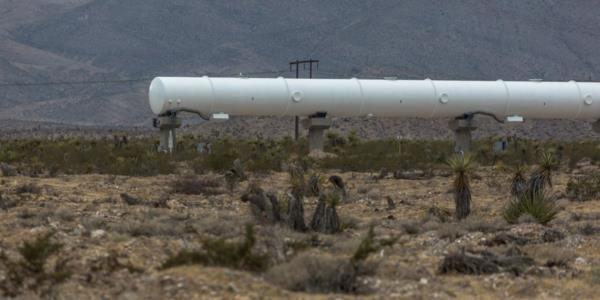
The once highly-anticipated Hyperloop One project, originally championed by Elon Musk, has officially come to an end. The company recently announced that it will be shutting down its operations, laying off employees, and looking to sell its test track and remaining machinery. This disheartening news comes after the company had hired over 200 people in 2022, only to inform the remaining employees that they would lose their jobs by the end of December.
As part of this wind-down process, the intellectual property of Hyperloop One, including its logos, slogans, and branding, will be transferred to DP World, a logistics company based in Dubai. With this, the once-promising, futuristic transport concept will cease to exist as an independent entity.
The Hyperloop project first gained attention in 2013 when Elon Musk envisioned a transportation system that would allow passengers to travel from Los Angeles to San Francisco in just 35 minutes. The concept relied on magnetic levitation, enabling near-silent travel at incredible speeds—nearly twice as fast as commercial jet flights and four times faster than high-speed trains.
Musk proposed the use of aerodynamic aluminum capsules to transport passengers or cargo through a low-pressure tube, reaching speeds of up to 760mph. The tubes could either be elevated on pylons or installed underground, and the entire system had the potential to revolutionize the way we live, work, trade, and travel. Musk described it as the 'fifth mode of transportation.'
With a vision as ambitious as this, Hyperloop One managed to raise approximately $450 million in funding and even built a test track near Las Vegas for experimental purposes. Investors, including Richard Branson of Virgin, showed interest in the company, lured by the prospect of transforming transportation as we know it.
However, despite the initial excitement and significant investments, the project faced numerous challenges along the way. In 2020, Hyperloop One conducted its first and only test with human passengers, and it became evident that the promised speeds were far from achievable. The pod reached a top speed of only 100mph, falling substantially short of the original goal.
Critics of the Hyperloop concept argue that while it may be technically feasible, the financial barriers to mass-market implementation seem insurmountable. The project's top executives had initially projected that operational hyperloops would be seen globally by 2020, but the deadline was subsequently pushed to 2021. Today, no hyperloop systems exist anywhere in the world, leaving some skeptical about the feasibility of this once-hyped mode of transportation.
With the unfortunate end of Hyperloop One, it seems that the dream of revolutionizing travel with this futuristic concept has dissipated. The challenges faced by the project have demonstrated just how difficult it is to turn visionary ideas into tangible realities, particularly in highly complex and capital-intensive industries.
As we bid farewell to Hyperloop One, it serves as a reminder that innovation requires more than just grand visions and lofty ambitions. It demands careful planning, robust financing, and a realistic understanding of the practical challenges that lie ahead.
While the Hyperloop may not become a reality in the near future, it has undoubtedly sparked a conversation about the future of transportation and the need for innovative solutions to address the growing demands of our modern world. Perhaps, in time, new technologies and fresh ideas will emerge to pave the way for a truly revolutionary transportation system. Until then, we can only reflect on the rise and fall of this groundbreaking concept and continue to explore other avenues for progress.







.jpg?w=600)