
HYDERABAD: Mosquitoes in Hyderabad have become resistant to chemicals mostly used in anti-fogging operations, entomologists said, even as residents are growing increasingly frustrated with the seemingly never-ending struggle against mosquitoes.
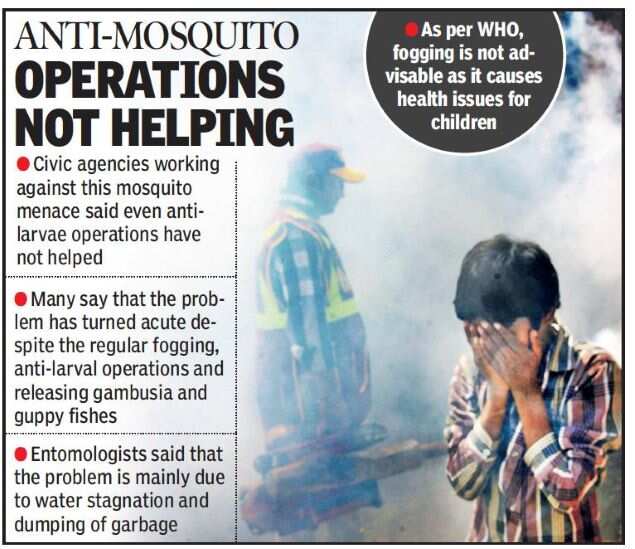
Civic agencies working against this aerial menace said even anti-larvae operations have not helped to keep them under control at a time when dengue cases are on the rise.
“We have some peace only during the daytime. Once it is 6 pm, our only focus is how to get rid of these mosquitoes. I have liquid mosquito repellents, coils and sprays, but nothing is working,” said Harsh Vardhan, a resident of Somajiguda.
While some residents blame the civic authorities for not being able to control the menace, many also say that the problem has turned acute despite the regular fogging, anti-larval operations and releasing gambusia and guppy fishes into city water bodies to check breeding of mosquitoes.
Geetika Singh, who was visiting her family in Mehdipatnam from the USA, said that her two-year-old daughter was covered with mosquito bite marks in just one night.
A resident of Kukatpally said the situation had worsened after just two spells of rains recently.
“Even with mosquito nets on doors and windows, we are unable to keep them out. I think the hyacinth-filled water bodies in the city could be the reason behind these large swathes of mosquitoes in the city. With fogging and regular mosquito repellents not working, we are forced to use incense sticks that might causing respiratory problems in children and elderly people,” said Prashant Singh, a resident of Green Hills near Moosapet.
Entomologists said the problem of mosquitoes is mainly due to water stagnation and dumping of garbage in water bodies.
“Even though fogging does not eradicate mosquitoes completely, we are doing it mainly due to demand from the public. We use a chemical called Melathion which does not kill dengue or chikungunya causing mosquitoes. As per WHO, fogging is not advisable as it causes health issues for children, elderly and pregnant women,” said Dr A Rambabu, chief entomologist, GHMC.
“That is the reason, we use another chemical called Pyrethrin, which does not produce smoke and it is used only in places where positive dengue cases are reported. Pyrethrin targets the infected mosquito and kills it,” said Dr Rambabu To control breeding of mosquitoes in stagnant water, authorities are conducting house to house anti-larval operations, releasing gambusia fishes into the water bodies as they eat the larvae of mosquitoes, and dropping oil balls in dirty water ponds or stagnant water, which forms a film on the surface of the water, killing mosquitoes and larvae, and breaking the reproductive chain.
“The hyacinth, which is also one of the reasons for the breeding of mosquitoes, is being removed by excavators. But in some lakes, it keeps growing back due to discharge of sewage and people dumping waste into them,” Dr Rambabu added.