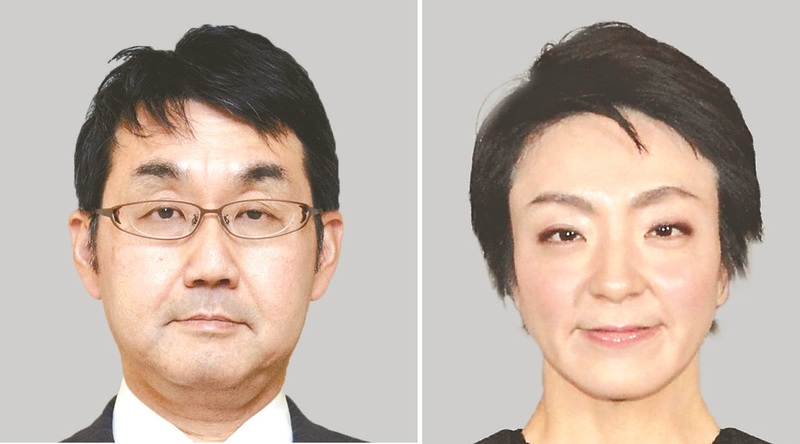
Two Diet members -- a married couple -- were arrested Thursday on suspicion of buying votes in a scandal related to the wife's campaign for the July 2019 upper house election.
Prosecutors arrested Anri Kawai, 46, who for the first time was elected to the House of Councilors from the Hiroshima prefectural constituency, and her husband, Katsuyuki, 57, a House of Representatives member elected from Hiroshima Constituency No. 3 and former justice minister, on suspicion of violating the Public Offices Election Law. They are suspected of giving nearly 100 local assembly members and others a total of about 25 million yen in cash, with the intention of asking them to collect votes for Anri.
The Kawais submitted resignation letters dated Tuesday to the ruling Liberal Democratic Party, which were accepted the following day.
In relation to Anri Kawai's campaign team for last year's upper house election, suspicions emerged in October that staff members working in her campaign vehicles had been provided with a daily allowance of 30,000 yen each, which is double the legal ceiling. The Hiroshima District Public Prosecutors Office has launched investigations into the offices of the Kawais in Hiroshima and other related locations since January.
Through this series of searches, the district prosecutors office confiscated multiple lists that included the names of local assembly members and those related to the campaign team, as well as the amount of money, according to sources.
Prosecutors closely examined these lists and also gathered corroborative evidence, which made them believe that the Kawais had paid a total of about 25 million yen to nearly 100 people -- including some members of the Hiroshima prefectural and city assemblies, in addition to local mayors -- to ask them to gather votes for Anri in the upper house election.
Katsuyuki Kawai is believed to have offered 91 people a total of about 24 million yen from March last year, when Anri Kawai was endorsed by the LDP as its second candidate for the Hiroshima prefectural constituency -- with two seats up for grabs -- to August that year, the month after the upper house election. Meanwhile, Anri Kawai, allegedly in collusion with her husband, is suspected of providing five people 1.7 million yen in total from March to June.
Around March, authorities beefed up the Hiroshima District Public Prosecutors Office's preparedness for investigations into the case by dispatching about 20 officials, including some from the Tokyo District Public Prosecutors Office's special investigation squad.
Voluntary questioning was conducted people whom the Kawais are believed to have paid. Most of the local assembly members admitted to being offered cash by the couple, according to sources.
Some of them reportedly told prosecutors that they had never been offered money from the couple during their past elections. Prosecutors believe that these comments could support suspicions that the Kawais provided cash with the intention to buy votes for Anri's upper house election campaign.
The Kawais were questioned by prosecutors during the Golden Week holiday period in May, but Katsuyuki Kawai and Anri Kawai both denied the allegations of distributing cash. The Kawais have also denied any involvement in wrongdoing when speaking to reporters.
With regards to illegal payments made by Anri Kawai's campaign team to staff members working in campaign vehicles, the Hiroshima District Court on Tuesday sentenced 18 months in prison, suspended for five years, to Hiroshi Tatemichi, one of her state-paid secretaries. Indicted for violation of the Public Offices Election Law, prosecutors sought 18 months in prison for 54-year-old Tatemichi.
Anri Kawai's election win will be nullified if her secretary's sentence is finalized and the court judges that guilt-by-association should be applied in this case.
Read more from The Japan News at https://japannews.yomiuri.co.jp/