FORT LAUDERDALE, Fla. _ Hurricane Delta, a major Category 3 storm with 120 mph winds, was approaching the Louisiana coast Friday morning with a danger of life-threatening flooding, according to the 8 a.m. advisory from the National Hurricane Center.
Louisiana prepares for Delta as its forecast to slam into the state with slightly diminished strength as a Category 2 storm sometime Friday evening, the hurricane center said in its 8 a.m. update.
Heavy rain and a storm surge up to 11 feet are expected along portions of the northern Gulf Coast on Friday.
"The combination of a dangerous storm surge and the tide will cause normally dry areas near the coast to be flooded by rising waters moving inland from the shoreline," the hurricane center said Friday morning.
As of 8 a.m., Delta _ the earliest 25th-named storm ever to form _ was located 160 miles south of Cameron, La., traveling north at 12 mph with maximum sustained winds at 120 mph. Category 3 hurricanes on the Saffir-Simpson scale have wind speeds between 111 and 129 mph.
Delta, which is traveling over the western Gulf of Mexico, is expected to make landfall about 10 or 20 miles east of where Hurricane Laura made landfall as a Category 4 hurricane about six weeks ago.
Delta's hurricane-force winds extend outward from its core up to 40 miles and its tropical-storm-force winds extend 160 miles. Delta's threatening size is causing a large risk of life-threatening storm surge along the Gulf Coast where the tide will cause normally dry areas to be flooded by rising waters moving inland as high as 7 to 11 feet from the Rockefeller Wildlife Refuge to Morgan City, Louisiana.
A storm surge warning is in effect for High Island, Texas, to the mouth of the Pearl River, Louisiana including Calcasieu Lake, Vermilion Bay, and Lake Borgne.
A hurricane warning is in effect for High Island, Texas, to Morgan City, Louisiana.
A tropical storm warning is in effect for west of High Island to Sargent, Texas, east of Morgan City, Louisiana, to the mouth of the Pearl River, including New Orleans, Lake Pontchartrain and Lake Maurepas.
As Delta gets closer to Louisiana later Friday, the storm should lose steam as it encounters less oceanic heat and more winds shear causing its maximum sustained winds to drop to 110 mph, the NHC said.
When it makes landfall, it will be the 10th named storm to pass over the U.S. this year, breaking the record for a single season, which was previously nine storms in 1916, Colorado State University meteorologist Philip Kloztbach said.
This would be the record-tying fourth storm to make landfall in Louisiana this year. The state has already seen landfalls by tropical storms Cristobal and Marco and Hurricane Laura, which ravaged the southwestern region as it roared ashore as a Category 4 storm in August. More than 6,600 Laura evacuees remain in hotels around the state, mainly in New Orleans, because their homes are too heavily damaged to return.
Louisiana also had four storms make landfall in 2002 among tropical storms Bertha, Hanna, Isidore and hurricane Lilli.
Overall, it's been an exhausting stretch for Louisiana, which had three storms make landfall in 2005 and 2017.
Although the most intense thunderstorms in Delta have been west of the eye the biggest threat of tornadoes remains in the right front quadrant of the storm.
"The reason for that," said John Cangialosi, hurricane specialist at the National Weather Service Office in Miami, "is that winds are typically stronger on that side because it is moving in the same direction of the motion and the wind is typically coming onshore, assuming the system is making landfall, which can drag storm surge and bring the stronger winds inland."
The hurricane center said if the peak storm surge occurs at high tide, the area in Louisiana from the Rockefeller Wildlife Refuge to Port Fourchon, including Vermilion Bay, could see seven to 11 feet of water.
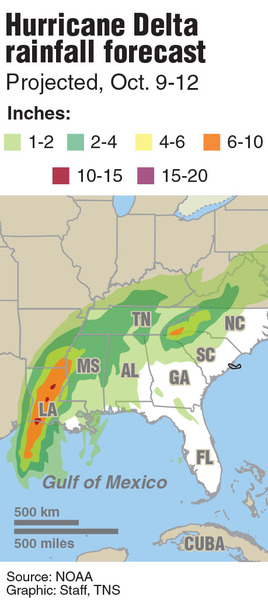
Delta is expected to inundate the region with up to 10 inches of rain and isolated areas seeing as much as 15 inches in southwest and south central Louisiana.
There is potential for dangerous and prolonged flash flooding and river flooding in the region, according to the hurricane center.
Forecasters are fairly certain about where Delta will make landfall but its intensity remains a little more uncertain because intensity forecasting is tougher than track forecasting.
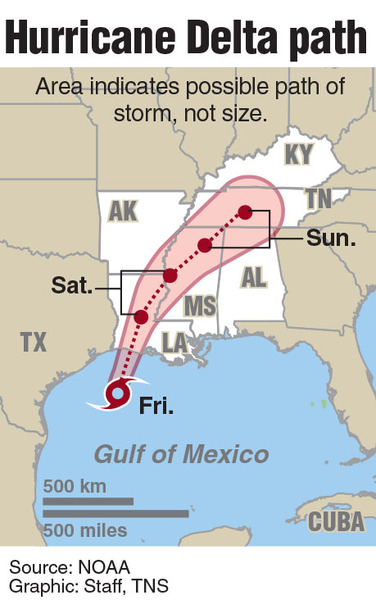
"The track or movement, the trajectory a hurricane follows is largely determined by what we call the steering currents," said Dr. Pablo Santos, meteorologist in charge at National Weather Service Office in Miami. "Think of it this way, the low- and high-pressure systems around the hurricane.
Santos said those steering currents can be analyzed very well by computer models.
Santos said intensity changes, and especially rapid intensification, depends more on what happens inside the storm, around the eyewall, and it happens on a much smaller scale, which is problematic for forecasters.
"What goes on in that inner core _ the convection, the thunderstorms developing, which is the mechanism by which the energy from the surface is sucked up into the hurricane and released within the hurricane _ plays a critical role in intensification, and therein lies the problem," he said.
Santos said Hurricane Hunter aircraft are a great aid to predicting intensification. But he said the process also involves computer models that have higher resolution, are far more precise, and have a good representation of the process going on at the microphysical scale, such as what's going on inside the eyewall with cloud droplets, ice particles and other elements.
"There's tons of research being thrown into it, to help us improve," Santos said, "but that is the challenge with intensity, particularly rapid intensification. So we always say the skill there is limited."
The center of Delta made landfall at about 5:30 a.m. Wednesday along the northeastern coast of the Yucatan Peninsula, near Puerto Morelos, as Category 2 storm, according to the hurricane center.
It's the strongest storm ever named after a letter in the Greek alphabet, eclipsing Hurricane Beta in 2005, which reached 115 mph.
Delta underwent rapid intensification Tuesday, which is defined as an increase of maximum sustained winds by at least 35 mph in a 24-hour period. In 36 hours, Delta went from a tropical storm to a Category 4 hurricane.
"Delta is the fastest storm to intensify from tropical depression to a Category 4 storm in modern records," said Michael Ventrice, meteorological scientist for The Weather Company.
Delta beat Hurricane Keith (2000) by six hours for most rapid intensification.
The National Hurricane Center is also watching an area of disorganized showers and thunderstorms in the far eastern Atlantic. The area has a 20% of development in the next 5 days, the hurricane center said.
This has been a busy hurricane season with nine named storms making landfall in the U.S., which ties the record number established in 1916. Beta became the first storm named after a letter of the Greek alphabet to make landfall in the continental U.S. when it came ashore near Port O'Connor, Texas on Sept. 21.
The Gulf Coast was hit twice in September. In addition, to Beta, Hurricane Sally made landfall on Sept. 16 near Gulf Shores, Ala.
In late August, the region was pummeled in a 72-hour period by Hurricane Laura and Tropical Storm Marco. Laura came ashore in coastal Louisiana at Category 4 strength. Marco, which had briefly been a hurricane in the Gulf of Mexico, made landfall as a tropical storm near the mouth of the Mississippi River.
Hurricane Hanna made landfall in southern Texas in late July. And Tropical Storm Cristobal made a second landfall on the Louisiana coast on June 7.
October storms often threaten Florida as they move north and then northeastward. But none of the nine storms that hit the continental U.S. this year made landfall in Florida.
Delta broke the record for the earliest 25th named storm ever to form, eclipsing the previous mark of Nov. 15, 2005, when Tropical Storm Gamma briefly formed in the Caribbean Sea.
If Delta maintains its current forecast track, it would break a record by becoming the 10th named storm in a hurricane season to make landfall in the continental U.S. It would also be "the first-ever hurricane named after a Greek letter to strike the U.S.," according to AccuWeather.
Delta is also chasing the record 2005 hurricane season, which had 27 named storms. In that year there were 14 named hurricanes and seven major hurricanes _ three of which (Katrina, Rita and Wilma) _ reached Category 5 status. On Dec. 30, 2005, Tropical Storm Zeta formed as the 28th named storm of the year, setting the all-time record.
After Delta, the next storms would be named Epsilon, Zeta and Eta.
Because 2020 is a La Nina year, forecasters expect late-season storm activity to increase in October and possibly even carry into November. Hurricane season officially ends Nov. 30.