The number of newly confirmed cases of infection with the novel coronavirus totaled 309 on Tuesday in Tokyo.
Every day, these breaking reports appear on newspaper websites and TV. But some may wonder why the number of newly confirmed cases fluctuates so widely depending on the day of the week?
It stands at 169 on Monday; 310 on Thursday; and 315 on Saturday. When looking at the average number of newly confirmed cases by day of the week in Tokyo over the past 4 weeks (between July 8 and Aug. 4), the trend is clear: There tend to be fewer newly confirmed infections in the first half of the week and more in the second half.
The data announced by the Tokyo metropolitan government reflects the findings of PCR tests and other examinations conducted a few days earlier. Even if they feel ill, people tend to rest quietly at home over the weekend, and the number of those who get tested early the following week will increase. Therefore, the number of newly confirmed cases tends to rise from Thursday on and over the weekend.
Prompt, accurate transmission of information by administrative organizations is vital as a countermeasure against infectious diseases. This is supported by the sharing of information on infected patients among relevant organizations.
"Sharing information early is absolutely key, and the top-priority issue," Shigeru Omi, chairman of a governmental subcommittee on the novel coronavirus, emphasized during a press conference on July 6.
But there is a wide disparity between the ideal and reality. The transmission of relevant data has stagnated between administrative organizations, causing a time lag in the dissemination of information. How did this situation develop?
--Deadline set at 9 a.m.
"Incident reports" on A4-size paper arrive every day from 31 public health centers in Tokyo, to two fax machines in the infectious disease countermeasures department on the 30th floor of the Tokyo metropolitan government building.
These reports each contain 19 items of data on an infected patient, including the patient's name, address, the day when their symptoms appeared, and the day when they tested positive on a PCR test.
The process leading to the announcement of the data is primarily conducted manually. An incident report is drawn up by a doctor based on the result of the PCR test, and is sent via fax to the relevant public health center. Each health center then checks that there are no omissions in the report, and transfers it to the metropolitan government.
The metropolitan government announces the number of newly confirmed cases of infection on the day, an aggregate of the incident reports it received in the 24 hours up until 9 a.m. of that day. The deadline is set early in the day, an official of the metropolitan government said, because it takes time for the government to gather via telephone such additional facts as the infection route, and to put the data in order.
The more the number of new cases grows, the greater the amount of work done by doctors, and workers at health centers.
An official in charge at the metropolitan government said: "Public health centers need a lot of time to conduct these tasks, from testing to the transmission of the incident reports. This consequently causes a few days' delay from the time of the testing to the announcement of the newly confirmed cases."
Information is collected by the Health, Labor and Welfare Ministry based on the announcements made by prefectural governments and the governments of ordinance-designated major cities. As the ministry totals the number of infected cases and so forth on the basis of information carried on the homepages of local governments, the summary of relevant information is further delayed.
The reality is a far cry from the ideal of "sharing information quickly."
-- Limits of old system
Initial attempts to summarize data on novel coronavirus patients were made via the NESID, or National Epidemiological Surveillance of Infectious Diseases, an information-sharing system that the central government has operated since 2006 to track the outbreak of contagious diseases.
It failed to function, however, due to the limitations of the system and a lack of cooperation among administrative organizations.
The fundamental problem with the NESID was its inability to follow up on patients, a measure deemed essential in combatting infectious diseases. It could ascertain who was a patient, but key data could not be entered, such as the status of seriously ill patients, and the number of those hospitalized and those discharged. These facts are vital for establishing a medical service system and containing the spread of infections.
The health ministry asked health centers to collect this data from medical institutions, via telephone and other means, and report the data to the ministry via local governments. But the health centers also had to make inquiries about infection routes and who had been in close contact with infected patients, in parallel with the entry of data into the NESID.
From April, when the number of infected patients soared, public health centers in various parts of the country were overwhelmed. A senior official of the health ministry said, "Only 20 percent to 30 percent of the local governments we asked to make reports actually did so."
On May 8, the ministry gave up on collecting data via local government reports, and switched to compiling data that had been released on local governments' websites. At one point, the actual number of people admitted to the hospital or receiving medical treatment was found to be 4,984 fewer than the information released by the central government, thus calling into question the reliability of the data put out by the state.
Moreover, the data on infected patients announced by local governments are, in many cases, insufficient, as they are limited to such facts as their sex, age and place of residence. The current Infectious Diseases Law requires local governments to report to the state the data deemed necessary for the central government to take measures to prevent infections, and these facts are deemed to fall outside laws related to the protection of personal data.
But according to the senior ministry official and others, there was a number of cases in which the ministry's requests for detailed data were denied on such grounds as the protection of privacy and there being no precedent for providing such information.
The government's expert panel on the novel coronavirus on June 24 said in a report summarizing its activities, "We were unable to disclose relevant data, conduct public research and put out reports as swiftly as in other countries, making it difficult for the measures implemented by Japan to be assessed internationally."
--Hopes for HER-SYS
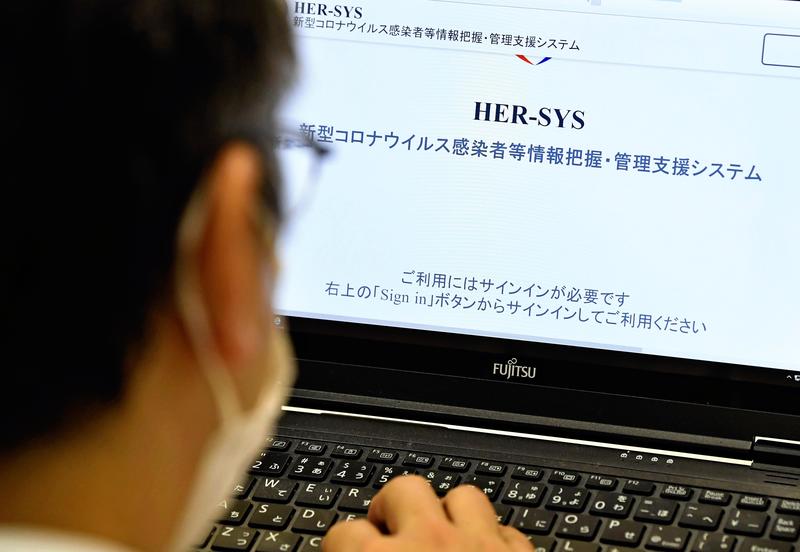
To break out of the current situation, the ministry has given up on the NESID and developed HER-SYS, or the Health Center Real-time information-sharing System on COVID-19.
Health centers entered data into the NESID. But with HER-SYS, doctors and even infected patients can update information such as whether they are hospitalized or have been discharged, and their current symptoms, via personal computers or smartphones. One senior health ministry official expressed hope that "the central and local governments will be able to share the latest information instantly."
But most of the 155 local governments, including the 47 prefectural governments, that are taking part in HER-SYS, have also stipulated in ordinances that, from the viewpoint of security, if a system is introduced in which personal information is exchanged with outside organizations via the internet, the government must hear the opinions of a council comprised of relevant experts.
The ministry initially aimed to have the system start operating in late May. It has taken some time for related procedures to be conducted at each local government, so 43 local governments had not started using the system as of July 3.
The governments of Tokyo and Osaka Prefecture, which together account for half the infected patients around the nation, also have to reenter their data on patients into the HER-SYS, so their introduction of the system has been delayed until early August.
As the crisis has been spreading again, it has become increasingly necessary to trace the movements of infected patients and examine under what conditions infection could spread.
Shoji Tsuchida, a professor at Kansai University and an expert on safety psychology, said: "Unless the central and local governments immediately ascertain what is happening where and take steps, the seeds of the spread of infection cannot be eliminated. Whether HER-SYS can be made to function well, by implementing thorough security measures, will be key to future developments."
Read more from The Japan News at https://japannews.yomiuri.co.jp/