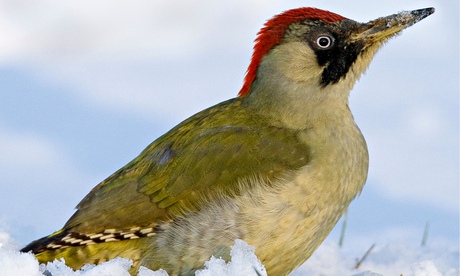
A black-faced woodpecker had come to ground on a white-out of a morning. Frost had played peculiar tricks with its colours, highlighting the dark markings on its head, suppressing the muted shades on its body.
Just as it had cast a glaze over the meadow, the frost seemed to have bleached out the grass-green tones that gave the bird its name. The green woodpecker pecked at the frozen soil, a peck-and-pause routine that lasted for some minutes. An ant-licker in summer, what was it finding now?
In the bright white landscape of fields and lakes, strong colours and sudden movements sang out. Binoculars swung towards a glowing orb on the far side of the big lake. It was as if a zebra-crossing beacon had parked in the reeds. The image resolved into a beach ball of lurid yellow, lodged among the stems.
At once, a shape popped up from the water much closer to. I caught sight of a grebe, slim and angular, great but not crested, but then it was under again.
The ripples from its dive had barely smoothed out when a cluster of bubbles appeared at the surface five metres or so to the left. Five metres more and another cloud of froth came up.
I was playing Guess the Grebe, anticipating exactly where the next eruption of air would happen. I guessed right just once, before the swimming bird doubled back and surfaced at the spot where it had dived.
Here was a hunter with no frills attached. The softening springtime orangey-brown ruff of feathers around its neck and dainty little ear tufts were no more.
Stripped bare in winter of its delicate finery, the grebe took on a different character. This was a creature of a monochrome world, drawn in charcoal, its lighter patches smudged, dark areas fuzzy. A tail of black dribbled down from its jet-black eye to the one feature that dominated the bird. Sharply defined, it was a deadly sharp beak of enormous proportions.
A line of Shakespeare filled my head: “Is this a dagger I see before me?”