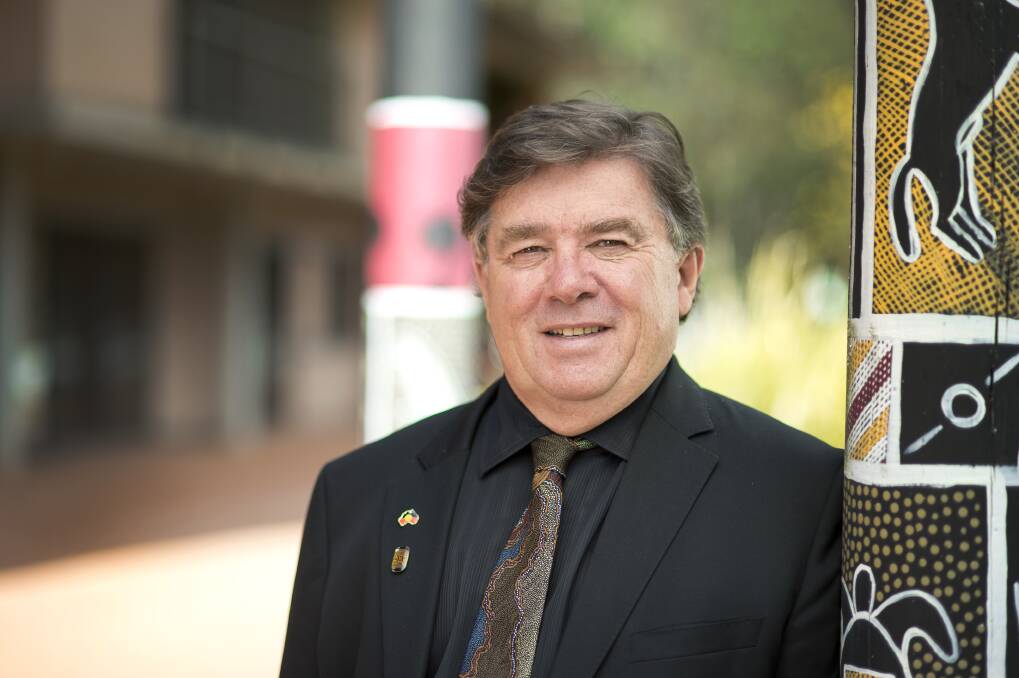
EMERITUS Professor John Maynard likens Australia's history to a puzzle with most of the pieces missing.
The expert in Indigenous history is calling for a government-led national truth telling project similar to the Truth and Reconciliation Commission in South Africa, where victims provided testimonies about their experiences.
"This truth telling process would be a part of putting those pieces back into the puzzle," Professor Maynard said.
"It would be across the country, it would be interviews with people, it would be telling stories of the past."
He said the process would aim to help people "heal from the scars of the past" to enable Indigenous and non-Indigenous people to "join hands and walk on together to an equitable future and to share this incredible country".
"The main thing is to recognise what happened in this country.
"A lot of our people who are still there still suffer intergenerational trauma of what has transpired... we've got a long way to go."
He said truth telling reflected the Uluru Statement from the Heart reforms of voice, treaty and truth.
Aboriginal and Torres Strait Islander people, he said, were not calling for anything new.
His grandfather Fred Maynard was president of the country's first organised Aboriginal political group, the Australian Aboriginal Progressive Association, which formed in 1924 and fought for social, economic and political change.
"The manifesto which they put to state and federal governments at that time was a national land rights agenda if you like," he said.
"Well before the 60s and 70s they demanded enough land for each and every Aboriginal family in the country and my grandfather stated 'We have overriding rights above all others in our land'.
"They also put up self determination."
In addition, the AAPA called for protection boards to be abolished, the process of removing Aboriginal children from families to be stopped and for an all Aboriginal board under the Commonwealth Government.
"Sadly it just shows just how little progress has been made because we're still fighting over the same things that were put up by these incredible activists 97 years ago this year," he said.
"That's the tragedy of the legacy, is that all the things they put on the table nearly 100 years ago, we're still battling for today.
"The reality is if you want to look at any statistics in this country, be it health, education, housing, employment, the highest rates of incarceration - the statistics clearly show we've made no progress as far as healing the country."
Professor Maynard said his grandfather's life story was "erased" from history and memory until he was asked to compile it for the family, using newspaper clippings, photos and letters.
Professor Maynard went to the University of Newcastle's Wollotuka Institute in 1993 to ask for advice.
"I was kidnapped into doing a diploma course which of course led on to a BA and a PhD and being made a professor."
His PhD about his grandfather and the AAPA became a book.
"From the outset I was writing for my family... but then I found myself writing for Aboriginal people," he said.
"First and foremost that's my audience that I targeted. I've never sought to write directly for the academy.
"I want my people to be able to read what I write, enjoy what I write and gain inspiration from it, especially our young people, that they have heroes and heroines in our past which we were largely deprived of."
He said he hoped to see the number of Aboriginal historians grow.
"I would argue today there's not an Aboriginal community in the country where people aren't putting together their family and community history because of the need to fill the gaps, because we were cut off from history, we were deprived of memory, we were deprived of so much and we're in the process of putting a lot of that back together."
He said he also aimed to help non Indigenous Australians "fill in the gaps" of history.
Professor Maynard said NAIDOC Week was time for Indigenous people to feel pride in celebrating their culture.
"There are changes in people - people want to be part of and celebrate Aboriginal culture," he said.
"This is a really strong movement and that's the way of the future. It seems to be a throwback to the 1960s and 1970s, where there were mass movements of people wanting change. People are there mobilising in support in large numbers.
"Let's hope this is the time. This is one of those moments where we've got the opportunity to really press and really make change now for the good of everybody in this country."
He said the theme, Heal Country, was both about healing the environment and the community from its painful past.
"Our culture was all about preserving and handing over to the next generation the environment in pristine condition, so there's that aspect of healing country and the other aspect as far as this country is concerned is healing country from history.
"The reality is what has gone on in this country over the last 230 odd years, it has to be dealt with, and that's why the truth telling process needs to be looked at and will be, for me, a major focus over the next three, four, or five years.
"There's a sickness embedded in this country that needs to be cleansed and healed from - and we've all got a part to play in going through that process."