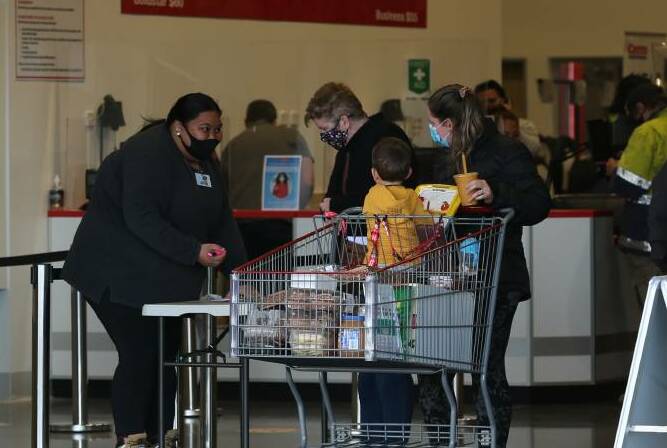
Hunter New England Health will no longer publish low-risk COVID-19 exposure sites after finding no transmission was occurring among customers in supermarkets and other shops.
The change, which will come into effect this weekend, will mean far fewer exposure sites will be listed publicly and fewer people will need to get tested and isolate as casual contacts.
The head of the Hunter Public Health Unit's venue risk assessment team, Dr Rebecca Hogbin, said the new "risk matrices" would allow contact tracers to focus on higher-risk venues.
Health districts in virus-hit Sydney made the same decision last month, and the Central Coast Local Health District followed suit on Wednesday.
HNEH said it would focus on households, workplaces, apartment complexes, nursing homes, health care, schools and childcare centres.
HNEH's decision to change the way it deals with and reports exposure sites is a reflection of rising case numbers in the region.
The Hunter has recorded 86 new cases in the past two days, and the list of exposure sites has grown rapidly.
Dr Hogbin said evidence from throughout NSW showed short visits of less than 15 minutes to supermarkets, petrol stations, takeaways and other retailers did not spread the virus.
She said no one who had been identified as a casual contact in the Hunter had subsequently tested positive.
"In the 1500 low-risk venues we've assessed, we haven't seen any transmission," she said.
The public health team would continue to treat exposures sites case-by-case and would tailor responses depending on how long a customer was in a shop and whether they used self-checkouts and a mask.
HNEH public health controller Dr David Durrheim said on ABC Newcastle on Thursday that most virus transmission in the region had occurred through friends and families interacting closely in groups, sometimes in contravention of public health orders.
"It's really not the trivial people passing each other in the supermarket that's causing it," he said.
HNEH had identified "very few transmission events" at work sites.