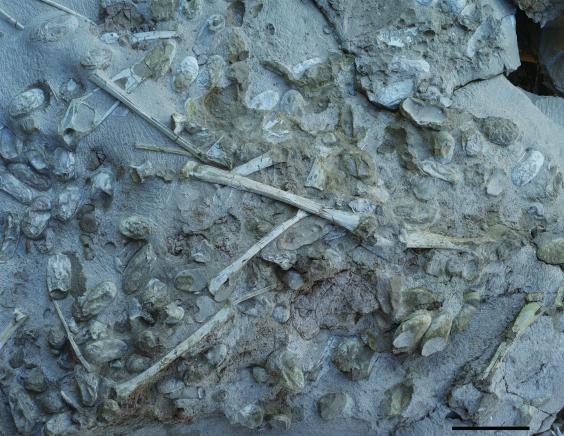
An ancient site containing more than 200 fossilised eggs belonging to ancient flying reptiles known as pterosaurs has been found.
The eggs belong to a species called Hamipterus tianshanensis, which soared over what is now north west China about 120 million years ago.
The palaeontologists who made the discovery note both the “extraordinary quantity of eggs”, and the fact some of them contain “the first pterosaur three-dimensional embryos”.
This level of preservation allows researchers to learn more about the behaviour of these prehistoric creatures.
Previous evidence of pterosaur reproduction has been rather lacking, limited to a handful of eggs from Argentina and China identified in 2004.
Prior to this, there was no evidence at all these reptiles laid eggs.
But the new discovery, which consists not only of eggs but the bones of adults as well, paints a vivid picture of a nesting colony.
The findings were published in a paper led by Dr Xiaolin Wang of the Chinese Academy of Sciences in the journal Science.
Dr Wang and his collaborators outline how they used CT scans to look inside the eggs, 16 of which contained embryos that were somewhat intact.
From these embryos, the scientists could see that the structures supporting the pectoral muscles – crucial for flight – were noticeably underdeveloped.
This allowed the scientists to infer that when these animals hatched, they were unable to fly. The newly hatched pterosaurs would therefore have required care and attention from their parents if they were to survive.
The fossils also reveal more secrets about pterosaur lifestyles. “The find reinforces the view that pterosaur eggs were soft-shelled and needed to be buried,” said Dr Charles Deeming, a biologist at the University of Lincoln who was not involved in the study.
This draws comparison with modern day lizard eggs, and suggests that while the pterosaurs may have cared for their offspring, they didn’t incubate them like birds. Instead, they relied on the earth to keep their eggs warm.
The rarity of such a fossilisation event makes this discovery, and the knowledge gained from it, all the more precious.
“Fossilisation is a rare event requiring a specific set of conditions to come together,” said Dr Deeming.
“Then of course we have to find the fossils in the first place.”